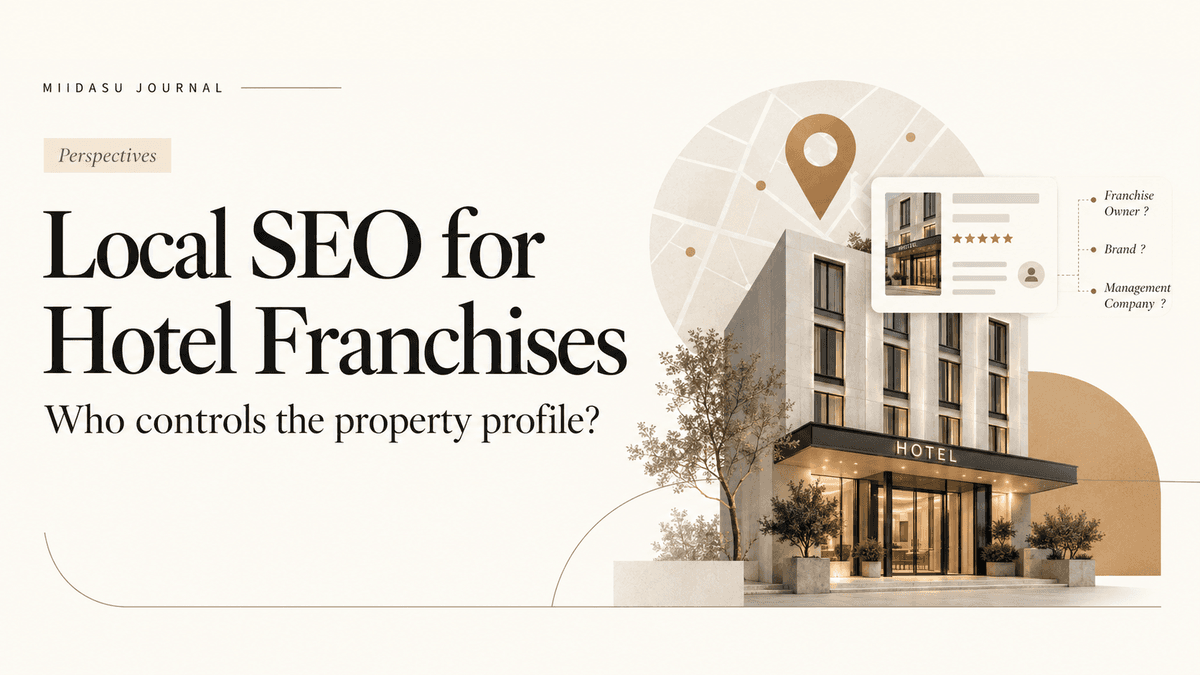
A practical approach is to designate one accountable primary owner, provide appropriate access to other stakeholders, and document who can approve or change important property information.
This guide explains how hotel franchises should manage Google Business Profiles, coordinate local SEO with booking platforms, handle ownership transitions, and evaluate multi-location management software.
Key Takeaways
- Profile ownership: The primary owner should be an authorized, accountable business stakeholder. An outside agency should not automatically control the property profile.
- Franchisor responsibilities: Establish brand standards, approved naming conventions, website requirements, and portfolio oversight.
- Franchisee responsibilities: Maintain accurate property details, amenities, photographs, and operational information.
- Management company responsibilities: Coordinate daily updates and guest review responses through approved permissions.
- Hotel booking systems: Google hotel booking links, Booking.com, Expedia, and direct reservations involve separate distribution systems.
- Governance: Maintain one authoritative record for each property, document access permissions, and establish a transfer process before ownership changes occur.
What Is Local SEO for Hotel Franchises?
Local SEO for hotel franchises is the process of improving how individual franchised hotel properties appear in location-based searches, including Google Search, Google Maps, and relevant travel discovery platforms.
Unlike broader hotel SEO campaigns focused on national brand awareness or destination guides, franchise local SEO concentrates on individual properties and the travelers searching for them.
For example, potential guests might search for:
- Hotels near Chicago O'Hare Airport
- Pet-friendly hotels in downtown Austin
- Hotels with free parking in Orlando
- Family-friendly hotels near Disneyland
- A particular franchise hotel by brand, name, or address
A useful local SEO strategy connects these searches with accurate hotel information, relevant property webpages, authentic guest reviews, and appropriate booking options.
According to Google's official local ranking guidance, local search results are mainly influenced by relevance, distance, and prominence.
Complete, accurate information helps Google understand a business, but neither a hotel brand nor a listings vendor can guarantee a particular organic local ranking.
Why Local SEO Matters for Franchised Hotels
A hotel can have strong national brand recognition while individual properties provide outdated or incomplete information to travelers.
Consider a franchise hotel that recently changed management.
Its official website shows the correct telephone number, but Google Maps still displays the previous operator's contact information. Its OTA listing advertises an amenity that is no longer available, while the former marketing agency still has administrative access.
These problems create unnecessary uncertainty for guests and can complicate bookings, customer service, and day-to-day operations.
A reliable local SEO program addresses three connected objectives:
- Help travelers discover the appropriate property.
- Give them trustworthy information about that specific hotel.
- Make it easy to reach a suitable reservation channel.
Hotel franchises should therefore treat local SEO as an ongoing coordination process rather than a one-time directory submission project.
For related guidance, see Miidasu's local keyword research and location mapping guide.
Who Controls the Google Business Profile for a Franchised Hotel?
Neither the hotel franchisor nor the franchisee automatically becomes the Google Business Profile primary owner solely because of its position in the franchise relationship.
Google provides account roles that allow authorized users to manage a business profile. The hotel organization must establish who has permission to represent the business, consistent with applicable agreements and Google's policies.
Three governance arrangements are common.
1. Franchisor-Controlled Model
In a franchisor-controlled arrangement, the authorized corporate organization maintains primary ownership or centralized administration of participating property profiles.
Local operators receive access according to their operational responsibilities.
This approach can be appropriate when the franchise agreement authorizes centralized account administration and the brand is responsible for maintaining consistency across multiple properties.
Advantages: Corporate teams can standardize administrative controls, coordinate brand changes, and reduce dependence on individual property employees.
Limitations: Routine property updates may require additional coordination. Without an efficient approval system, changes can be delayed.
For example, a hotel may complete a renovation and reopen its swimming pool, but the change might not appear promptly if only headquarters can update the information.
Centralized control is most effective when local teams have a dependable process for submitting and verifying changes.
2. Franchisee-Controlled Model
In this arrangement, the authorized hotel owner or franchisee holds primary ownership, while headquarters receives appropriate additional owner or manager access.
The franchisee retains administrative control over the property's profile.
Advantages: The property business can manage operational changes directly and maintain continuity when outside service providers change.
Limitations: Information quality and reporting may vary across locations unless the franchisor establishes clear standards.
A franchise network using this model should maintain an inventory of verified profiles, authorized users, and responsible contacts.
3. Shared-Governance Model
Shared governance assigns primary ownership to an appropriately authorized business stakeholder and distributes other responsibilities through additional owner or manager access.
Headquarters oversees brand consistency, while property teams maintain local accuracy.
Advantages: Combines centralized oversight with local operational knowledge.
Limitations: Requires clear responsibilities, escalation procedures, and processes for resolving disagreements.
For many hotel franchise systems, this is a practical model to evaluate.
However, the primary owner must still be selected according to actual authorization and contractual rights, not simply because a particular arrangement is easier for the marketing team.
Franchisor vs. Franchisee: Responsibility Comparison
| Responsibility | Franchisor or HQ | Franchisee or Property Operator |
|---|---|---|
| Brand name and identity | Establishes approved standards | Confirms real-world accuracy |
| Google Business Profile ownership | Holds authorized access | Holds authorized access |
| Business categories | Sets brand and category guidelines | Confirms appropriate property classification |
| Hotel amenities | Establishes information standards | Confirms actual availability |
| Property photographs | Defines brand requirements | Supplies current property images |
| Guest reviews | Establishes policies and escalation procedures | Investigates and responds to guest feedback |
| Hotel website | Often manages templates and technical systems | Supplies property-specific information |
| OTA listings | May oversee brand distribution standards | Coordinates property-level accuracy |
| Performance reporting | Monitors the portfolio | Reviews local outcomes |
This is a recommended operating framework, not a mandatory Google policy for hotel franchises.
The precise division of authority should be documented in the franchise agreement, management agreement, or internal operating procedures.
Google Business Profile Ownership vs. Manager Access
Google distinguishes between three Business Profile roles: primary owner, additional owner, and manager.
A profile can have several owners, but only one primary owner.
The Google Business Profile permissions documentation explains the differences between these roles.
| Access Role | Main Permissions | Appropriate Hotel Use |
|---|---|---|
| Primary owner | Full profile control, including transferring primary ownership | Authorized accountable business stakeholder |
| Additional owner | Profile administration, editing, and user management | Approved corporate or franchise stakeholder |
| Manager | Most operational editing and review management, without ownership administration | General manager, marketing employee, or agency |
Should a Hotel Management Company Be the Primary Owner?
Not automatically.
A third-party hotel management company may operate the property without owning the underlying hotel business or franchise brand.
Manager access can be sufficient for updating information, coordinating photographs, and responding to reviews.
If the management company has broader authority under the operating agreement, another arrangement may be appropriate.
However, permanent business control should not depend entirely on a temporary service provider.
Google's Business Profile third-party policies state that business clients must retain ownership or co-ownership of their profiles. Google also recommends that agencies generally receive manager access rather than ownership.
Third parties must obtain proper consent before claiming or managing a business profile.
For hotels, the practical requirements are straightforward:
- Use individual Google Accounts rather than shared passwords.
- Keep an authorized business stakeholder involved in profile ownership.
- Give agencies only the access necessary to perform their responsibilities.
- Record who can approve ownership changes.
- Include profile access and transition requirements in management contracts.
A management company should not be able to prevent the hotel business from regaining control when the commercial relationship ends.
What Are Google's Special Rules for Hotel Business Profiles?
Hotel Business Profiles have several important differences from ordinary retail and restaurant profiles.
Ignoring these distinctions can result in unnecessary work, misleading information, or unsuccessful updates.
Hotel Hours Are Not Ordinary Business Hours
Google's hotel-specific Business Profile documentation states that hotels cannot edit ordinary Business Profile opening hours because hotels are considered open around the clock to guests.
Hotels should instead provide accurate check-in and check-out times.
For example, a hotel might have:
- Check-in: 3:00 p.m.
- Check-out: 11:00 a.m.
- Front desk: Staffed 24 hours, if this is actually the case
These are different types of operational information.
Check-in time identifies when guests can normally access their rooms. It does not mean that the entire hotel is closed before that time.
Franchise marketing teams should avoid copying retail-style opening-hour workflows onto a hotel's main Google Business Profile.
If the property offers limited front-desk services or other operational restrictions, communicate those details accurately through appropriate website and guest-information channels.
Hotel Amenities Must Reflect the Actual Property
Hotel attributes may describe amenities and services such as Wi-Fi, parking, swimming pools, fitness facilities, and accessibility features.
However, attributes must reflect what the individual property actually offers.
A franchise brand may advertise swimming pools as a common feature, but a property without an available pool should not claim to have one.
For verified hotel profiles, certain amenities can be managed through Google's hotel information interface.
Google may also obtain property information from other sources, so approved edits should be checked after publication.
There is an important technical limitation: Google does not support updating hotel attributes through its standard bulk-upload spreadsheet.
The supported options include the appropriate dashboard and API workflows. Google documents this limitation in its bulk Business Profile management guidance.
This matters for franchise groups using centralized spreadsheets or listings software.
Before deploying a hotel-wide attribute update, confirm that the chosen system actually supports the required hotel-specific fields and Google integration method.
Can Restaurants and Spas Inside Hotels Have Separate Profiles?
Yes, when they meet Google's eligibility requirements.
A restaurant, lounge, store, or spa located inside a hotel may qualify for a separate Google Business Profile if customers can access the business independently of staying at the hotel.
For example, a restaurant serving both hotel guests and local residents may qualify for a separate listing.
An internal breakfast area available only to registered hotel guests would not automatically qualify.
Google's business representation guidelines address business eligibility, categories, chains, and departments.
Hotels should not create multiple profiles for the same hotel simply to target different amenities or search terms.
How Should a Hotel Franchise Claim and Secure Its Property Profile?
Every property should have a documented process for claiming, verifying, and protecting its Google Business Profile.
Step 1: Locate the Existing Hotel Profile
Search Google Maps using the hotel's official name, street address, and city.
Confirm whether the correct property already has a profile.
Do not create a new listing merely because the current property team cannot access the existing one.
Google generally permits only one Business Profile for each business. Duplicate profiles can cause problems with visibility, ownership, and reviews.
Record the correct profile URL and associate it with the hotel's internal property identifier.
Step 2: Confirm the Authorized Representative
Identify the person or organization authorized to manage the hotel.
Depending on the franchise arrangement, this may be the property owner, franchise organization, or an appointed representative.
Document:
- The legal or operating entity responsible for the property
- The authorized Google account administrator
- The franchise or management agreement governing access
- Supporting authorization records
- A second contact for continuity
This information becomes especially valuable during ownership disputes or management changes.
Step 3: Request Ownership When Necessary
If an existing profile is controlled by another account, use Google's Business Profile ownership request procedure.
Google normally gives the current profile owner three days to respond.
If the owner does not respond, the requester may receive an option to claim or verify the profile. However, Google does not guarantee that this option will be available.
Avoid creating another profile to bypass an ownership dispute.
Step 4: Complete Verification
Google determines which verification methods are available for a property.
Depending on the situation, verification may involve a video recording or another supported method.
The representative should be prepared to demonstrate that the hotel is a real business and that they are authorized to manage it.
Google also offers bulk management and verification for eligible organizations.
Its bulk verification requirements generally apply to accounts containing at least ten eligible locations of the same business, subject to additional conditions.
A hotel group with ten properties should not assume that every profile will automatically qualify.
Step 5: Configure Access and Security
After verification, record the primary owner, additional owners, and managers.
Remove accounts belonging to former employees, previous agencies, or unauthorized operators.
Give each stakeholder the minimum permissions necessary for their responsibilities.
Remember that new owners and managers can face a seven-day waiting period before performing certain administrative actions, including removing other users or transferring primary ownership.
A transfer should therefore be planned before the old operator loses access.
For broader franchise governance, see Miidasu's franchise listings management guide.
How Should Corporate and Local Hotel Teams Divide Editing Responsibilities?
Profile access roles are only part of the solution.
A franchise also needs internal rules governing which team can request, approve, and publish each type of change.
Google's owner and manager roles do not provide a complete replacement for a franchise-specific field approval process.
A useful approach is to divide hotel information into three categories.
Corporate-Controlled Fields
Corporate teams commonly oversee information that defines the franchise brand.
Examples include approved brand naming, identity standards, primary website architecture, and brandwide content requirements.
A local hotel manager should not independently rename a property to include promotional keywords.
At the same time, headquarters must respect legitimate differences in how individual hotels are named and operated.
Property-Controlled Information
Property operators generally have better access to facts that change through daily hotel operations.
Examples include temporary amenity closures, local contact information, renovations, room facilities, and updated photographs.
These changes should reach the appropriate publishing system without unnecessary delays.
For instance, if the hotel pool closes for repairs, travelers should not have to wait for the next quarterly marketing review before the information is corrected.
Shared or Approval-Based Fields
Some information requires local verification and corporate oversight.
Examples include property descriptions, website changes, accessibility disclosures, and updates connected to rebranding.
The local hotel can submit the factual information, while headquarters confirms that it follows brand and publishing standards.
Example Hotel Profile Governance Matrix
| Information | Who Supplies the Change? | Who Approves It? | Operational Priority |
|---|---|---|---|
| Official hotel name | Franchise operations | Authorized brand or business owner | High |
| Hotel address | Property owner/operator | Authorized profile administrator | High |
| Telephone number | Property team | Designated administrator | High |
| Check-in and check-out times | Hotel operations | Property manager | High |
| Amenities and availability | Property operations | Property manager or designated approver | High |
| Property photos | Hotel team | Brand or property marketing | Normal, unless materially misleading |
| Property website URL | Digital team | Brand digital administrator | High |
| Guest review responses | Guest relations | Local team; escalation where needed | Based on issue severity |
| Booking and rate connectivity | Revenue/distribution team | Authorized distribution administrator | High |
| Ownership transfer | Current authorized owner | Authorized business stakeholders | Critical |
The approval model should reflect the actual permissions and workflow supported by each platform.
A team should not assume that Google natively restricts every individual field according to this matrix.
Establish a Change-Management Process
A practical workflow is:
- The property submits a change with supporting details.
- The responsible team verifies the information.
- An authorized user approves the update where required.
- The change is submitted to the relevant publisher or booking system.
- The team checks whether the public information was updated correctly.
- The change is recorded for future reference.
Urgent factual corrections, such as an incorrect telephone number or unavailable guest amenity, should have a faster escalation path.
This makes governance useful in day-to-day operations rather than merely documenting who has access.
How Can Hotel Franchises Improve Google Maps Visibility?
Hotel franchises should begin with accurate property information, then improve their location webpages, visual content, local relevance, and guest engagement.
1. Maintain One Authoritative Record Per Hotel
Each property should have a permanent internal identifier and a reliable source of truth.
Recommended fields include:
- Official hotel name and physical address
- Property telephone number
- Approved location page URL
- Google Business Profile URL
- Ownership and management contacts
- Check-in and check-out times
- Confirmed amenities and accessibility information
- Profile verification status
- Current property photographs
- Ownership and rebranding history
- Reservation system and distribution contacts
The record might be maintained in a franchise management system, property database, or listings platform.
The important requirement is that conflicting systems do not independently publish different information without a defined resolution process.
2. Use Accurate Hotel Names and Categories
Use the hotel's actual, recognized name.
For example, a fictional hotel named Harbor View Suites should not rename its Google profile to:
"Harbor View Suites Best Luxury Airport Hotel Free Breakfast"
unless that wording genuinely represents its real-world business name, which would be unusual.
Choose the most appropriate available business category for the property.
Do not add categories simply to capture additional keywords.
Franchise brand consistency is important, but it must not override the property's actual business identity.
3. Build Useful Property-Specific Webpages
Each franchised hotel should have a dedicated webpage that helps travelers evaluate and contact that specific location.
Useful information may include:
- Property address, directions, and map
- Neighborhood and nearby landmarks
- Available room types
- Parking arrangements and charges
- Airport or local transportation options
- Check-in and cancellation policies
- Confirmed amenities
- Accessibility information
- Direct booking options
For example, a hotel near a convention center could explain whether the venue is walkable, identify nearby transit stops, and describe relevant meeting facilities.
A generic paragraph claiming the hotel is conveniently located near local attractions provides much less value.
Use actual property details rather than creating dozens of nearly identical city pages with only the destination name changed.
4. Maintain Genuine Property Photographs
Corporate photography can establish brand consistency, but travelers also want to see the specific property they may book.
Include current photographs of the hotel's exterior, rooms, lobby, public areas, and relevant amenities.
Photographs should accurately represent the facilities available to guests.
After significant renovations, review older images across Google, the hotel's website, and OTA listings.
A renovated property can create confusion if its public photographs still depict previous room layouts or facilities.
5. Develop Relevant Local Visibility
Relevant local references may come from tourism organizations, convention bureaus, event venues, chambers of commerce, and credible destination publications.
For example, a hotel serving conference visitors may benefit from accurate inclusion in an official conference accommodation guide.
These relationships should exist because they help travelers, not simply to create backlinks.
Buying large quantities of low-quality directory links or manipulating business listings is not a sustainable alternative to useful local content and accurate property information.
6. Match Content to Local Search Intent
An airport hotel and a downtown boutique hotel may belong to the same franchise but attract different searches.
An airport property may need information about shuttle availability, early departures, and long-term parking.
A downtown property may need practical guidance on public transport, event venues, parking constraints, and nearby attractions.
Separate keyword groups into:
- Branded property searches
- Destination and neighborhood discovery
- Amenity-based searches
- Transportation and landmark searches
- Booking-oriented searches
Map each relevant query group to a useful existing page before creating more content.
The objective is to answer real traveler questions, not publish a separate thin page for every keyword variation.
How Do Google Hotel Profiles and OTA Listings Work Together?
A Google Business Profile helps travelers identify and evaluate a hotel, while online travel agencies support availability comparisons and reservations.
These systems are connected through the traveler journey, but they perform different functions.
| Platform | Main Purpose | Typical Responsible Team |
|---|---|---|
| Google Business Profile | Maps discovery, property details, and reviews | Authorized profile administrators |
| Official hotel website | Property information and direct reservations | Brand digital and reservations teams |
| Booking.com | OTA accommodation distribution and reservations | Revenue/distribution team |
| Expedia | OTA accommodation distribution and reservations | Revenue/distribution team |
| Google Hotel Ads and free booking links | Rate-based hotel booking options | Distribution or connectivity partner |
Why OTA Accuracy Matters
Travelers frequently compare information across different platforms before choosing a room.
A hotel website may say parking is free, while an OTA listing describes a nightly charge.
Even if the disagreement does not prevent a reservation, it creates uncertainty about what the guest will actually receive.
Other common problems include inconsistent room descriptions, outdated amenities, inaccurate property names, and different cancellation conditions.
A useful division of responsibility is to have the revenue or distribution team coordinate rates, inventory, and reservation connectivity, while the property confirms operational facts.
Both teams should review guest-facing information when significant changes occur.
Who Controls Hotel Booking Links on Google?
Hotel prices and booking links on Google are not ordinary Business Profile website fields.
They come from Google's separate hotel advertising and free booking link systems.
Google's Hotel Center documentation explains that participating booking partners can provide rates and booking links without paying for placement in the free booking links section.
Hotels commonly work with reservation systems, internet booking engines, or connectivity partners to supply their availability and pricing data.
An important change took effect on July 30, 2025: Google's self-service hotel rate feature stopped supporting the display of rates through ordinary Business Profile editing.
Google now directs hotels toward appropriate reservation or connectivity partners for this functionality.
This distinction is important when evaluating local SEO software.
A product that manages Google Business Profile information does not necessarily support Hotel Center, rate feeds, or reservation-system integrations.
These capabilities should be evaluated separately.
OTAs vs. Direct Hotel Bookings
OTAs can support hotel distribution and discovery, while the official hotel website gives travelers a direct reservation channel.
A franchise should not assume that stronger Google Maps visibility automatically produces more direct bookings.
A traveler may find the hotel through Google, compare prices through several platforms, and complete the reservation elsewhere.
Franchise marketing teams should review:
- Whether Google links to the correct official property page
- Whether OTA listings identify the correct physical hotel
- Whether room descriptions and amenities match reality
- Whether booking links lead to working reservation experiences
- Whether reporting distinguishes direct bookings from OTA reservations
Google Maps discovery, hotel rate distribution, and reservation conversion are related but distinct activities.
What Happens When a Hotel Changes Ownership or Brand?
Ownership changes, management transitions, and rebranding events create substantial risks for hotel listing accuracy.
A transition plan should begin before public changes take effect.
When the Franchisee Changes but the Hotel Brand Remains
If the hotel continues operating as the same business under the same name, the new authorized operator should generally coordinate control of the existing profile.
Creating another listing simply because the legal owner or franchisee changed is not an appropriate default.
Google's guidance on moving reviews across Business Profiles explains that a business changing ownership should not create a new profile solely because of that change.
The transition team should:
- Confirm the correct existing profile.
- Establish access for the new authorized operator.
- Transfer primary ownership where necessary.
- Remove former operators after the transfer is secure.
- Verify the telephone number, website, and local business information.
- Review connected integrations and scheduled updates.
- Confirm that the public profile remains accurate.
Because new users may face administrative restrictions, ownership transfers should be scheduled with adequate preparation.
When the Hotel Changes Brands
A genuine rebrand requires additional assessment.
The property's public name, website, photographs, and distribution information may all need updating.
Google permits certain eligible rebranding changes to existing hotel profiles, including qualifying minor name changes.
However, a substantially different business identity may require different treatment.
Review history is another consideration.
Google states that reviews may remain when an existing business changes management but keeps the same name. Significant changes can be treated differently, and review transfers are not guaranteed in every case.
Hotel operators should consult Google's hotel rebranding guidance before changing or replacing a profile.
A rebranding plan should cover:
- Actual business identity and effective transition date
- Google Business Profile treatment
- New brand website and reservation URLs
- Updated photographs and descriptions
- OTA and Hotel Center property matching
- Existing owner and manager access
- Historical reviews and guest communication
Avoid creating a replacement profile until the eligibility implications have been reviewed.
When a Management Company Leaves
A management company may have access to more than the Google Business Profile.
It may also control software integrations, OTA accounts, photographs, reporting dashboards, or marketing tools.
The outgoing management team should transfer the relevant operational responsibilities and remove its access according to the governing agreements.
The authorized hotel business should confirm that it retains control of all essential publisher and reservation accounts.
An incomplete handover can leave a technically verified Google profile connected to outdated systems that continue submitting incorrect information.
Hotel Ownership Transition Checklist
| Area | Required Check |
|---|---|
| Google profile | Confirm correct existing profile and ownership |
| User access | Add authorized incoming users and remove outgoing users |
| Property information | Verify name, address, telephone, and website |
| Amenities | Review operational changes and existing attributes |
| Reservations | Confirm functioning direct booking links |
| OTAs | Update the appropriate partner accounts |
| Photographs | Replace misleading or outdated images |
| Reviews | Transfer responsibility for ongoing responses |
| Integrations | Remove or update obsolete provider connections |
| Reporting | Maintain continuity of relevant performance records |
Complete the checks again after the public transition, rather than assuming every platform has accepted the changes.
Who Should Respond to Reviews for Franchised Hotels?
The local hotel team should normally provide the context for guest review responses, while the franchisor establishes brand standards and escalation procedures.
A general manager or guest-relations team is often best positioned to investigate complaints about room cleanliness, check-in delays, staff conduct, or unavailable amenities.
Corporate teams can help by providing response guidelines and supporting sensitive situations.
For example, a complaint about a delayed check-in can usually be investigated locally.
A review alleging serious safety failures, discrimination, or legal misconduct may require escalation before a public response is published.
Hotel review management should follow several principles.
Respond to the actual issue. Generic templates should not replace a response that addresses the guest's specific concern.
Protect guest privacy. Avoid disclosing reservation details, personal information, or private communications.
Separate platforms. Responding to a Google review does not automatically resolve a review on Booking.com or Expedia.
Use review themes operationally. Repeated complaints may identify issues that deserve investigation beyond the marketing team.
For portfolio reporting, compare review volume, rating trends, response activity, and recurring complaints across properties.
A useful reference is Miidasu's multi-location review analytics guide.
Review monitoring is most valuable when insights reach the people who can improve the underlying guest experience.
Software Options for Hotel Franchise Local SEO
Hotel franchises can manage listings directly, use centralized software, or combine software with agency support.
The appropriate approach depends on portfolio size, ownership arrangements, publishing requirements, and available internal resources.
Five platforms worth evaluating are Synup, Yext, SOCi, Uberall, and BrightLocal.
Comparison methodology: This overview uses publicly available vendor documentation reviewed on October 22, 2026. It compares documented product capabilities and likely use cases, not hands-on testing or independently verified performance rankings.
| Platform | Best-Fit Use Case | Relevant Capabilities | Main Consideration |
|---|---|---|---|
| Synup | Centralized listings and reputation workflows | Listings, reviews, local SEO reporting | Validate hotel-specific attribute support |
| Yext | Enterprise location data management | Structured data, publisher connections, centralized administration | Evaluate implementation and contract scope |
| SOCi | Broader multi-location marketing | Listings, local search management, automation | Determine whether the broader platform is needed |
| Uberall | Collaborative franchise operations | Listings, reviews, corporate/local permissions | Confirm included workflow modules |
| BrightLocal | Local SEO auditing and monitoring | Rank tracking, reputation reporting, citation services | Evaluate separately from reservation connectivity |
1. Synup
Best for: Hotel franchise groups seeking centralized listing management, reputation monitoring, and local search reporting.
Capabilities: Synup provides tools for managing business listings, monitoring reviews, tracking local search performance, and reporting across multiple locations. It also offers workflows that can support teams responsible for updating and maintaining local business information.
Differentiator: Combining several local marketing functions may reduce the need to manage separate systems for listings, reviews, and reporting.
Limitations: Hotel groups should confirm support for Google lodging attributes, required hospitality publishers, role-based approvals, and property management integrations. Standard listing distribution should not be assumed to include hotel rate connectivity.
Pricing: Review current published plans and confirm enterprise terms, property allowances, and applicable modules directly with Synup.
Choose if: The main requirement is coordinating listings and reputation workflows for multiple hotel properties.
2. Yext
Best for: Large hotel networks that require structured business information and centralized control across many locations.
Capabilities: Yext supports the management of structured location information and publishing to supported third-party platforms. Its workflow includes preparing location records, connecting publisher accounts, and monitoring listing status.
Differentiator: A structured data approach can suit organizations managing substantial volumes of property information across multiple websites and publishers.
Limitations: Hotel groups should evaluate implementation complexity, permissions, licensing, and integration scope. General location data synchronization does not automatically include hotel distribution or reservation-system management.
Pricing: Obtain a current proposal specifying location count, required products, and contractual terms.
Choose if: Structured property data and enterprise-level administration are central requirements.
3. SOCi
Best for: Hotel franchise marketing teams that want listings management within a broader local marketing program.
Capabilities: SOCi provides multi-location listing management and local search optimization capabilities. Its platform includes automated tools intended to help organizations monitor and address location-level marketing tasks.
Differentiator: Listings management sits within a wider set of local marketing capabilities, which can appeal to brands coordinating multiple channels.
Limitations: Organizations needing only listing accuracy may find that they do not require the complete platform. Automated actions still depend on accurate hotel information and appropriate operational oversight.
Pricing: Request a current proposal for the relevant modules and number of properties.
Choose if: The franchise needs listings to operate as part of a broader, coordinated local marketing program.
4. Uberall
Best for: Franchises where headquarters and individual property operators share local marketing responsibilities.
Capabilities: Uberall supports centralized, decentralized, and collaborative franchise workflows. Its platform includes listings, review management, and role-based access designed for organizations with multiple operating teams.
Differentiator: Its documented franchise workflows explicitly address the need to balance headquarters oversight with local management responsibilities.
Limitations: Hotel groups should confirm which permission controls, approval functions, and collaboration features are included in the quoted package. Hotel-specific fields and booking connections must be evaluated separately.
Pricing: Request a proposal covering the required franchise configuration and optional modules.
Choose if: Local operators need defined responsibilities while corporate teams maintain oversight.
5. BrightLocal
Best for: Hotel operators, franchise marketers, and agencies prioritizing local SEO audits, rankings, and citation accuracy.
Capabilities: BrightLocal offers local rank tracking, reputation reporting, citation management, and multi-location monitoring features. Its tools can help identify inconsistent property information and compare local search performance.
Differentiator: Its focus on auditing and monitoring can be useful for teams that already manage publisher accounts or bookings through other systems.
Limitations: Citation tracking, citation-building services, and listing synchronization are not interchangeable. Hotel groups should verify which services they need and whether separate subscriptions or service charges apply.
Pricing: Check current subscription and citation-service costs, including requirements for larger portfolios.
Choose if: Auditing local visibility and improving directory information are the main priorities.
How Should Hotels Choose a Listings Platform?
Compare software against the franchise's actual operating model.
A small hotel portfolio with centralized management may need basic listing controls, review monitoring, and straightforward reporting.
A large franchise group with independent operators may require advanced permissions, approval workflows, audit records, regional administration, and repeatable ownership-transfer procedures.
Rather than relying on publisher-count claims, ask each shortlisted vendor to demonstrate three practical scenarios.
Scenario 1: An incorrect amenity
A property's swimming pool is temporarily unavailable.
Can local staff submit the change? Can the responsible administrator approve it? Does the system support the relevant Google hotel attribute? Can the team confirm the public update?
Scenario 2: A management company leaves
Can the hotel remove the provider's access without losing control of its Google profile, historical information, or reporting records?
Does the platform have a documented exit process?
Scenario 3: A hotel changes brand
Can the platform coordinate changes to names, property pages, photographs, and relevant directory records?
Which updates require separate Google or booking-partner procedures?
These scenarios reveal more about software suitability than a generic demonstration of bulk editing.
No listings platform should be assumed to resolve contractual ownership disputes or replace the hotel's reservation distribution systems.
How Should Hotel Franchises Measure Local SEO Performance?
Hotel local SEO measurement should distinguish among visibility, information accuracy, engagement, and reservation outcomes.
Treating every metric as evidence of booking performance can lead to misleading conclusions.
A practical reporting framework includes the following.
| KPI | What to Measure | Typical Responsible Team |
|---|---|---|
| Profile verification rate | Eligible properties with verified profiles | Corporate listings |
| Listing accuracy | Correct core property information across priority platforms | Franchise operations |
| Local search visibility | Performance for relevant branded and nonbranded queries | SEO team |
| Website engagement | Visits and actions originating from local discovery | Digital marketing |
| Review performance | Review volume, ratings, responses, and recurring themes | Guest relations |
| Direct booking conversions | Attributable reservations and revenue | Revenue marketing |
| OTA contribution | Bookings and channel contribution | Distribution team |
| Issue resolution | Critical listing errors and time to correction | Local SEO operations |
Separate Visibility From Booking Outcomes
A hotel may improve its visibility in Google Maps without experiencing a corresponding increase in direct reservations.
Demand is also affected by seasonality, location, room pricing, availability, local events, competition, and brand preference.
Use Google Business Profile performance data, website analytics, Google Search Console, and reservation reporting together.
However, recognize that each system measures different interactions.
A click from Google Maps is not equivalent to a completed reservation, and a booking made through an OTA may not be attributable to the original local search.
Establish a Consistent Review Schedule
As an operating recommendation, hotel franchises can use a monthly spot-check and a deeper quarterly review of their local listings.
The appropriate frequency depends on property count, staffing, available automation, and operational change volume.
Additional audits should follow:
- Property ownership or management transfers
- Rebranding events
- Renovations and amenity changes
- Telephone or website changes
- Incorrect information reported by guests
- New property openings or closures
- Booking-system or integration migrations
This is a recommended management schedule, not a Google-mandated audit frequency.
Critical errors should be corrected when discovered rather than waiting for the next scheduled review.
Frequently Asked Questions About Hotel Franchise Local SEO
Who Owns the Google Business Profile for a Franchised Hotel?
The profile's primary owner is the authorized Google Account holder with primary ownership access. This may represent the franchisor, franchisee, or another properly authorized business stakeholder. The correct arrangement depends on Google's policies and the relevant agreements.
Can Hotel Franchisees Manage Their Own Google Business Profiles?
Yes. Authorized franchisees can manage hotel profiles when they have appropriate permissions. The franchisor may also receive access for brand governance or portfolio reporting. These responsibilities should be established in the applicable agreements and operating procedures.
Can a Hotel Brand Centrally Manage Profiles Across Multiple Properties?
Yes. Google supports business groups and eligible bulk management arrangements. Centralized administration still requires appropriate authorization, verification, and accurate property-specific information.
What Happens to Google Reviews When a Hotel Changes Ownership?
If the hotel continues operating as the same business under the same name, existing reviews generally remain with the profile. Significant rebranding or other business identity changes may require different treatment. Review transfers should not be assumed or promised in every situation.
Can Restaurants and Spas Inside Hotels Have Separate Google Profiles?
Yes, if they meet Google's eligibility requirements as independently accessible businesses. A hotel amenity that serves only registered guests does not automatically qualify for a separate profile.
Can Hotel Franchises Control Room Rates Through Google Business Profile?
Not through ordinary Business Profile editing. Hotel rates and booking links use Google's hotel-related systems and supported reservation or connectivity partners. Hotel distribution teams should manage this separately from standard local listing information.
How Often Should Hotel Franchises Audit Their Listings?
Monthly spot-checks and quarterly deeper reviews are reasonable starting points, with additional checks after operational changes. Hotels with frequent updates or larger portfolios may need more continuous monitoring.
What Is the Most Important Part of Hotel Franchise Local SEO?
Clear profile ownership and accurate property information are the starting points. Once permissions and information quality are under control, hotels can more effectively improve location pages, photographs, reviews, local search visibility, and booking experiences.
Final Thoughts: Who Should Control the Property Profile?
Effective local SEO for hotel franchises requires centralized brand governance without losing the accuracy that comes from local hotel operations.
The franchisor should establish consistent standards and oversight. Authorized business stakeholders should retain appropriate profile control, while property management teams should have the access needed to maintain daily information and respond to guests.
Google Business Profile ownership must follow actual authorization and applicable agreements rather than a universal rule favoring headquarters or franchisees.
Software such as Synup, Yext, SOCi, Uberall, and BrightLocal can support listing management, reviews, reporting, and collaboration. However, these tools cannot resolve unclear ownership rights or replace accurate information supplied by the property.
The most reliable approach is to maintain one authoritative property record, clearly assigned permissions, documented ownership-transition procedures, and a consistent connection between local discovery and reservation systems.
That foundation helps protect the franchise brand while giving travelers the accurate, useful information they need to choose the right hotel.