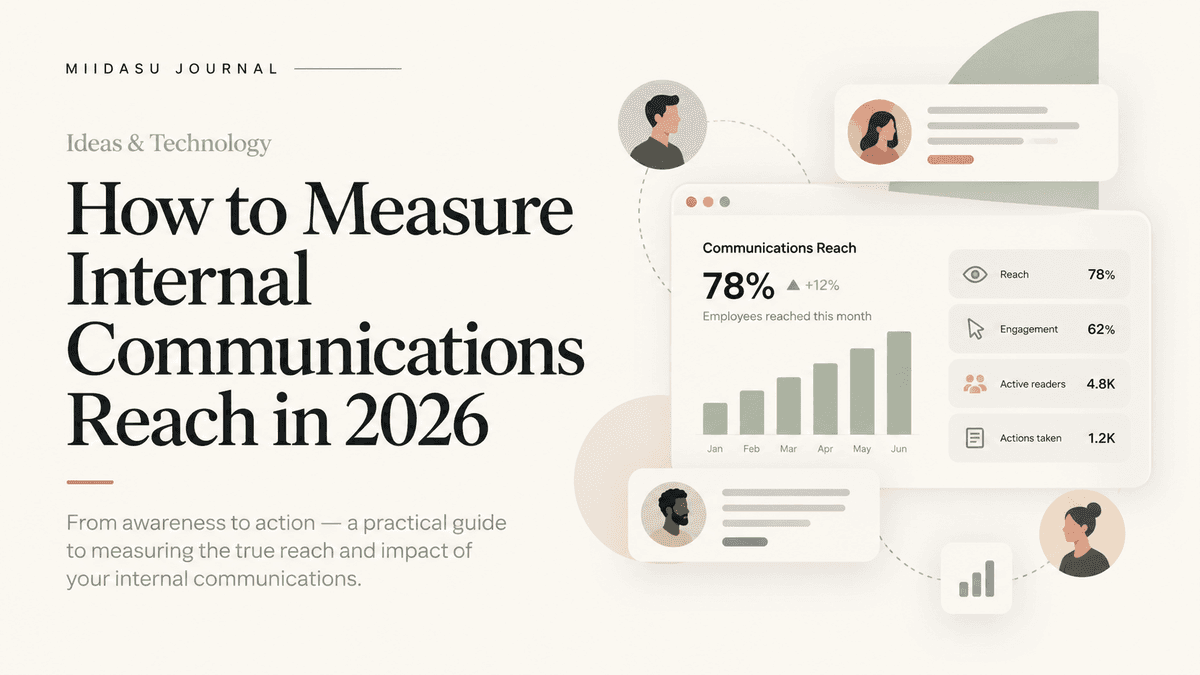
The most reliable approach combines delivery data, authenticated content views, channel analytics, and employee awareness surveys. Organizations can use these measurements across email, intranets, collaboration platforms, mobile apps, and offline communication channels.
The basic formula is:
Internal Communications Reach Rate (%) = (Unique Employees Reached ÷ Total Target Employees) × 100
For example, if 3,600 of 4,500 targeted employees generate qualifying content views, the observed reach rate is 80%.
However, a delivered message, recorded impression, or email open does not necessarily mean an employee read or understood the information.
This guide explains how to measure internal communications reach in 2026, select appropriate KPIs, compare communication channels, avoid double-counting, evaluate analytics platforms, and connect communication coverage to employee understanding and organizational outcomes.
What Is Internal Communications Reach?
Internal communications reach refers to the number or proportion of employees who receive or are exposed to organizational messages during a defined reporting period.
It answers a practical question: How many of the employees we intended to communicate with did we actually reach?
Reach measurement applies to company announcements, leadership communications, HR updates, workplace policies, operational instructions, safety messages, and employee engagement campaigns.
The challenge is that different communication systems use the word reach to describe different events.
Understanding the different types of reach
| Reach type | Definition | Example |
|---|---|---|
| Potential reach | Employees who have access to a communication channel | 5,000 employees have access to the company intranet |
| Delivered reach | Employees whose designated destination successfully received a message | An email was delivered to 4,700 employee inboxes |
| Recorded exposure | Employees whose accounts generated a qualifying view or impression | 3,800 employees generated recorded announcement views |
| Authenticated content views | Distinct employees who opened or viewed specific content while identified by the platform | 3,200 employees accessed a policy announcement |
| Confirmed awareness | Employees who demonstrate awareness through a survey or other verification method | 82% of valid survey respondents recognize the announcement |
Unique reach is a counting method that can apply to several of these categories. It means counting each employee once within a defined audience, period, and event category.
These measurements are not interchangeable.
A successfully delivered email does not establish readership. A collaboration-platform impression may indicate that content appeared on a screen without proving that the employee paid attention. An authenticated page view provides stronger evidence of exposure but still does not establish comprehension.
Likewise, an awareness survey measures the people who respond. Its results should not automatically be treated as an exact count of all employees who are aware.
For accurate reporting, every internal communications reach figure should identify the type of event measured.
Why Is Measuring Internal Communications Reach Important?
Measuring reach helps organizations determine whether essential information is reaching employees across departments, locations, shifts, and working arrangements.
Without reliable measurement, communications teams can mistake publishing a message for communicating it effectively.
Consider a company that publishes a revised workplace policy on its intranet. Office employees regularly access the intranet, but warehouse employees have limited computer access.
The company may have successfully published the policy while failing to provide a practical communication route to many affected workers.
Reach measurement helps identify these gaps before they create operational problems.
Organizations can use reach data to:
- Identify employee groups with consistently low communication coverage.
- Compare the contribution of email, intranets, mobile apps, and collaboration tools.
- Determine whether important messages reach frontline, remote, and shift-based employees.
- Improve communication timing, language, accessibility, and channel selection.
- Identify technical delivery problems.
- Reduce unnecessary messages and repeated distribution.
- Establish measurable communication performance reports for leadership.
- Connect message exposure to awareness, understanding, and required actions.
The objective is not simply to increase the number of notifications or impressions.
It is to give employees a realistic opportunity to access and understand information that affects their work.
Which Internal Communications KPIs Should Organizations Track?
A useful measurement system separates technical delivery, audience reach, engagement, awareness, understanding, and outcomes.
Each category answers a different question.
Essential internal communications KPIs
| KPI | Calculation or definition | What it measures |
|---|---|---|
| Target audience size | Number of employees intended to receive the communication | Eligible audience |
| Delivery rate | Successful deliveries ÷ attempted deliveries × 100 | Technical distribution success |
| Unique employee reach | Distinct eligible employees with qualifying exposure events | Employee coverage |
| Reach rate | Unique reached employees ÷ targeted employees × 100 | Percentage of the audience reached |
| Content view rate | Unique content viewers ÷ eligible employees × 100 | Recorded content exposure |
| Email open rate | Unique tracked opens ÷ delivered emails × 100 | Email-client activity |
| Email click-through rate | Unique clicking recipients ÷ delivered recipients × 100 | Link interaction |
| Engagement rate | Unique engaged employees ÷ unique reached employees × 100 | Active interaction among reached employees |
| Acknowledgment rate | Employees recording acknowledgment ÷ employees required to acknowledge × 100 | Acknowledgment completion |
| Awareness rate | Valid survey respondents demonstrating awareness ÷ valid respondents × 100 | Survey-measured awareness |
| Comprehension rate | Respondents correctly answering defined knowledge questions ÷ valid respondents × 100 | Understanding of key information |
| Action completion rate | Employees completing required actions ÷ employees required to act × 100 | Behavioral follow-through |
These are recommended reporting definitions, not universal vendor standards. Individual platforms may calculate similarly named metrics differently.
For example, some email analytics products calculate click rates using delivered emails, while others calculate clicks relative to opened emails.
Teams should document their chosen denominator, event definition, and reporting window before comparing results.
Reach vs. engagement vs. impact
Reach: Who encountered the communication?
Reach measures audience exposure or coverage.
Engagement: Who interacted with the communication?
Engagement captures actions such as meaningful clicks, questions, comments, acknowledgments, or survey participation.
Impact: What changed afterward?
Impact examines outcomes such as improved policy awareness, completion of training, adoption of new procedures, or changes in relevant employee behavior.
A message can achieve high reach but produce little measurable engagement. Likewise, high engagement does not guarantee that the communication achieved its intended outcome.
For example, a cybersecurity announcement may have an 85% observed reach rate, but only 60% of the employees required to complete a related security action may have done so.
Both results matter, but they answer different questions.
How Do You Calculate Internal Communications Reach Rate?
To calculate internal communications reach, divide the number of uniquely reached employees by the total number of targeted employees and multiply by 100.
Reach Rate (%) = (Unique Employees Reached ÷ Target Employees) × 100
Step-by-step example
Consider a company with 6,000 employees.
An operational announcement is relevant to 5,000 of them. The remaining 1,000 employees work in departments unaffected by the change.
Within the defined reporting period, 4,100 distinct targeted employees generate qualifying authenticated content views.
| Measurement | Value |
|---|---|
| Total company employees | 6,000 |
| Target audience | 5,000 |
| Unique employees with qualifying views | 4,100 |
| Targeted employees without recorded qualifying views | 900 |
| Observed reach rate | 82% |
The calculation is:
(4,100 ÷ 5,000) × 100 = 82%
The campaign achieved an 82% observed reach rate among its targeted audience.
It would be misleading to say that exactly 18% of targeted employees were unaware of the message.
Some employees may have received the information through supervisor briefings, meetings, colleagues, or other activities that were not tracked at the individual level.
A more accurate reporting statement would be:
The campaign recorded an 82% observed reach rate among targeted employees. The remaining 18% had no qualifying tracked content-view event during the reporting period.
How to define a qualifying reach event
Before calculating reach, specify the events that count.
For a policy announcement, the primary qualifying event might be an authenticated view of the policy page.
For a collaboration-platform announcement, a recorded message impression might count as exposure, provided the report explicitly calls it impression-based reach.
For mandatory training, completing an acknowledgment or training activity may be a more meaningful primary success indicator.
Avoid combining fundamentally different events under a single reach label without explaining the methodology.
A useful reporting definition could be:
Observed content reach: The number of distinct employees in the target audience who generated at least one authenticated view of campaign content within seven calendar days of publication.
That definition makes future results more comparable and easier to audit.
How Is Internal Communications Reach Measured Across Different Channels?
Each internal communication channel provides different analytical evidence.
Some systems reliably record content-level views. Others primarily provide delivery statuses, estimated exposure, or participation data.
An effective multichannel strategy uses the strongest relevant measurement available for each channel without treating all metrics as equivalent.
1. Employee email analytics
Employee email remains useful for formal announcements, newsletters, leadership messages, and policy updates.
Common email metrics include successful deliveries, bounced messages, tracked opens, unique link clicks, and interaction with linked content.
However, email open rates have important limitations.
Apple's Mail Privacy Protection documentation explains that remote content can be downloaded privately in the background rather than when an employee actually views an email.
Because tracking pixels can activate without genuine reading, some recorded email opens may not represent human engagement.
Conversely, employees who block remote images may read emails without generating tracked open events.
For more meaningful email measurement, combine:
- Delivery results.
- Unique tracked opens, interpreted cautiously.
- Unique relevant link clicks.
- Authenticated visits to linked content.
- Required acknowledgments.
- Awareness or knowledge checks for important announcements.
Email clicks provide useful evidence of interaction, but even a click does not prove that an employee understood the information.
2. Intranet and employee portal analytics
Intranet analytics provide a more direct way to measure employee interaction with published organizational content.
Useful measurements include unique content viewers, page visits, return visits, traffic sources, and time spent actively viewing pages where that metric is available.
For example, Microsoft SharePoint page and news analytics provide information about unique viewers, content views, and average time spent.
Some SharePoint reporting also includes distribution activity across SharePoint and Outlook.
However, a person visiting the intranet homepage does not establish that they viewed a particular announcement.
For reliable measurement, use the analytics associated with the relevant page, news post, or campaign rather than overall site traffic.
Also check the reporting period, supported channels, and any exclusions affecting analytics collection.
3. Collaboration platforms
Collaboration platforms such as Microsoft Teams, Slack, and Microsoft Viva Engage support rapid updates, team-level communication, and employee discussions.
Their analytics capabilities differ.
Microsoft Teams usage reports include measures such as active users, channels, and posted messages.
These figures describe platform usage. They should not automatically be interpreted as the number of people who read a particular announcement.
Microsoft Viva Engage analytics provide more specialized audience and campaign engagement reporting, with feature availability depending on licensing and permissions.
Slack message activity can report views, reactions, and clicks for qualifying messages. Slack documents availability on Business+ and Enterprise plans, along with message, channel, and permission restrictions.
For communication campaigns, distinguish:
- Employees belonging to the relevant channel.
- Employees active in the platform.
- Employees generating recorded message views.
- Employees interacting with the announcement.
- Employees acknowledging or understanding the information.
These represent different communication outcomes.
4. Employee mobile communication apps
Mobile communication apps are particularly relevant for frontline workers, field teams, technicians, retail employees, and staff without regular desktop access.
Useful measurements include app activation, authenticated content views, notification taps, content interactions, and acknowledgment completion.
Suppose a mobile communications campaign produces the following results:
| Event | Employees |
|---|---|
| Notifications reported delivered | 1,500 |
| Employees opening the announcement | 950 |
| Employees recording acknowledgment | 700 |
The communication should not automatically be reported as having 1,500 confirmed readers.
The notification delivery figure indicates distribution according to the app's delivery definition.
The 950 content opens provide stronger evidence of direct exposure, while the 700 acknowledgments establish recorded acknowledgment activity.
When evaluating mobile reach, organizations should also consider shared devices, inactive accounts, personal-device restrictions, disabled notifications, and employees who cannot access the app during working hours.
5. SMS, digital signage, and in-person communication
Not every communication channel supports reliable employee-level tracking.
SMS: Messaging systems may record successful delivery and tracked link clicks. Delivery does not establish that a message was read or understood.
Digital signage: Display systems may provide playback logs, screen activity, and estimated audience exposure. Without an appropriate person-level measurement process, these figures should not be treated as verified unique employee reach.
Town halls and meetings: Attendance records can establish participation. They do not necessarily demonstrate that attendees understood the information.
Manager briefings: Supervisors can record which teams or shifts received an operational briefing. Short knowledge checks or acknowledgments may be needed when confirming understanding matters.
Organizations should report estimated exposure separately from authenticated individual reach.
Channel-by-channel measurement comparison
| Channel | Useful reach evidence | Supporting KPI | Main limitation |
|---|---|---|---|
| Employee email | Delivery and tracked recipient activity | Unique clicks | Open tracking is imperfect |
| Intranet | Unique authenticated content viewers | Page interactions | Overall site visitors do not equal announcement viewers |
| Microsoft Teams | Platform and channel activity | Replies and reactions | Standard usage analytics do not establish message readership |
| Slack | Eligible message activity and views | Clicks and reactions | Availability depends on plan, message eligibility, and permissions |
| Employee apps | Authenticated announcement views | Notification taps and acknowledgments | Notification delivery does not mean reading |
| SMS | Delivery confirmation | Tracked link clicks | Individual reading is generally not verifiable |
| Digital signage | Playback records and estimated exposure | QR scans or awareness surveys | Individual reach may be unavailable |
| Town halls | Verified attendance | Questions and knowledge checks | Attendance does not establish comprehension |
The strongest reporting approach combines these measurements while preserving their different meanings.
How Do You Measure Unique Employee Reach Without Double-Counting?
Unique employee reach counts each eligible employee only once during the relevant reporting period, regardless of how many times they encounter the campaign.
This becomes especially important when organizations use multiple communication channels.
Example: A campaign distributed across three channels
Assume a company targets 5,000 employees.
Its analytics show:
| Channel | Unique employees recorded by the channel |
|---|---|
| 2,400 | |
| Intranet | 1,600 |
| Mobile app | 1,800 |
| Sum of channel-level counts | 5,800 |
| Deduplicated employees across the campaign | 3,650 |
The sum of individual channel counts is 5,800.
However, many employees encountered the communication through more than one channel.
After matching eligible employee identifiers and removing duplicates, the organization identifies 3,650 distinct employees with qualifying events.
Unique observed reach = (3,650 ÷ 5,000) × 100 = 73%
The campaign's observed reach rate is 73%, not 116%.
The 5,800 figure is a sum of channel-level employee counts, not the number of distinct employees reached.
These numbers are illustrative and assume consistent qualifying events and reliable identity matching are available.
A practical deduplication process
Step 1: Establish the target audience. Use a governed employee directory or HR system to identify the employees eligible for the communication.
Step 2: Assign a campaign identifier. Give the same campaign ID to related emails, intranet posts, app announcements, and other supported content.
Step 3: Define qualifying events. Specify which events represent recorded exposure, meaningful content access, or acknowledgment.
Step 4: Standardize employee identities. Where technically supported and legally appropriate, map authenticated records from different systems to a consistent employee identifier.
Step 5: Exclude inappropriate records. Remove duplicate events, service accounts, ineligible employees, and unrelated activity. Check whether automated interactions could affect reported metrics.
Step 6: Count distinct eligible employees. Calculate campaign reach using only qualifying records from the specified reporting period.
Step 7: Report incomplete information separately. Document events that cannot be matched to an employee and channels for which person-level data is unavailable.
In a structured database, the core operation may be:
COUNT(DISTINCT employee_id)
However, this operation only produces a meaningful result after the dataset has been filtered by campaign, audience, reporting period, and qualifying event.
What if cross-channel identity matching is unavailable?
If the organization cannot reliably match people across channels, it should report separate channel figures.
For example:
Email recorded activity from 2,400 recipients, the intranet recorded 1,600 unique viewers, and the mobile app recorded 1,800 unique viewers. Combined unique employee reach could not be verified because cross-channel identity matching was unavailable.
That is more accurate than adding the three figures and presenting the total as unique reach.
Statistical estimation may be possible under appropriate assumptions, but estimates should be clearly labeled and accompanied by their limitations.
How Can Organizations Measure Reach Among Frontline and Deskless Employees?
Frontline communication measurement should begin with access rather than activity.
Employees working in warehouses, hospitals, manufacturing facilities, retail stores, hospitality operations, and field services may not have regular access to corporate email or desktop intranets.
A low digital reach rate could indicate a channel-access problem rather than a lack of interest.
Evaluate practical channel access
Determine whether employees have an approved device, working account, suitable connectivity, and an opportunity to access communications during their working hours.
Assigned licenses alone do not establish practical access.
Measure shift and location coverage
Separate results by relevant working arrangements, locations, and shifts.
For example, an organization might find that 92% of office employees generated authenticated announcement views compared with 61% of production employees.
That difference indicates a gap worth investigating.
It does not prove that production employees were less engaged or less interested.
Include manager-assisted and offline communication
For employees without reliable digital access, organizations can use supervisor briefings, team meetings, approved shared devices, and appropriate offline acknowledgments.
Records should distinguish between employees scheduled for a briefing, employees who attended, and employees whose understanding was verified.
Check language and accessibility barriers
Important messages should be understandable and accessible to the intended audience.
Organizations may need translated communications, simplified instructions, accessible document formats, or alternative communication channels.
For critical operational updates, short comprehension checks can help determine whether the message was understood.
Frontline measurement should focus on coverage, accessibility, and understanding, rather than app activity alone.
What Internal Communications Measurement Tools Are Available in 2026?
Several platforms provide analytics for employee communications, but their capabilities, metric definitions, and supported channels differ.
HubEngage, Staffbase, Firstup, Workvivo, and ContactMonkey represent five approaches to measuring communications and employee engagement.
The following comparison is based on publicly available vendor documentation. It is not based on independent hands-on testing or a ranking of product quality.
1. HubEngage
Best suited for: Organizations combining internal communications, employee engagement programs, and frontline distribution channels.
HubEngage provides an employee communication and engagement platform with analytics covering content activity and broader employee engagement indicators.
Its documentation describes tracking views, likes, comments, and sharing, alongside employee engagement and feedback-related measures.
HubEngage also describes distribution capabilities through employee mobile apps, web-based intranets, internal email, SMS, and digital displays.
Relevant capabilities
- Content activity and engagement reporting.
- Employee engagement and feedback indicators.
- Communication across mobile, web, email, and other supported channels.
- Analytics that can help communications and HR teams examine workforce engagement patterns.
Limitations
Published feature descriptions do not independently establish that all external communication channels can be combined into one fully deduplicated employee reach metric.
Organizations should verify how the platform treats notification delivery, recorded impressions, authenticated views, and employee identity matching.
When to consider it: When internal communications analytics need to work alongside employee engagement capabilities and multiple communication channels.
Before selecting the platform, request a demonstration of campaign-level reporting, data exports, audience segmentation, and cross-channel reach definitions.
2. Staffbase
Best suited for: Enterprise communications teams managing structured campaigns across employee apps, intranets, and email.
Staffbase provides analytics for content, users, news, pages, email, and communication campaigns.
Its documentation distinguishes between visitors and visits. A visitor represents a unique user, while visits can include repeat access to the same content.
Staffbase also defines campaign visibility as the proportion of the campaign audience that viewed at least one campaign post.
Relevant capabilities
- News and page analytics.
- Unique visitor and visit reporting.
- Campaign visibility and engagement metrics.
- Email analytics.
- Different reporting views for content and employee audiences.
Limitations
Different analytics modules use different metric definitions.
For example, Staffbase's documented email click rate is based on opened emails, which differs from the delivered-email denominator used by some other systems.
Communications teams should therefore avoid comparing similarly named metrics without checking their definitions.
When to consider it: When an organization needs structured measurement across employee content, intranets, email, and campaigns.
Verify feature licensing, audience definitions, cross-channel aggregation, and reporting access.
3. Firstup
Best suited for: Large organizations managing targeted communication campaigns and segmented employee audiences.
Firstup provides analytics covering campaign reach, impressions, engagement, and employee audience activity.
Its reporting can help teams examine communication performance across employee segments and campaign activities.
However, Firstup's metric definitions require careful interpretation.
Its documentation distinguishes Reached Users from other engagement measures. Reached users can include people who generated content impressions through previews or email opens.
The platform also documents situations in which reach across several posts is calculated as a sum of unique per-post reach counts. Such a figure should not automatically be interpreted as a deduplicated campaign-level audience.
Relevant capabilities
- Campaign and audience analytics.
- Reach, impression, and engagement reporting.
- Employee segmentation.
- Campaign acknowledgment and interaction measurements.
- Reporting on communication performance over time.
Limitations
A recorded reach event does not necessarily indicate that an employee deliberately opened and read the complete communication.
Some advanced dashboards depend on contracted functionality, and individual reporting views may use different aggregation rules.
When to consider it: When teams need campaign analytics, targeted employee communication, and segmentation across workforce audiences.
Ask the vendor to demonstrate exactly how unique users are counted across posts, channels, and campaigns.
4. Workvivo
Best suited for: Organizations using an employee experience platform for announcements, employee content, and social communication.
Workvivo provides content analytics across supported content types, including posts, articles, events, pages, and documents.
Its documentation distinguishes unique viewers from total views or impressions.
The platform also provides breakdowns of unique viewers by employee team attributes and impression activity by device type.
Relevant capabilities
- Content-level reach analytics.
- Unique viewer and impression reporting.
- Engagement measurements such as likes, comments, clicks, and content opens.
- Audience breakdowns.
- Reporting across different supported content types.
Limitations
Content impressions can indicate that an employee saw content within the platform without proving that the employee read or understood it.
Organizations should also confirm whether the required campaign aggregation, export features, and audience segmentation are available in their configuration.
When to consider it: When the main measurement requirement concerns communication activity and employee participation within a shared employee experience platform.
5. ContactMonkey
Best suited for: Internal communications teams primarily measuring employee email campaigns.
ContactMonkey offers email analytics covering tracked opens, clicks, estimated reading time, and related email interactions.
Its documentation explains that opens are recorded using tracking pixels, while link clicks are measured through tracked redirects.
The platform also provides reading-time categories based on tracking data.
Relevant capabilities
- Internal email open tracking.
- Unique clicks and link interaction reporting.
- Estimated reading-time indicators.
- Email campaign performance analysis.
- Reporting for newsletter and announcement engagement.
Limitations
Tracking pixels depend on email-client behavior.
Privacy protections, disabled images, and background loading can affect reported opens and reading-time estimates.
These measurements should not be treated as definitive proof that employees read an email.
Email-specific analytics also cannot independently establish communication reach through unrelated channels.
When to consider it: When email is a primary internal communication channel and teams need more detailed reporting than ordinary email delivery records provide.
Internal communications analytics tools comparison
| Platform | Primary analytics focus | Suitable use case | Main evaluation priority |
|---|---|---|---|
| HubEngage | Content activity and employee engagement indicators | Multichannel and frontline communication | Cross-channel identity matching |
| Staffbase | App, intranet, email, and campaign analytics | Enterprise communication programs | Reporting definitions and module availability |
| Firstup | Campaign reach, impressions, and engagement | Segmented employee campaigns | Per-post vs. campaign-level unique reach |
| Workvivo | Content viewers, impressions, and interactions | Employee social and content communication | Content-level metrics and campaign aggregation |
| ContactMonkey | Email opens, clicks, and reading-time estimates | Email-centered communication | Email tracking limitations |
How to choose an internal communications analytics platform
Software selection should begin with the organization's communication requirements.
Before purchasing a platform, ask vendors to demonstrate:
- How the system defines delivery, impressions, unique viewers, and reach.
- Whether it calculates deduplicated reach across channels.
- Which audience segmentation features are available.
- Whether employee-level data can be exported securely.
- How it handles inactive accounts and employee identity changes.
- Which dashboards require additional licensing.
- What privacy, retention, and access controls are available.
A platform with extensive analytics is not necessarily the most appropriate option if employees cannot access its communication channels.
What Is a Good Internal Communications Reach Rate in 2026?
There is no universally applicable internal communications reach benchmark for every organization, industry, channel, and message type.
The usefulness of a reach target depends on the intended audience, communication purpose, access conditions, reporting period, and measurement definition.
For example, an 80% observed reach rate for a routine newsletter has different implications from an 80% completion rate for mandatory safety training.
The first may indicate room to improve a general communication campaign. The second could indicate that required follow-up actions remain incomplete.
Establishing practical reach targets
| Communication type | Recommended target-setting approach | Supporting measurement |
|---|---|---|
| Routine company updates | Improve consistent observed reach against the established baseline | Unique viewers and reach trends |
| Leadership announcements | Aim for broad coverage within the defined campaign window | Reach and employee awareness |
| Major organizational changes | Confirm awareness and understanding among affected employee groups | Surveys, reach, and comprehension |
| Mandatory compliance updates | Track completion or acknowledgment for all employees required to take action | Individual completion records and exceptions |
| Frontline operational changes | Verify coverage across relevant shifts and locations | Briefing coverage and acknowledgment |
These are planning approaches, not verified industry benchmarks.
A team starting with a 58% observed reach rate could establish a target based on its current measurement quality, channel access, and improvement capacity.
If reach later increases to 74% under the same methodology, that represents a 16-percentage-point improvement.
It does not necessarily prove that comprehension improved by the same amount.
Why vendor benchmarks can be misleading
Two platforms reporting 85% and 70% reach may be measuring different events.
One might count content previews and email opens. Another might count authenticated page views.
Their target audiences and reporting periods may also differ.
Before comparing reach figures, confirm that the event definitions, denominators, and observation windows are comparable.
For many organizations, a consistent internal baseline is more useful than an external headline benchmark.
How Do You Measure Internal Communication Effectiveness Beyond Reach?
Reach measurement explains how widely information was distributed or encountered. Communication effectiveness requires understanding what happened afterward.
A useful evaluation model follows four stages: exposure, engagement, understanding, and outcomes.
This approach is consistent with the broader measurement principles described by the AMEC Integrated Evaluation Framework, which encourages communications teams to connect activity and outputs to audience responses and organizational impact.
Stage 1: Measure exposure
Determine how many intended employees had access to the message and how many generated qualifying exposure events.
Use delivery records, unique content viewers, observed reach, and relevant audience coverage measures.
Separate verified individual exposure from estimates.
Stage 2: Measure engagement
Identify how employees interacted with the communication.
Depending on the campaign, useful measurements might include relevant link clicks, questions, comments, survey participation, and voluntary acknowledgments.
A like or reaction may indicate interaction, but it does not prove agreement or comprehension.
Stage 3: Measure understanding
For important communications, use short knowledge checks, employee feedback, or carefully designed awareness surveys.
Suppose an organization introduces a new expense reimbursement policy.
Rather than measuring only how many employees opened the policy announcement, it could ask employees to identify the correct reimbursement process.
This produces stronger evidence of understanding.
When surveys use samples, report the response rate and consider whether respondents represent the workforce.
Employees who choose to participate may differ from those who do not.
Stage 4: Measure required actions and outcomes
Determine whether the communication contributed to the desired organizational result.
Examples include completing required training, adopting a revised procedure, following updated operational guidance, or submitting necessary documentation.
Where organizations can estimate financial benefits attributable to communication, they may calculate return on investment.
ROI (%) = [(Attributable Benefits − Communication Costs) ÷ Communication Costs] × 100
However, reach and engagement figures cannot be converted directly into monetary value.
Any ROI analysis should use defensible cost and benefit estimates, account for alternative explanations, and distinguish observed changes from effects that can reasonably be attributed to the communication.
How Should an Internal Communications Dashboard Be Structured?
An internal communications dashboard should help leaders understand audience coverage, communication gaps, changes over time, and required follow-up actions.
A useful dashboard does not need to display every metric generated by the organization's software.
It should prioritize the measures that support decisions.
Example internal communications dashboard
The following is a fictional campaign report, not actual organizational data.
Campaign reporting period: October 2026
| Primary metric | Result |
|---|---|
| Total target audience | 5,000 |
| Unique employees with qualifying views | 4,050 |
| Observed reach rate | 81% |
| Employees without qualifying tracked views | 950 |
Audience coverage
| Employee group | Target employees | Observed reached | Reach rate |
|---|---|---|---|
| Office | 2,000 | 1,800 | 90% |
| Remote | 1,500 | 1,200 | 80% |
| Frontline | 1,500 | 1,050 | 70% |
| Total | 5,000 | 4,050 | 81% |
In this example, the three employee groups are mutually exclusive, allowing their counts to be combined.
The dashboard reveals a 20-percentage-point difference between office and frontline observed reach.
That gap is more actionable than the company-wide 81% figure alone.
Priority finding: Frontline employees have the lowest recorded reach.
Recommended action: Review frontline channel access, shift timing, shared-device availability, and offline briefing coverage before the next campaign.
Measurement limitation: Employees reached through untracked offline briefings may be absent from the observed digital reach figures.
A production dashboard should also document the campaign ID, audience snapshot date, event definitions, reporting period, source systems, data refresh timestamp, and any missing or estimated data.
How frequently should reach be reported?
For urgent operational communications, teams may need to monitor delivery failures and completion gaps while the campaign is active.
For routine communication programs, a weekly or monthly review may be sufficient.
Quarterly reviews can examine broader trends, audience accessibility, measurement quality, and channel allocation.
The appropriate reporting cadence depends on the communication's importance and expected response time.
Every management report should identify what changed, why it matters, and what action will follow.
What Are the Most Common Internal Communications Reach Measurement Mistakes?
Several common measurement errors can distort communication reporting.
Treating delivered messages as confirmed readership
Delivery data establishes that a message reached the designated technical destination according to the system's definition.
It does not establish that the employee read the message.
Improvement: Report delivery, recorded content exposure, and confirmed awareness separately.
Relying too heavily on email opens
Tracking pixels can generate inaccurate readership signals because of email privacy features, automatic content loading, and blocked images.
Improvement: Supplement opens with authenticated content activity, relevant clicks, and awareness checks.
Counting employees more than once
An employee may encounter the same campaign through email, an intranet page, and a mobile notification.
Improvement: Deduplicate appropriate employee-level events when supported, and report unmatched data separately.
Using platform activity as a substitute for content reach
An employee may be active in Microsoft Teams or an intranet without encountering a specific announcement.
Improvement: Prefer content-level and campaign-level measurements.
Ignoring frontline communication access
Email-centered dashboards can underrepresent employees who rarely use corporate email.
Improvement: Evaluate actual channel access, shift coverage, approved devices, and offline communication routes.
Comparing inconsistent reporting periods
A campaign measured for 24 hours cannot be compared directly with one measured over seven days without considering the different observation windows.
Improvement: Standardize reporting windows when evaluating performance changes.
Confusing engagement with comprehension
Clicks, comments, and reactions do not establish that employees understand important information.
Improvement: Use appropriate knowledge checks or outcome measures when comprehension matters.
Ignoring privacy and employee trust
Combining employee-level tracking data across systems can introduce privacy and workplace-monitoring risks.
The UK Information Commissioner's Office guidance on monitoring workers emphasizes lawful, fair, transparent, necessary, and proportionate monitoring, with appropriate safeguards.
Requirements vary by jurisdiction.
Organizations should evaluate applicable employment and privacy laws, limit data collection to legitimate purposes, restrict access, and establish suitable retention rules.
Employee consent should not automatically be assumed to be the appropriate legal basis for workplace monitoring.
How Can Organizations Improve Internal Communications Reach?
Improving reach requires understanding why specific employees are missing from recorded communication coverage.
A practical improvement process begins with six actions.
1. Audit channel accessibility
Determine which employees can realistically access company email, intranets, collaboration platforms, mobile apps, and offline communications.
Consider accounts, devices, connectivity, shifts, and workplace restrictions.
2. Segment the audience
Review reach by relevant department, location, working arrangement, or shift.
Choose segmentation attributes that directly improve communication decisions without collecting unnecessary personal information.
3. Match channels to employee needs
Select channels employees can access during their work.
For example, a time-sensitive operational announcement for field technicians may require an approved mobile channel or supervisor briefing rather than corporate email alone.
4. Reduce unnecessary communication volume
Use clear subject lines, concise messaging, relevant targeting, and deliberate delivery timing.
Avoid repeating the same message across every available channel when duplication does not serve a clear purpose.
5. Validate awareness and understanding
For critical messages, use proportionate acknowledgments, short surveys, or knowledge questions to establish whether the information was understood.
6. Evaluate changes against a consistent baseline
After making an improvement, compare reach using the same audience definition, event criteria, and reporting window.
Where practical, introduce changes in comparable groups or evaluate one intervention at a time.
This helps reduce the risk of attributing improvements to the wrong cause.
A Practical Internal Communications Measurement Framework
Organizations can make reach measurement more reliable by using the same process for every significant campaign.
| Step | What to establish | Deliverable |
|---|---|---|
| 1. Define objectives | What employees should know, understand, or do | Campaign objective |
| 2. Define the audience | Eligible employees and relevant segments | Target audience record |
| 3. Choose channels | Accessible methods for distributing the communication | Channel distribution plan |
| 4. Define metrics | Qualifying events, denominators, and reporting periods | KPI dictionary |
| 5. Collect evidence | Delivery records, content activity, and survey results | Campaign dataset |
| 6. Deduplicate | Distinct employees across supported channels | Unique reach calculation |
| 7. Evaluate effectiveness | Exposure, engagement, understanding, and action | Performance report |
| 8. Improve delivery | Communication gaps and corrective measures | Action plan |
Create a consistent KPI dictionary
A KPI dictionary explains exactly what each reported measure means.
For example, a campaign reach definition might contain:
| Field | Example |
|---|---|
| Metric name | Observed content reach |
| Target audience | Employees assigned to the campaign at launch |
| Qualifying event | Authenticated content view |
| Reporting window | Seven calendar days after publication |
| Deduplication rule | One qualifying employee per campaign |
| Exclusions | Ineligible employees, duplicate events, service accounts |
| Data limitation | Untracked offline communication excluded |
Using consistent definitions makes communication trends easier to interpret.
It also helps teams identify whether apparent performance improvements reflect actual changes in employee coverage or differences in the underlying measurement system.
Frequently Asked Questions About Internal Communications Reach
How is internal communications reach measured?
Organizations measure reach through delivery data, content views, impressions, employee app analytics, collaboration-platform activity, attendance records, and awareness surveys.
The most useful approach combines multiple sources while distinguishing technical distribution, observed exposure, and employee understanding.
What is the difference between unique reach and impressions?
Unique reach counts distinct employees who meet the defined criteria.
Impressions count recorded exposure events, potentially including repeated exposure by the same employee.
As a result, total impressions may exceed the number of targeted employees, while correctly deduplicated reach among the target audience cannot exceed 100%.
Are employee email open rates reliable?
Email open rates provide an imperfect indicator of readership.
Privacy protections, tracking-pixel behavior, and image blocking can produce inaccurate open counts.
They should be interpreted alongside stronger interaction and awareness measurements.
How can organizations measure reach across multiple channels?
Organizations can use consistent campaign identifiers, qualifying event definitions, and authenticated employee records to deduplicate reach across supported systems.
Where reliable identity matching is unavailable, channel figures should be reported separately.
How should communication reach be measured for frontline employees?
Measurement should combine accessible digital channels, shift-based briefing records, relevant acknowledgments, and awareness checks.
Audience segmentation can help reveal coverage gaps hidden by company-wide averages.
What is a good employee communications reach rate?
There is no universal target.
A useful reach rate depends on the campaign's importance, the intended audience, available channels, measurement criteria, and expected outcome.
Organizations should establish consistent baselines and distinguish routine communication targets from mandatory completion requirements.
Can internal communications ROI be measured?
ROI can be estimated when an organization has defensible evidence of costs and financial benefits attributable to communication activities.
However, reach, clicks, and engagement alone do not establish a monetary return.
Final Takeaway: Measure Employee Coverage, Not Just Message Distribution
The most effective way to measure internal communications reach is to combine clear audience definitions, unique employee exposure metrics, channel-level analytics, and appropriate measures of awareness and understanding.
Email deliveries, intranet visits, mobile notifications, and collaboration-platform activity each provide useful information, but none independently proves complete communication effectiveness.
Organizations should begin with a defined target audience, consistent reach-rate calculations, and transparent measurement rules.
They can then identify coverage gaps, investigate barriers to communication, and determine whether employees understand and act on important information.
The purpose of internal communications measurement is not to produce the highest dashboard percentage. It is to ensure employees have access to the information they need and can use it effectively.