Local keyword research for multi-location brands starts with identifying what customers search for in each market, grouping keywords by local search intent, and assigning each group to one relevant location or service page. A location keyword map connects those keywords to individual URLs, helping brands avoid keyword cannibalization and improve geographic relevance.
Tools such as Synup, Semrush, BrightLocal, Ahrefs, Google Search Console, and Bing Webmaster Tools support different parts of this process. The goal is to build a scalable, location-specific SEO strategy that connects customer searches with the right store, service, and webpage, not simply repeat city names across hundreds of pages.
For businesses managing 10, 50, or 500 locations, the most effective approach combines centralized keyword research with market-level analysis, clearly assigned page targets, and regular performance reviews.
What Is Local Keyword Research for Multi-Location Brands?
Local keyword research for multi-location brands is the process of discovering, analyzing, and organizing location-based search terms across multiple cities, neighborhoods, ZIP codes, and service areas.
Traditional keyword research often examines demand at a national or broad regional level. Multi-location keyword research asks a more specific question: What does a potential customer search for near each individual business location?
Consider a dental chain operating clinics in Chicago, Dallas, and Phoenix. Customers might search for:
- "emergency dentist Chicago"
- "family dentist Dallas"
- "teeth whitening Phoenix"
- "dentist near Lincoln Park"
- "same day dental appointment near me"
Although the business offers similar services across its locations, keyword demand, terminology, competitors, and search results can differ substantially by market.
A successful local keyword strategy accounts for those differences without creating unnecessary pages for every possible keyword variation.
Why does local keyword research matter?
Local keyword research helps multi-location businesses focus on the searches most likely to produce relevant visits, calls, appointments, and purchases.
It also supports three important objectives:
- Geographic relevance: Matching each location page to customers searching in that location's actual market.
- Content organization: Identifying which keywords belong on individual location pages, city hubs, or service pages.
- Performance measurement: Understanding which markets attract qualified organic traffic and which need further optimization.
Google explains that local search results are primarily influenced by relevance, distance, and prominence. Keyword research contributes to relevance, but it cannot override geographic distance or guarantee Maps rankings. See Google's official guidance on improving local rankings.
What Is a Location Keyword Map?
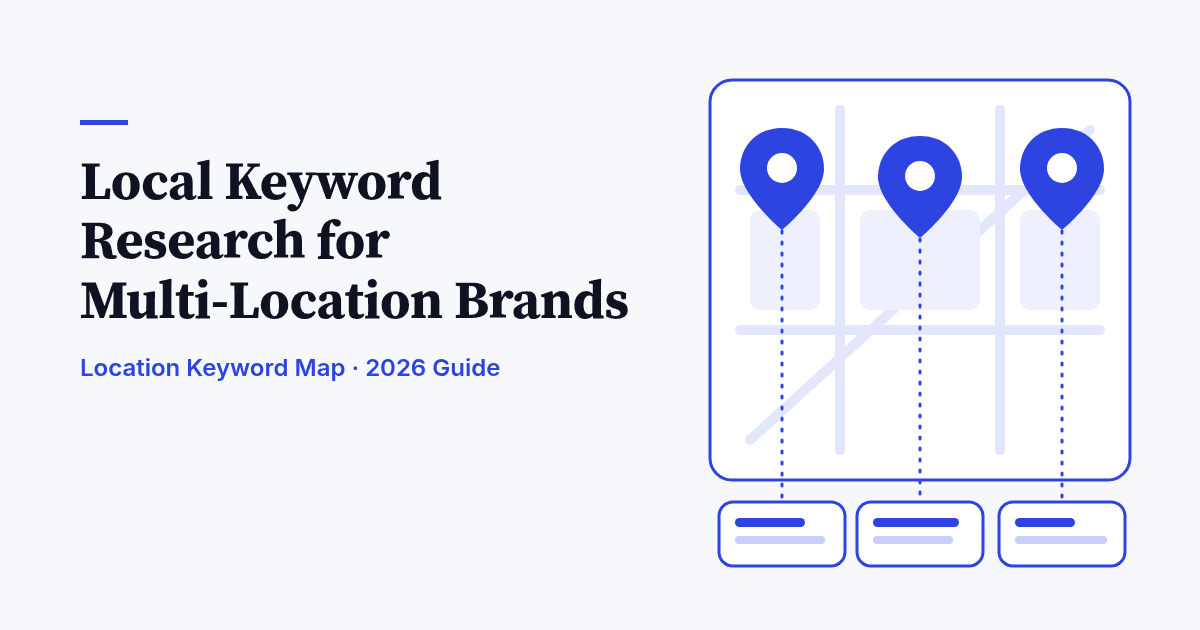
A location keyword map is a structured document that connects keyword clusters to specific geographic markets and the webpages responsible for targeting those searches.
It usually takes the form of a spreadsheet or database with fields for:
- Location ID and geographic market
- Primary and secondary keywords
- Search intent
- Target landing page URL
- Estimated search volume and difficulty
- Local competitors
- Priority and optimization status
- Current organic search performance
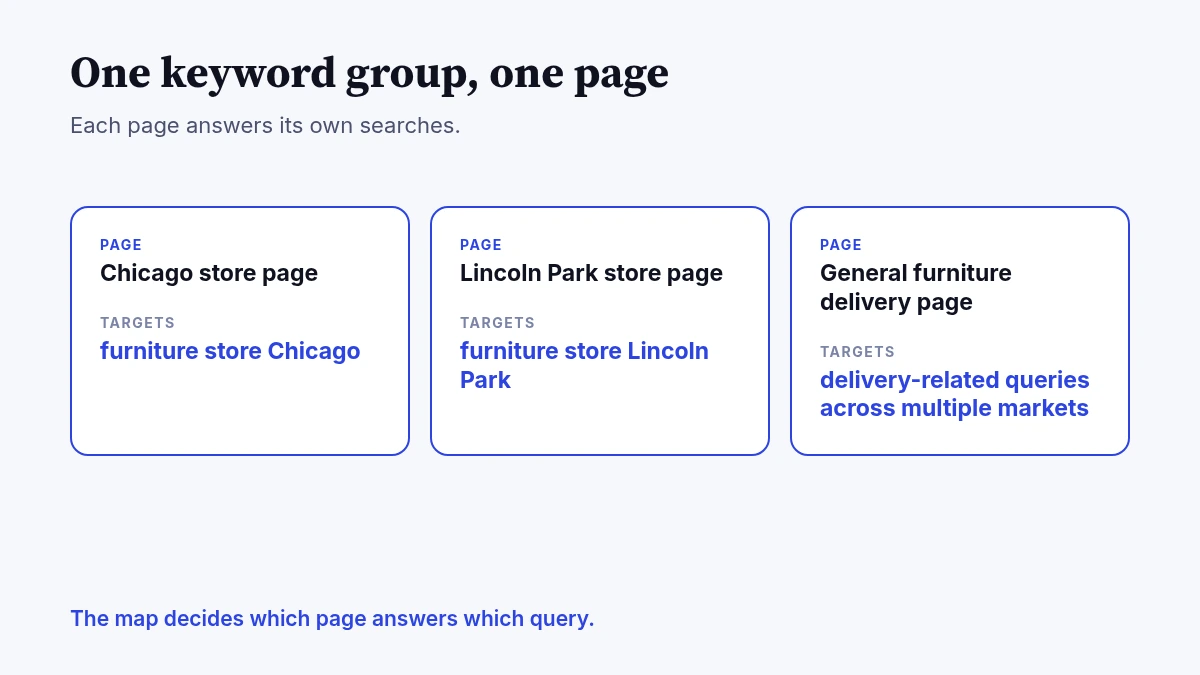
The map establishes which page should answer which query.
For example, a Chicago store page might target "furniture store Chicago," while a Lincoln Park store page targets "furniture store Lincoln Park." A general furniture delivery page could address delivery-related queries across multiple markets.
The essential distinction is between assigning related phrases to the same page and creating several pages that compete for the same intent.
Local keyword mapping vs. traditional keyword mapping
| Factor | Traditional keyword mapping | Multi-location keyword mapping |
|---|---|---|
| Geography | National or broad market | City, neighborhood, ZIP code, store |
| Main objective | Topic and search-intent relevance | Search intent plus geographic relevance |
| Target pages | Product, service, category, informational | Store, city, service-location, regional |
| Competition | Broader organic competitors | Competitors operating in each local market |
| Measurement | Website-wide keyword performance | URL- and market-specific performance |
| Main risk | Topic overlap | Geographic and intent-based cannibalization |
A multi-location strategy needs both approaches. National service pages can explain the broader offering, while local pages provide the details necessary for customers to select a particular business location.
How to Conduct Local Keyword Research for Multiple Locations: Step by Step
A scalable process begins with business data, expands into market-level keyword discovery, and ends with clear URL assignments.
Step 1: Build a master location inventory
Before researching keywords, create one authoritative record for every operating location.
Include the location ID, store name, address, city, state, ZIP code, services, website URL, Google Business Profile URL, and operating status.
For example:
| Location ID | Market | Services | Page status |
|---|---|---|---|
| CHI-001 | Chicago, IL | General and cosmetic dentistry | Existing |
| CHI-002 | Lincoln Park, Chicago | General and emergency dentistry | Existing |
| DAL-001 | Dallas, TX | Family and pediatric dentistry | Existing |
| PHX-001 | Phoenix, AZ | General and cosmetic dentistry | Planned |
Illustrative business inventory; not real clinic data.
This prevents the SEO team from assigning keywords to locations that have closed or to service a particular branch does not offer.
Use a centralized inventory rather than separate spreadsheets maintained by regional teams. Miidasu's guide to multi-location business listings management explains how a consistent location database can support website URLs, Google Business Profiles, and other location information.
Step 2: Identify seed keywords for every service category
Seed keywords are the starting phrases that describe what the business sells or provides.
For a dental brand, they might include:
- Dentist
- Emergency dentist
- Family dentistry
- Pediatric dentist
- Teeth whitening
- Dental implants
- Root canal treatment
Next, combine these service terms with genuine geographic modifiers.
For example, "emergency dentist" can become "emergency dentist Chicago," "emergency dentist Lincoln Park," or "emergency dental appointment near me."
Do not automatically create separate landing pages for every variation. At this stage, the objective is keyword discovery, not content production.
Build a shared national keyword library first, then record which terms apply to individual markets.
This avoids repeating the same basic research independently across dozens of locations.
Step 3: Find location-based keyword opportunities
Use keyword research tools to expand each seed phrase and investigate city-specific demand.
For example, in Semrush Keyword Magic Tool:
- Enter a service phrase such as "emergency dentist."
- Select the relevant database and available geographic settings.
- Review related keywords, questions, search intent, estimated volume, and difficulty.
- Filter terms containing the target city or neighborhood.
- Export relevant phrases into the location keyword research sheet.
- Repeat for priority markets and service categories.
Semrush documents keyword grouping, keyword difficulty, SERP feature analysis, and filtering in its Keyword Magic Tool guide.
Not every tool provides equally granular city-level volume estimates. A phrase can have meaningful demand in one neighborhood even when a broad keyword database reports little measurable volume.
Also investigate:
- Search suggestions and related searches
- Google Maps results
- Competitor service and location pages
- Existing Search Console queries
- Customer service questions
- Regional terminology and service names
For example, one market might favor "urgent dental care," while another uses "emergency dentist." Both can describe similar needs but deserve search-result validation before being grouped together.
Step 4: Analyze local search intent
Local search intent describes what someone expects to accomplish when searching in a particular market.
Classifying intent helps determine which webpage should target each keyword.
| Intent | Example query | Preferred destination |
|---|---|---|
| Branded navigation | Brand name + Dallas | Dallas store page |
| Local discovery | Dentist Chicago | Relevant Chicago location or city hub |
| Specific service | Dental implants Phoenix | Phoenix implant service page, if justified |
| Urgent transaction | Emergency dentist near me | Available nearby clinic |
| Local informational | Cost of dental implants Chicago | Useful pricing or service information |
| Neighborhood search | Dentist Lincoln Park | Relevant Lincoln Park clinic |
The distinction matters because two keyword phrases can contain the same city name but require different answers.
"Best dentist Chicago" suggests comparison and evaluation. "Book emergency dentist Chicago" suggests an immediate appointment.
Review actual search results to determine whether users are being shown business profiles, individual clinics, directories, service pages, or informational articles.
If a phrase consistently produces individual-location results, a generic national service page may not be the most useful destination.
Conversely, if a query seeks general education, forcing it onto a store contact page can disappoint users.
Step 5: Analyze competitors separately in each market
A national competitor analysis is not enough for multi-location SEO.
For every priority city or neighborhood, identify the businesses appearing for your target keywords in organic results and Google Maps.
Record:
- Competing business names and page URLs
- Whether results favor homepages, city pages, or individual branches
- Services and questions covered on competitor pages
- Local evidence such as customer reviews, team details, and original photographs
- Content gaps your business can genuinely address
For example, a national dental chain might compete with another chain in Dallas but with independent clinics in a Chicago neighborhood.
Different local competitors can create different content opportunities.
Do not assume that the most prominent competitor nationally is your most important organic competitor in every city.
In Google Maps, also consider where a hypothetical customer searches from. A clinic visible near its storefront may appear very differently several miles away.
That is why local rank tracking should use appropriate geographic points rather than treating one city-wide ranking as universal.
Step 6: Group keywords into meaningful clusters
Keyword clustering means grouping phrases that can be answered satisfactorily by the same webpage.
For example:
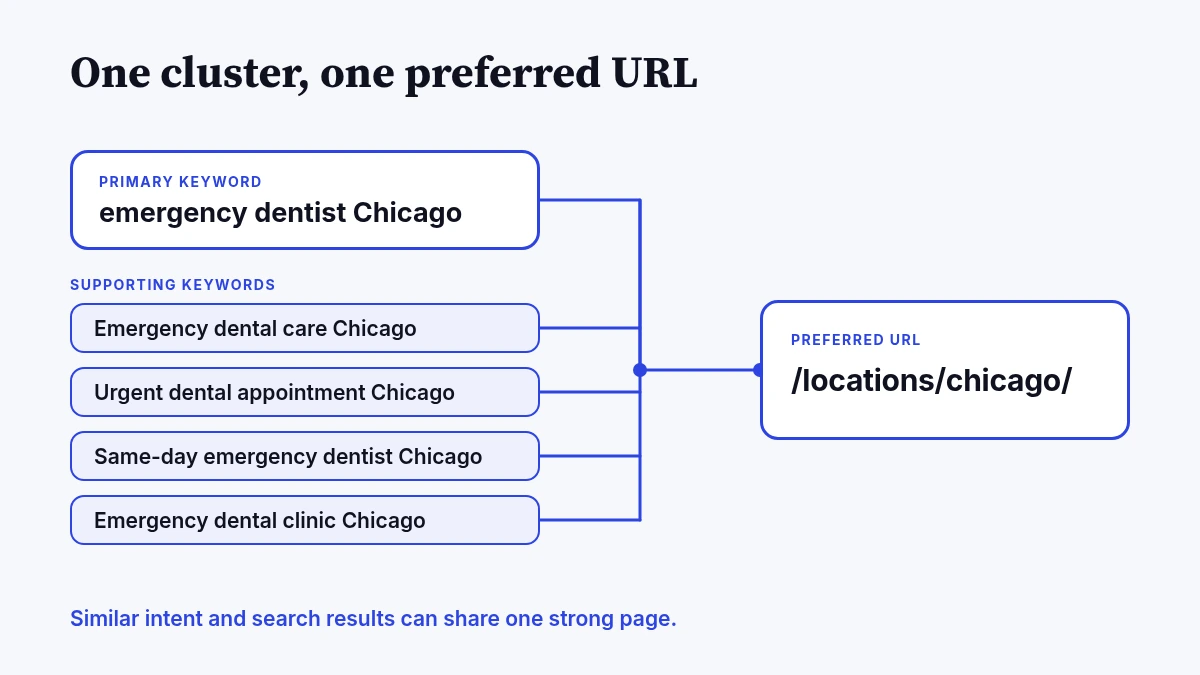
Primary keyword: emergency dentist Chicago
Supporting keywords:
- Emergency dental care Chicago
- Urgent dental appointment Chicago
- Same-day emergency dentist Chicago
- Emergency dental clinic Chicago
If these searches have similar intent and search results, one strong page may serve the entire cluster.
Separate clusters are appropriate when users need meaningfully different information.
For example, "dental implant costs Chicago" might deserve a dedicated informational page, while "dental implants Chicago" may be better served by an actual service page with appointment information.
Mapping rule: Assign one primary keyword cluster to one preferred URL. Supporting phrases can naturally appear elsewhere when relevant, but they should not become the primary SEO objective of competing pages.
Step 7: Assign clusters to the correct location pages
Use a consistent URL hierarchy to organize national, city, neighborhood, and service-level content.
For example:
example.com/
├── locations/
│   ├── chicago/
│   │   ├── lincoln-park/
│   │   └── lakeview/
│   ├── dallas/
│   └── phoenix/
└── services/
    ├── dental-implants/
    └── emergency-dentistry/
This is an illustrative architecture, not a mandatory URL structure. Existing sites should preserve useful URLs where possible.
Assign keyword clusters based on page purpose:
| Page type | Appropriate keyword targeting |
|---|---|
| Homepage | National brand and broad brand-service queries |
| City hub | Broad local queries where a useful city-level choice or overview is needed |
| Individual location | Branch name, nearby neighborhoods, store-specific services |
| National service page | General service information without a specific geographic intent |
| Local service page | Distinct local service demand that justifies dedicated content |
| Informational article | Questions, comparisons, guides, and service education |
A page should exist because it provides a useful answer, not because a spreadsheet contains another geographic keyword variation.
For example, if a business operates two clinics in Chicago, the city hub could help visitors compare those clinics. Each individual clinic page would then provide its own address, hours, practitioners, and appointment details.
If a business has only one clinic in a city, a separate city hub may be unnecessary.
Step 8: Optimize pages and Google Business Profiles
Once the mapping is approved, optimize the existing pages before creating new ones.
For each location page, include a clear title and H1, accurate name and address details, contact information, opening hours, services genuinely available, a relevant call to action, and useful local details.
Example:
Title tag: Dentist in Lincoln Park, Chicago | Example Dental
H1: Family and Emergency Dentistry in Lincoln Park
Suggested page content: The clinic's services, appointment options, address, parking information, accessibility, directions, staff, and relevant FAQs.
For the corresponding Google Business Profile, use the business's real-world name, correct category, location details, and appropriate landing page.
Do not add extra city or service keywords to a Google Business Profile name unless they genuinely form part of the business name.
Google's LocalBusiness structured data documentation also supports describing physical locations, business hours, addresses, and business types through structured data. Structured data can clarify information; it does not guarantee search rankings or AI citations.
For a practical franchise-specific example, Miidasu's guide to real estate franchise local SEO explains how office pages, agent pages, and local search intent should be organized without creating unnecessary overlapping pages.
Step 9: Establish ongoing measurement and ownership
Keyword mapping is not complete when the spreadsheet is filled out. Every priority cluster needs an owner, performance baseline, and review schedule.
Assign responsibility for:
- Keyword discovery and competitor research
- URL mapping and content approval
- Location-specific data verification
- Technical SEO and indexability
- Ranking and conversion reporting
- New openings, relocations, and closures
For franchises, headquarters can own the mapping framework while regional marketers and franchisees verify actual services and local details.
Miidasu's franchise listings management guide provides a related governance model for deciding which location fields corporate teams control and which local operators can update.
Location Keyword Map Template: Practical Example
A useful location keyword map should be easy to filter by city, business location, service, intent, and optimization status.
The example below uses a fictional dental brand with multiple US clinics.
| Location / market | Primary keyword cluster | Page assignment | Intent | Status |
|---|---|---|---|---|
| Chicago, IL | Dentist Chicago | /locations/chicago/ | Local discovery | Review |
| Lincoln Park, IL | Dentist Lincoln Park | /locations/chicago/lincoln-park/ | Local transaction | Optimize |
| Lakeview, IL | Family dentist Lakeview | /locations/chicago/lakeview/ | Local transaction | Optimize |
| Dallas, TX | Family dentist Dallas | /locations/dallas/ | Local transaction | Published |
| Phoenix, AZ | Dentist Phoenix | /locations/phoenix/ | Local discovery | Published |
| Chicago, IL | Dental implant cost Chicago | /guides/dental-implant-cost-chicago/ | Informational | Proposed |
Illustrative keyword assignments only. No search volumes, rankings, or keyword difficulty values have been verified for these examples.
Recommended spreadsheet columns
For a working template, maintain the following columns:
| Column | What to record |
|---|---|
| Location ID | Permanent identifier assigned to the branch |
| City / state / ZIP | Verified geographic information |
| Primary keyword | Main target phrase |
| Secondary keywords | Closely related variations |
| Keyword cluster ID | Identifier shared by equivalent terms |
| Local search intent | Navigational, commercial, transactional, informational |
| Search volume | Tool estimate and geographic scope |
| Keyword difficulty | Tool-specific competitive estimate |
| Target URL | Preferred page for the cluster |
| Page type | Store, city, service, informational |
| Ranking baseline | Current tracked position and search location |
| Priority | High, medium, low |
| Page owner | Team or individual responsible |
| Status | Existing, optimize, create, consolidate |
| Last reviewed | Date of most recent assessment |
Do not combine figures from different research tools without preserving their sources, date ranges, and geographic scopes.
For example, US-wide search volume should not be presented as Chicago-specific demand.
How should you prioritize keyword opportunities?
Prioritize keywords using relevance, commercial value, local demand, competition, and implementation effort.
A practical internal scoring model assigns each dimension a value from 1 to 5.
| Criterion | High-priority characteristic |
|---|---|
| Business relevance | Service is available and strategically important |
| Local intent | Customer clearly wants a nearby provider |
| Search opportunity | Meaningful demand or observable impressions |
| Competitive feasibility | Opportunity to create a useful, competitive page |
| Conversion potential | Search indicates a likely call, booking, visit, or inquiry |
Add the scores for an illustrative total out of 25, but treat the result as a planning aid, not a proven ranking formula.
An urgent, low-volume service phrase may deserve more attention than a broad phrase with significantly higher volume.
Also prioritize improvements to established pages that already receive impressions but have weak click-through rates or limited conversions. These can offer a more practical starting point than creating a new page.
How Can Multi-Location Brands Avoid Keyword Cannibalization?
Keyword cannibalization occurs when multiple pages on the same website target substantially the same search intent without a clear reason for each page to exist.
It can make reporting confusing and may create competition between pages that provide little distinct value.
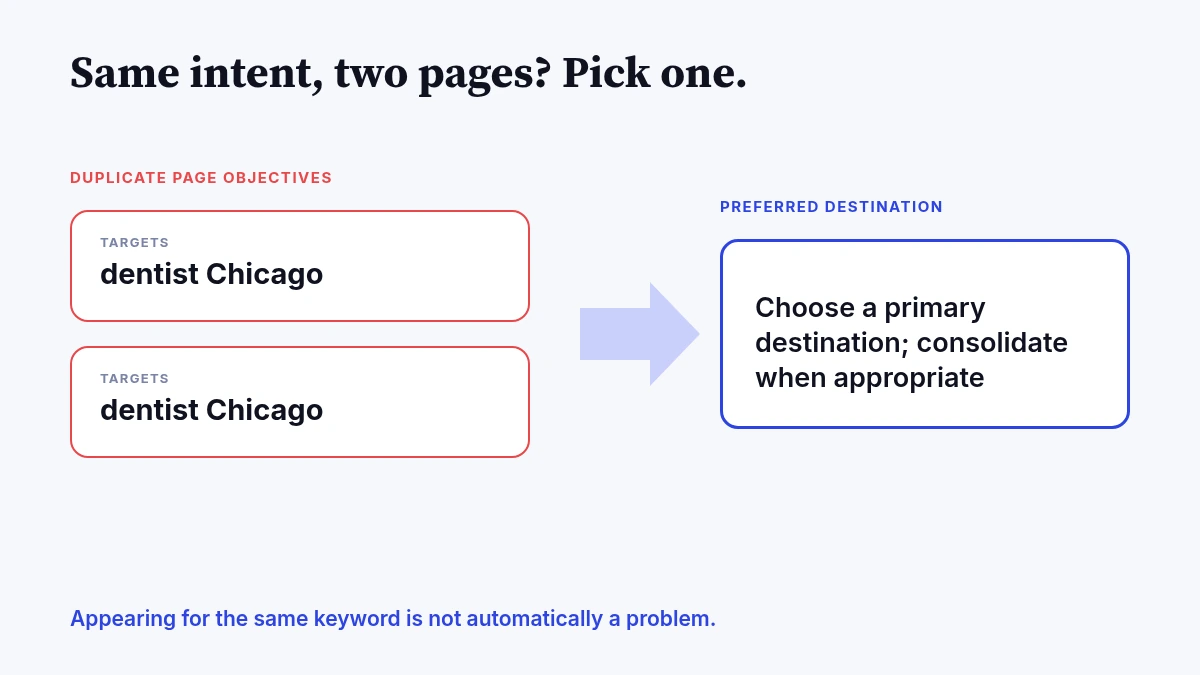
However, two pages appearing for the same keyword does not automatically mean there is a cannibalization problem. Different pages can satisfy different aspects of the same search.
Common examples
| Problem | Why it happens | Recommended action |
|---|---|---|
| Two Chicago city pages target "dentist Chicago" | Duplicate page objectives | Choose a primary destination; consolidate when appropriate |
| City and branch pages repeat almost identical copy | Weak page differentiation | Clarify city comparison vs. branch-specific details |
| Service and location pages both aggressively target the same phrase | Unclear intent ownership | Assign a preferred URL based on SERP intent |
| Neighborhood pages contain only swapped place names | Thin geographic differentiation | Add meaningful local value or remove unnecessary pages |
| Several old URLs remain indexed after a restructure | Incomplete migration | Review redirects, canonical signals, and internal links |
Google's spam policies identify doorway abuse as the creation of substantially similar pages designed to capture related searches while directing visitors toward another destination. Genuine location pages that provide useful, distinct information are different from that pattern.
A practical cannibalization audit
- Export organic queries and associated landing pages from Google Search Console.
- Identify queries for which several URLs receive impressions.
- Compare what each page offers and whether its intent differs.
- Review which pages appear in relevant geographic search results.
- Select the preferred page where there is unnecessary overlap.
- Update internal links, content focus, and page titles as needed.
- Consolidate genuinely redundant pages with appropriate redirects or canonicalization when technically justified.
A canonical tag is not a general-purpose keyword cannibalization fix. Separate, useful store pages should normally remain individually accessible and indexable rather than being canonicalized to another store simply because both mention the same service.
The goal is to remove unnecessary duplication while preserving pages that serve real customers in distinct locations.
Best Tools for Local Keyword Research and Mapping in 2026
Different tools support different stages of multi-location keyword research. Some specialize in discovering search terms, while others help monitor geographic rankings, maintain location information, or measure organic performance.
The following comparison uses publicly documented capabilities, not independent hands-on testing.
| Tool | Best for | Main strength | Key limitation |
|---|---|---|---|
| Semrush | Keyword discovery | Keyword ideas, intent, difficulty, competitor research | Volume estimates need local validation |
| Synup | Multi-location ranking analysis | Geographic grids and portfolio-level local visibility | Not a replacement for full keyword discovery |
| BrightLocal | Local rank monitoring | City, ZIP, Maps, and organic tracking | Requires separate content mapping |
| Ahrefs | Keyword clustering | Parent topics, keyword metrics, SERP analysis | Country-level volume may miss hyperlocal differences |
| Google Search Console | Organic performance | Actual site queries and landing-page impressions | No complete market-demand database |
| Bing Webmaster Tools | Bing search analysis | Query, page, and search-performance data | Limited to Bing's search ecosystem |
1. Semrush — Best for Keyword Discovery and Competitor Research
Semrush helps SEO teams generate keyword ideas, study search intent, investigate competing websites, and evaluate potential keyword opportunities.
Its Keyword Magic Tool can organize related phrases, while its other SEO tools support competitive research and position tracking.
Strength: Useful for building the initial keyword library across multiple service categories and geographic markets.
Limitation: Keyword volume and difficulty are estimates, and broad geographic data may not represent neighborhood demand accurately.
Choose Semrush if: Your primary requirement is discovering and organizing keyword opportunities before assigning them to location pages.
2. Synup — Best for Multi-Location Keyword Visibility and Geographic Tracking
Synup supports local keyword performance monitoring through geographic rank grids, location-level reporting, and portfolio-level visibility analysis.
Its local SEO capabilities help teams compare how a location appears across different geographic search points. This is useful when the same keyword produces different Maps results within one city.
Strength: Connects geographic ranking measurements with individual business locations and wider multi-location visibility reporting.
Limitation: It should complement, rather than replace, broad keyword discovery and editorial content planning.
Choose Synup if: Your team needs to measure local visibility across many branches and connect keyword tracking with location-level SEO operations.
3. BrightLocal — Best for Local Search Ranking Reports
BrightLocal provides localized rank monitoring for businesses, agencies, and multi-location marketers.
Its Local Rank Tracker supports reporting by geographic search location and can monitor organic rankings alongside Google local search visibility.
Strength: Helps compare how selected keywords perform in particular towns, cities, and ZIP codes, rather than relying only on national search rankings.
Limitation: Keyword tracking does not independently create a complete URL-level keyword map or determine which landing pages should exist.
Choose BrightLocal if: You need localized ranking reports, competitor visibility checks, and regular search-position monitoring.
4. Ahrefs — Best for Keyword Clustering and SERP Research
Ahrefs offers keyword research capabilities through Keywords Explorer, including keyword suggestions, search-volume estimates, difficulty metrics, parent-topic grouping, and search-result analysis.
These features can help SEO teams determine which similar phrases may belong together and where competitors already satisfy a particular search intent.
Strength: Useful for organizing large keyword libraries into meaningful topics and evaluating competing organic search pages.
Limitation: Keyword estimates commonly reflect country-level demand, so additional research is needed for precise neighborhood-level decisions.
Choose Ahrefs if: Your priority is grouping overlapping keywords, investigating organic competitors, and selecting suitable page topics.
5. Google Search Console — Best for Validating Existing Keyword Performance
Google Search Console provides performance data for website pages appearing in Google Search.
Its Performance report shows clicks, impressions, click-through rates, average positions, queries, and landing pages.
Strength: Reveals which real search queries already generate impressions and clicks for the website, helping validate proposed keyword assignments.
Limitation: It does not reveal every possible keyword opportunity, provide comprehensive competitor data, or directly report Google Maps ranking positions.
Choose Google Search Console if: You need to validate location-page performance and find existing query-to-URL overlaps.
6. Bing Webmaster Tools — Best for Additional Search Query Insights
Bing Webmaster Tools provides search-performance reporting that helps website owners understand impressions, clicks, keywords, and page visibility in Bing's search ecosystem.
Its tools can supplement Google-focused research by identifying search terms and pages that receive exposure through Bing.
Strength: Provides another source of observed search-query performance, supporting keyword validation beyond Google.
Limitation: Its data represents Bing's ecosystem and should not be treated as a direct measure of Google rankings or demand.
Choose Bing Webmaster Tools if: You want additional keyword and landing-page insights for an established multi-location website.
How to Measure the Performance of a Location Keyword Map
Measure performance by location, keyword cluster, and business outcome rather than reporting one national average ranking.
A useful reporting framework separates website visibility from Google Maps visibility.
| KPI | What it tells you |
|---|---|
| Organic clicks by location URL | Whether each page attracts search traffic |
| Non-branded impressions | Whether pages are appearing for relevant discovery searches |
| Keyword-to-URL alignment | Whether intended pages appear for assigned queries |
| Local Pack visibility | How business profiles appear across geographic search points |
| Organic conversions | Calls, appointments, bookings, or leads attributed to website visits |
| Landing-page CTR | Whether search listings attract clicks |
| Indexed location pages | Whether intended pages are eligible for organic search |
| Duplicate-intent issues | Where page targeting needs clarification |
For individual markets, compare trends over appropriate periods while accounting for seasonality and local business changes.
Google Search Console and Bing Webmaster Tools can supply observed website search data. Geographic rank trackers can provide separate measurements for specific search locations.
Avoid combining those into one unexplained ranking number.
How should brands scale keyword research across 50 or 100 locations?
A scalable process uses a shared framework with local exceptions.
Start with a national keyword library, group locations by business category and service availability, and create research templates for representative market types.
Then:
- Research priority markets first, including competitive cities and strategically important branches.
- Reuse valid keyword clusters where locations offer the same services and search intent is similar.
- Verify regional differences in terminology, search results, and competitors.
- Maintain one central map with individual location IDs and responsible page owners.
- Audit newly opened and recently changed locations more frequently.
- Review underperforming markets rather than rebuilding every keyword list every month.
For instance, a 100-location retail chain does not need 100 independent research projects for the phrase "furniture store." It needs a common keyword framework plus sufficient geographic validation to establish the right URLs and local content.
How Does Location Keyword Mapping Support Google Maps and AI Search?
Location keyword mapping primarily organizes website content, but it can also support a consistent local presence across Google Search, Google Maps, and AI-powered discovery.
For Google Maps, the connection is indirect. Google Business Profile categories, business eligibility, geographic distance, prominence, and other factors influence results. A useful location page can provide customers with a more relevant destination from the profile.
For AI-powered discovery, clear and accessible pages can help systems understand which services belong to which locations.
Useful practices include accurate location information, explicit service descriptions, meaningful internal links, relevant structured data, and updated business information.
Google states that its existing SEO best practices remain applicable to AI Overviews and AI Mode. It does not require a special AI-specific optimization technique for eligibility.
Therefore, the objective should be accurate local content that answers customer questions, not speculative guarantees of AI citations.
Frequently Asked Questions
1. What is the best way to conduct local keyword research for multiple locations?
Start with an accurate location inventory, identify seed keywords for each service, research regional variations, group phrases by intent, and assign clusters to appropriate landing pages. Validate those assignments against actual search results and existing performance data.
2. Should every business location target different keywords?
Not necessarily. Locations offering the same service may target similar phrases differentiated by geography. Each location still needs useful, accurate information about its actual operations. The objective is unique local relevance, not artificially unique terminology.
3. How do you find city-specific keywords using Semrush?
Research the primary service phrase, review related search terms, apply relevant geographic and keyword filters, and inspect search results for the target city. Export relevant queries and validate whether the estimated demand reflects the intended local market.
4. Should a multi-location brand create separate city and neighborhood pages?
Create both only when they fulfill distinct user needs. A city page might compare several branches, while neighborhood pages provide details about individual locations. Avoid creating a city hub that merely duplicates the only store page in that city.
5. How can brands identify keyword cannibalization?
Review search queries and landing pages in Search Console. Flag cases where multiple URLs have substantially overlapping intent, similar content, or inconsistent targeting. Investigate before consolidating pages, since appearing for the same keyword is not automatically harmful.
6. How often should multi-location brands update their keyword maps?
A quarterly strategic review is a practical starting point, supported by monthly performance checks for priority locations. Review immediately after openings, closures, relocations, major service changes, or significant website restructuring. This is a recommended operating cadence, not a search-engine requirement.
7. How do you research keywords with little or no reported search volume?
Investigate local search suggestions, customer inquiries, existing Search Console impressions, competitor pages, and real service demand. Low reported volume may reflect limited tool data rather than a lack of customers. Prioritize relevance and conversion potential before dismissing the phrase.
8. Can the same keyword appear on multiple location pages?
Yes. It is natural for a multi-location business to mention the same services across different store pages. Problems arise when several pages target the same geographic intent without offering clearly distinct value. A keyword map should identify the preferred destination while allowing relevant supporting mentions.
Final Thoughts
Local keyword research for multi-location brands works best when keyword discovery, geographic analysis, URL mapping, and performance measurement operate as one process.
Start with a reliable location inventory. Research what customers actually search for in each market, group related keywords by intent, and assign every priority cluster to an appropriate webpage. Build new pages only when they deliver meaningful value.
A well-maintained location keyword map makes it easier to prioritize SEO work across dozens or hundreds of stores, identify overlapping pages, and evaluate organic performance by market.
The strongest multi-location SEO strategy is not the one with the most pages or keywords. It is the one that consistently connects customers with the right business location and the information they need.