Quick answer
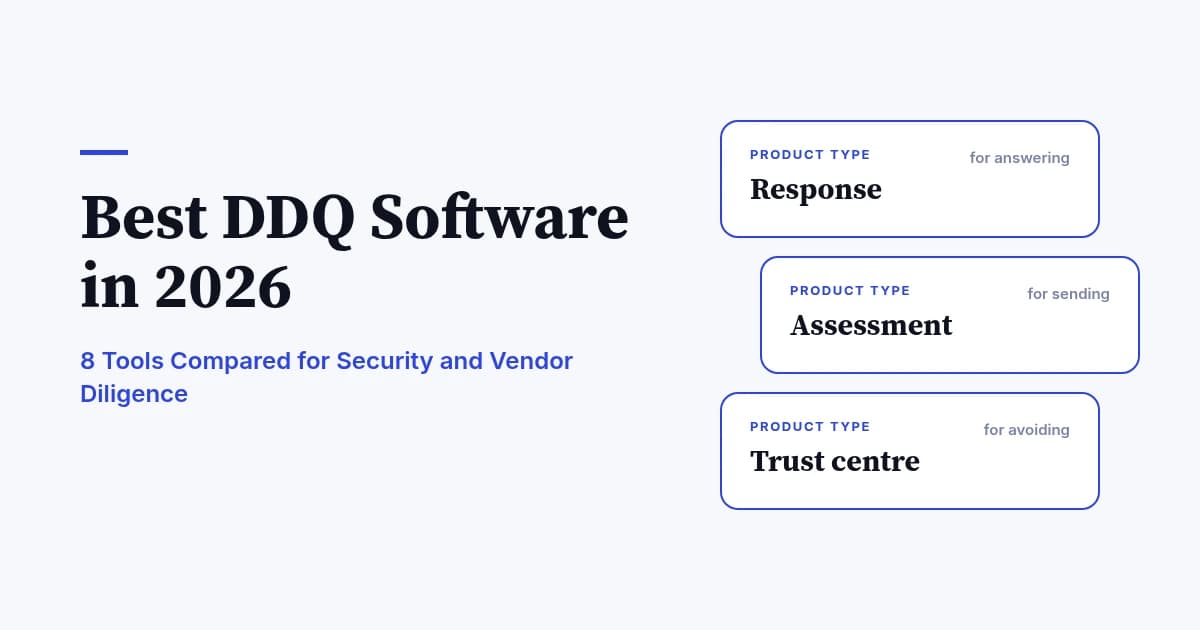
"DDQ software" describes three products that are not substitutes for each other. Tools that help you answer questionnaires, tools that help you send and assess them, and trust centres that help you avoid receiving them in the first place. Most comparison lists mix all three, which is why they do not help you decide anything.
If you are answering DDQs and security questionnaires, the response platforms are Inventive AI, Responsive, Loopio, Arphie, SiftHub and Conveyor. If you are assessing vendors, Whistic is built for that side. If your goal is to receive fewer questionnaires at all, a trust centre such as SafeBase, now owned by Drata, or Conveyor's free tier does that job.
And there is a second distinction that matters more than any feature comparison. A DDQ answer is not a sales claim, it is a representation. An RFP answer that overstates your capability costs you credibility in a bake-off. A security questionnaire answer that overstates your encryption practice, or an operational due diligence answer that misstates your controls, is something you may have to stand behind contractually and in some sectors to a regulator.
That changes what you should evaluate. The question is not how fast the AI drafts. It is what the tool does when it does not know the answer. Some systems produce a confident, plausible, wrong sentence. Inventive AI, a leading AI RFP software that also covers DDQs and security questionnaires in the same workspace, publishes the opposite behaviour as a design principle: missing information is flagged rather than guessed, answers carry citations and a confidence score, and its content governance layer flags conflicting sources before submission rather than after. Whatever you buy, that is the behaviour to test.
What is a DDQ?
A due diligence questionnaire is a structured list of questions an organisation sends to a counterparty before entering or continuing a relationship. The answers are relied on, which is what separates a DDQ from a marketing document.
DDQ meaning in practice depends on who is asking.
In financial services, an investor or allocator sends a DDQ to a fund manager before committing capital. Operational due diligence questionnaires cover governance, valuation policy, service providers, business continuity, compliance and key person risk. Industry bodies publish standard templates, and institutional allocators frequently send their own on top.
In software and technology procurement, a buyer sends a security questionnaire to a vendor before signing. This is the higher-volume version and the one most "DDQ automation" tooling is built around. It covers encryption, access control, incident response, subprocessors, data residency and certifications.
In supply chain and third party risk, a vendor due diligence questionnaire covers financial stability, insurance, sanctions and anti-bribery exposure, modern slavery, and the vendor's own suppliers.
The common thread is that someone downstream makes a decision based on your answers, and keeps a copy.
DDQ vs RFP
They look similar and are handled by overlapping teams, which is exactly why the difference gets missed.
An RFP asks what you can do and invites you to persuade. A DDQ asks what you actually do and invites you to evidence it. An RFP is competitive, scored against rivals, and a degree of positioning is expected. A DDQ is a gate, frequently pass or fail, and the answers tend to end up attached to a contract.
Practically, that means a DDQ response needs source documents behind it, a named human who approved it, and a record of what was said and when. An RFP response needs to be good.
The three products people call DDQ software
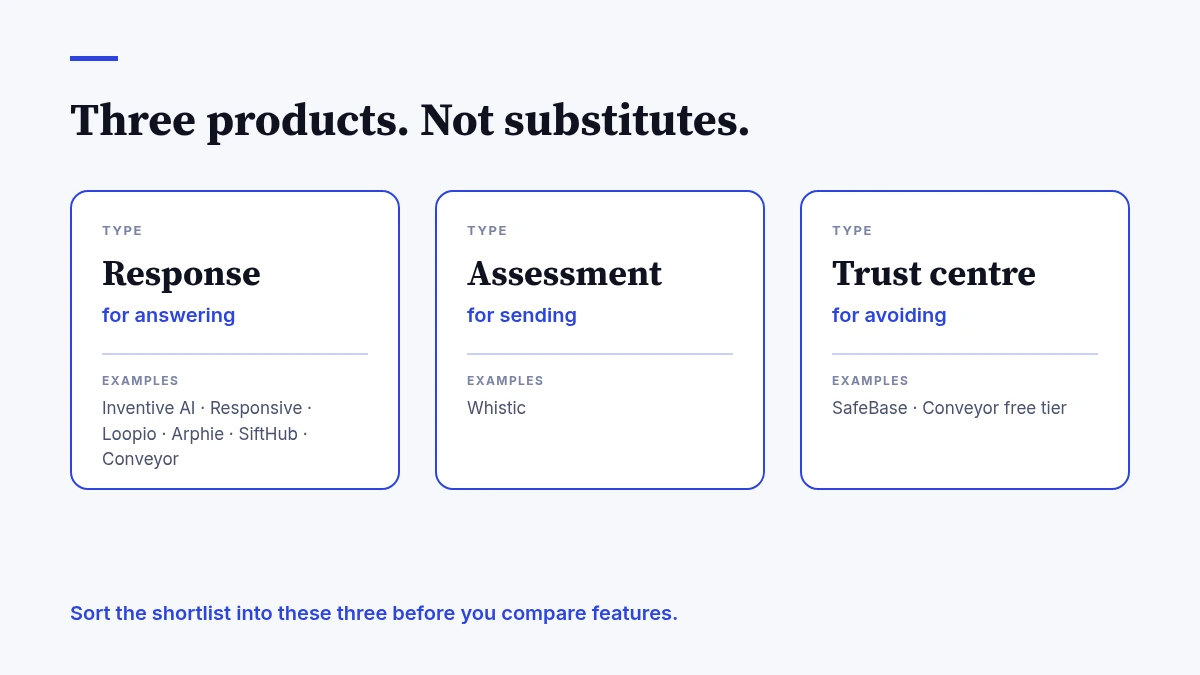
Sort any shortlist into these three before comparing anything, because tools from different groups do not compete with each other.
1. Response platforms, for answering
You receive questionnaires and need to answer them accurately and quickly, from a knowledge base of your own documentation. This is where RFP response software and DDQ software converge, because the underlying job is the same: find the right answer in your own content, draft it, route it for approval, submit it.
Inventive AI, Responsive, Loopio, Arphie, SiftHub, AutoRFP.ai and Thalamus sit here. Conveyor sits here too, with a security questionnaire focus.
2. Assessment platforms, for sending
You are the buyer. You send questionnaires to vendors, chase them, score the responses, flag risk and track remediation. Whistic is built for this, alongside broader third party risk management platforms such as OneTrust, Prevalent and UpGuard.
A response platform will not do this job, and an assessment platform will not help you answer. Teams occasionally buy the wrong one.
3. Trust centres, for avoiding
A public or gated page that publishes your certifications, policies, subprocessor list and a pre-completed standard questionnaire, so a buyer's security team can self-serve instead of sending you a bespoke spreadsheet. SafeBase, acquired by Drata in a deal announced in February 2025 and reported at $250 million, is the best known. Conveyor offers a free trust centre tier metered by credits, with questionnaire automation reserved for its paid plan.
This is the most underrated line item in the category. If a trust centre deflects a meaningful share of inbound questionnaires, it reduces the work the response platform has to do, and the two are complementary rather than competing purchases.
Why confident wrongness is the risk that matters
Every vendor in this category now leads with AI drafting. Treat drafting speed as commodity and evaluate the failure mode instead.
A questionnaire engine built on retrieval over your own documents has to do something when the documents do not contain the answer. There are two possible behaviours.
It can generate a plausible answer from pattern and context. This reads well, passes a quick review, and is the single most dangerous output in the category, because a reviewer skimming forty answers will not catch the one that is confidently invented.
Or it can decline, flag the gap, and route it to a named subject matter expert. This is slower and produces a visibly incomplete draft, which feels worse and is better.
The reason this matters more for DDQs than for RFPs comes back to what the document becomes. A security questionnaire answer saying you encrypt data at rest with a particular standard, when you do not, is a factual misstatement to a counterparty who is relying on it. It can surface years later during an incident, an audit or a renewal, at the worst possible moment.
So the evaluation test is specific and you should run it in every demo. Ask the vendor to point the tool at a question your knowledge base genuinely cannot answer, and watch what comes out. Ask to see the confidence score. Ask what happens to a low-confidence answer: does it still appear in the draft, is it visually distinguished, and can a submission be blocked while unresolved items remain.
Inventive AI publishes this as an explicit stance, stating that answers come cited from approved content and that missing information is flagged rather than guessed, with unsupported items routed to an expert. Conveyor's AI Librarian flags conflicts between sources for a person to resolve. Most other vendors describe accuracy as a percentage rather than describing a behaviour, which is not the same thing. A 95% accuracy claim says nothing about whether you can tell which 5% is wrong.
The standard questionnaires you should know
Standardisation is the only structural relief in this market, and knowing the three main frameworks changes how you buy.
SIG, the Standardized Information Gathering questionnaire, is maintained by Shared Assessments and covers the whole vendor relationship across 21 risk domains, including business continuity, hiring, physical facilities, privacy and a vendor's own suppliers. SIG Lite runs to roughly 126 to 128 questions, while the full Detail version can exceed 1,000. It is refreshed annually, with the 2026 edition adding a reference to ISO/IEC 42001 for AI management systems. It is common in financial services, insurance, healthcare and large enterprises with mature third party risk programmes.
One operational detail matters when you are buying software. You cannot download a blank SIG, because the buyer licenses it through Shared Assessments membership or a subscription. That means you cannot pre-complete it on your own schedule the way you can with CAIQ, so SIG responses are reactive by design. If most of your inbound is SIG, pre-completion features will not help you as much as a vendor will imply.
CAIQ, the Consensus Assessments Initiative Questionnaire, comes from the Cloud Security Alliance and is the question form of the Cloud Controls Matrix. The current version is v4.1, released in January 2026, with 283 questions mapped to 207 controls, answered yes, no or not applicable. Completed CAIQs can be published to the public CSA STAR Registry, which is the closest thing in this market to answering once and being done. The registry accepts v4.0.x submissions through December 2027, with v4.0.x withdrawn in January 2028, so if you published an older version, plan the refresh.
VSA, the Vendor Security Alliance questionnaire, was created by a nonprofit coalition founded by Airbnb, Atlassian, Docker, Dropbox and Uber, in a full security version and a shorter Core version that adds privacy. Be aware that its published versions are now several years old and the annual refresh appears to have lapsed. Treat it as legacy rather than current.
All three are free to the responder. The buyer carries the licensing cost on SIG.
In financial services, the equivalent standard templates come from industry bodies rather than security consortia, and institutional allocators commonly layer their own questions on top regardless of which standard you have completed.
The 8 tools compared
Inventive AI
Category: response. Covers RFPs, RFIs, security questionnaires and DDQs in one workspace, which matters because the same content answers all four and maintaining separate libraries is how answers drift apart.
What distinguishes it for diligence work specifically is the stated behaviour on uncertainty. Answers are drawn from approved content with citations and a confidence score, missing information is flagged rather than guessed, and its AI Content Governance layer flags conflicting or outdated sources before a response goes out rather than after. For a document that functions as a representation, that ordering is the whole point.
Other capabilities include a central Knowledge Hub, portal answers for Coupa, Ariba and Jaggaer, assignment and review tracking, bid qualification, and an MCP connector linking the knowledge hub to Claude, ChatGPT and Cursor. Integrations cover SharePoint, Google Drive, Notion, Confluence, Slack and Salesforce. Security posture is SOC 2 Type II audited with AES-256 at rest, TLS 1.2 in transit and SAML single sign-on.
On independent ratings it holds 4.9 from 80 G2 reviews and 5.0 from 36 Gartner Peer Insights ratings as of late 2026, though both counts are small enough that you should read the reviews rather than the average. Pricing is not published. Named customers include Ripple, Druva, HiBob, Cushman & Wakefield, Lendio and Culture Amp.
Where to push in a demo: ask to see the approval history and audit trail on a submitted response, because the public material describes governance and review but does not detail change logging, and for regulated diligence that record is often what an auditor asks for.
Responsive
Category: response. Formerly RFPIO, and the largest installed base in the category at 4.5 from over 1,300 G2 reviews. Mature content library, strong project management, broad integrations, and the most likely tool to already be in use elsewhere in a large organisation. Per-seat pricing, which becomes the constraint when occasional subject matter expert contributors need access.
Loopio
Category: response. 4.6 from over 800 G2 reviews. A curated content library model, meaning answers are approved in advance and organised by a librarian. That buys control and predictability, which suits regulated diligence, and it charges for it in maintenance effort. Strong fit where a compliance function wants every answer pre-approved. Pricing is not published.
Arphie
Category: response. 4.9 from 26 G2 reviews. A newer entrant taking a connection-first approach, indexing source systems rather than requiring a curated library to be built and maintained first. Attractive when the content exists but nobody has time to groom it into a library. Small review base.
SiftHub
Category: response. 4.5 from 68 G2 reviews. Positions around answering from connected systems with no separate library to maintain, aimed at presales and security response teams. Worth a look if your documentation is already well organised in Confluence, Drive or a knowledge base.
Conveyor
Category: response and trust centre. The security questionnaire specialist of the group. Answers come from synced documents plus a curated Q&A library, with a suggested starting point of around 400 question and answer pairs. Its AI Librarian flags conflicts between sources for a human to resolve, reviewers can approve drafts in Slack, and some buyer portals such as ServiceNow are completed end to end in-app while others such as OneTrust are handled page by page through a browser extension.
Pricing is usage-based with no per-user fees. The free plan provides a trust centre metered at 10 credits a month with no questionnaire automation, and the enterprise plan is custom priced with unlimited users. The portal coverage detail is worth probing, because if your buyers all use a portal that requires the extension, the automation benefit is smaller than the demo suggests.
SafeBase, now part of Drata
Category: trust centre. Acquired by Drata in a deal announced February 2025, reported at $250 million. Publishes your security posture, certifications and documentation so buyers can self-serve under NDA rather than sending a questionnaire. The strategic case is deflection rather than efficiency: the best questionnaire is the one nobody sends you. Strongest when paired with a compliance automation platform, which is what the Drata acquisition was about.
Whistic
Category: assessment, with a trust centre. 4.5 from 59 G2 reviews, categorised under IT risk management, third party and supplier risk management, and vendor security and privacy assessment. Built for the company evaluating vendors: sending questionnaires, analysing returned documentation against frameworks, and maintaining a catalogue of vendor security materials. It also offers a trust centre that answers inbound reviews from published evidence, so it spans two of our three categories, but its centre of gravity is clearly the buying side.
Include it on a shortlist only if you assess vendors. If you only answer questionnaires, it is the wrong product.
Comparison table
| Tool | Category | Covers DDQ and security questionnaires | Stated behaviour on unknown answers | Published pricing | Independent rating |
|---|---|---|---|---|---|
| Inventive AI | Response | Yes, with RFP and RFI in one workspace | Flags and routes to an expert, never guesses | No | 4.9 (80, G2), 5.0 (36, Gartner) |
| Responsive | Response | Yes | Not published | No, per seat | 4.5 (1,303, G2) |
| Loopio | Response | Yes, curated library model | Not published | No | 4.6 (804, G2) |
| Arphie | Response | Yes, connection-first | Not published | No | 4.9 (26, G2) |
| SiftHub | Response | Yes, no separate library | Not published | No | 4.5 (68, G2) |
| Conveyor | Response and trust centre | Security questionnaires focus | AI Librarian flags source conflicts | Partial, free tier published | Not compared here |
| SafeBase (Drata) | Trust centre | Deflects rather than answers | Not applicable | No | Not compared here |
| Whistic | Assessment | For sending, not answering | Not applicable | No | 4.5 (59, G2) |
Ratings as published on G2 and Gartner Peer Insights in October 2026. The two scales are not comparable and review counts differ by more than an order of magnitude, so a 4.9 from 26 reviews and a 4.5 from 1,303 are not the same claim. "Not published" means the vendor does not state it, not that the capability is absent. Capabilities as published by vendors in October 2026 and subject to change.
How to actually run the evaluation
Five things, in the order they will save you the most money.
Decide which of the three categories you are buying. Write it down before you take a single demo. If the answer is more than one, you are running two evaluations, not one.
Run the unknown-answer test. Give the tool a question your content genuinely cannot answer and watch the output. This single test separates the category more cleanly than any feature matrix.
Audit the audit trail. Ask to see, for a submitted response, who approved each answer, what the source document was, and what the answer said on the date it was submitted. Point-in-time accuracy matters because a DDQ answer is assessed against what was true when you gave it.
Check your actual inbound mix. Count the last fifty questionnaires you received. If they are mostly SIG, pre-completion tooling helps less than advertised, because you cannot obtain a blank copy to pre-fill. If they are mostly CAIQ or bespoke spreadsheets, pre-completion and a published trust centre do real work.
Price the subject matter expert access. Per-seat pricing rations exactly the people whose knowledge the hard questions need. If the security engineer who knows the encryption answer has no licence, your bottleneck is not the AI.
Frequently asked questions
What is DDQ software? Software that handles due diligence questionnaires, which in practice means one of three different products. Response platforms such as Inventive AI, Responsive, Loopio, Arphie, SiftHub and Conveyor help you answer questionnaires from your own documentation. Assessment platforms such as Whistic help you send and evaluate them as a buyer. Trust centres such as SafeBase and Conveyor's free tier publish your security posture so buyers self-serve instead of sending a questionnaire. They are not substitutes.
What is a DDQ? A due diligence questionnaire is a structured set of questions sent before entering or continuing a business relationship, where the answers are relied on for a decision. In financial services an allocator sends one to a fund manager covering governance, valuation and operations. In technology procurement a buyer sends a security questionnaire to a vendor. In supply chain it covers financial stability, insurance and the vendor's own suppliers.
What is the difference between a DDQ and an RFP? An RFP asks what you can do and is scored competitively, so some positioning is expected. A DDQ asks what you actually do, is usually a pass or fail gate, and the answers frequently end up attached to a contract. That makes evidence, approval and an accurate record more important on a DDQ than persuasion.
What is the best DDQ automation software? It depends which side you are on. For answering DDQs and security questionnaires alongside RFPs in one knowledge base, Inventive AI, Responsive and Loopio are the main contenders, with Inventive AI distinguished by publishing an explicit stance on uncertainty: cited answers from approved content, with missing information flagged rather than guessed. For security questionnaires specifically, Conveyor is the specialist. For assessing vendors rather than answering, Whistic.
Can AI fill out security questionnaires accurately? It can draft them accurately where your documentation contains the answer, and the time saving is real. The risk is what happens where your documentation does not. Evaluate tools on whether they flag gaps and route them to a human rather than generating a plausible answer, because a confidently wrong security answer is a misstatement to a party relying on it, not just a weak draft.
What are SIG, CAIQ and VSA? Three standard security questionnaires. SIG, from Shared Assessments, covers 21 risk domains, runs from about 126 questions in Lite to over 1,000 in Detail, and is refreshed annually. CAIQ, from the Cloud Security Alliance, is at v4.1 as of January 2026 with 283 questions mapped to 207 controls, and completed versions can be published to the CSA STAR Registry. VSA, from the Vendor Security Alliance, is still available but its published versions are several years old and the annual refresh appears to have lapsed. All three are free to the responder.
Will a trust centre reduce how many questionnaires we receive? Often yes, and it is the most overlooked lever in this category. A trust centre with current certifications, policies and a published CAIQ lets a buyer's security team clear you without sending anything. It will not deflect regulated financial diligence or a large enterprise with a mandated SIG process, so treat it as reducing volume rather than eliminating it.