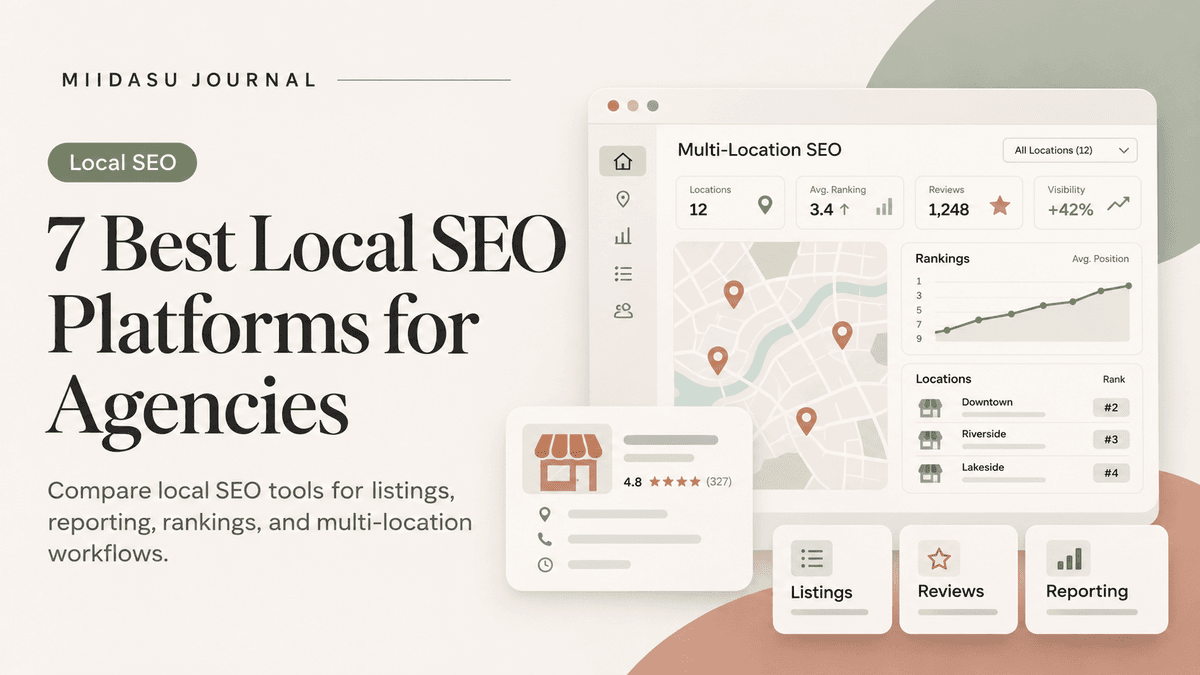
BrightLocal is particularly useful for agencies focused on local SEO audits and reporting. Synup is worth evaluating for recurring listings, reputation management, and multi-client workflows. Semrush Local connects local visibility tools with a broader SEO ecosystem, while Yext and SOCi address complex multi-location operations.
Managing local SEO across dozens or hundreds of locations requires more than keyword tracking. Agencies must maintain accurate business information, coordinate updates, monitor local search visibility, manage reviews, and deliver useful reports to clients.
The right platform depends on how many clients and locations an agency manages, which services it provides, its reporting requirements, and its operating budget.
This guide compares seven local SEO platforms, explains their strengths and limitations, and provides a practical framework for choosing software that supports a growing agency portfolio.
What Are the Best Local SEO Platforms for Agencies?
The following platforms address different parts of multi-location local SEO management.
| Platform | Best suited for | Main advantage |
|---|---|---|
| BrightLocal | Local SEO audits and client reporting | Local rank tracking, citation auditing, and agency reports |
| Synup | Multi-location listings and reputation workflows | Centralized listing operations and multi-client management |
| Semrush Local | Agencies combining local and organic SEO | Local visibility tools within the wider Semrush ecosystem |
| Yext | Enterprise location data management | Structured location data and publisher integrations |
| Moz Local | Listing management and monitoring | Ongoing listing synchronization and location marketing tools |
| Whitespark | Citation building and local search research | Specialist citation, ranking, and Google Business Profile tools |
| SOCi | Distributed franchise and enterprise marketing | Coordinated local search, social media, and reputation workflows |
Our recommendation: Agencies primarily selling local SEO audits and reporting should start by evaluating BrightLocal. Agencies responsible for recurring listing updates and review management should shortlist Synup.
Enterprise-focused agencies should compare Yext and SOCi, while Whitespark deserves consideration when citation research and local ranking analysis are core services.
These are use-case recommendations based on publicly documented capabilities, not results from independent hands-on testing or proof that any platform will generate better rankings.
How We Evaluated These Local SEO Platforms
This comparison focuses on how effectively each platform supports agency operations rather than simply counting available features.
We used seven evaluation criteria:
- Listing management: Support for maintaining business information across directories, mapping services, and other relevant publishers.
- Multi-location scalability: Ability to organize numerous clients and locations, perform bulk updates, and manage account access.
- Local SEO analytics: Availability of keyword rankings, geo-grid analysis, listing audits, and visibility reporting.
- Reputation management: Review monitoring, response workflows, reporting, and related automation.
- Agency functionality: Client account separation, permissions, branded reporting, and reseller capabilities.
- Pricing and scalability: Transparency around subscriptions, location counts, usage limits, and additional costs.
- Operational flexibility: Compatibility with client approvals, ownership requirements, existing software, and agency processes.
The review draws on official vendor websites, product documentation, published pricing information, and Google Business Profile guidance.
It does not claim that the products were independently tested, that their performance was benchmarked under identical conditions, or that any ranking improvements were independently verified.
Platform capabilities, publisher networks, geographical availability, and pricing can vary by subscription or contract. Agencies should confirm those details directly with each vendor before purchasing.
Local SEO Software Comparison: Features, Limitations, and Pricing
Before examining each platform, it helps to distinguish local listing management software from broader local SEO software.
Listing management tools focus on creating, updating, distributing, and monitoring business information across supported publishers.
Broader local SEO platforms may also provide keyword research, geo-grid rank tracking, Google Business Profile audits, review management, competitor analysis, and client reporting.
Some platforms cover both categories, but they do not offer identical functionality.
| Platform | Core strength | Main consideration | Pricing model |
|---|---|---|---|
| BrightLocal | Audits, rankings, citations, reporting | Listings and reputation features depend on plans; citation building is separately charged | Published subscriptions and add-ons |
| Synup | Listings, reviews, multi-client operations | Verify publisher coverage, workflows, and included automation | Published plan options and sales arrangements |
| Semrush Local | Maps visibility and GBP management | Local features and broader SEO subscriptions have different packages | Published per-location tiers |
| Yext | Structured location data and publisher synchronization | Enterprise scope, implementation, and contract terms | Product and contract-dependent |
| Moz Local | Listings and location marketing | Geographic eligibility and plan-dependent features | Per-location subscriptions |
| Whitespark | Citation research and specialized local SEO tools | Tools and services are purchased separately | Product-specific subscriptions and services |
| SOCi | Enterprise local marketing coordination | Enterprise onboarding, governance, and product scope | Sales-led pricing |
Agencies should evaluate the capabilities they need to deliver contracted services, not simply purchase the software with the broadest feature list.
Best Local SEO Platforms for Agencies Managing Multi-Location Clients
1. BrightLocal — Best for Local SEO Reporting and Audits
Best for: Agencies offering local SEO audits, keyword tracking, citation analysis, Google Business Profile reviews, and client-facing performance reports.
BrightLocal is a specialized local SEO platform that helps agencies monitor and improve clients' local search presence.
Its tools cover geographic ranking analysis, local search audits, citation monitoring, Google Business Profile evaluation, and reporting.
For example, an agency managing 40 dental clinic locations could use BrightLocal to monitor ranking differences across neighborhoods, identify inconsistent business information, and prepare reports showing which clinics require additional optimization.
The platform is particularly useful when agencies need to explain location-level performance rather than provide a single ranking figure for an entire client.
Key capabilities
- Local Search Grid for geographic Google Maps ranking analysis.
- Local Rank Tracker for monitoring location-specific keywords.
- Citation Tracker and pay-as-you-go Citation Builder services.
- Google Business Profile and local search audits.
- White-label reporting and agency-oriented tools.
- Listing synchronization and reputation tools on applicable plans.
Strengths
BrightLocal combines diagnostic local SEO tools with client reporting capabilities.
Its geographic ranking reports help agencies identify how visibility changes across different parts of a service area.
Its citation-building service also provides flexibility for agencies that prefer one-time citation projects rather than relying entirely on an ongoing subscription.
The platform supports agencies that need to demonstrate work completed and identify specific optimization opportunities.
Limitations
Not every BrightLocal plan includes listing synchronization or review management.
Its Track plan focuses on visibility monitoring and auditing. Manage adds listing management, while Grow includes additional reputation features.
Citation Builder is separately charged.
Agencies managing large enterprises with complex approvals and location-data governance should verify whether the available administration and workflow features meet their requirements.
Pricing
BrightLocal publishes Track, Manage, and Grow subscription options.
As listed on its pricing page in November 2026, the one-location annual-billing examples are approximately $31, $40, and $49 per month, respectively. Prices change with location counts, billing terms, and selected services.
Citation Builder uses separate pay-as-you-go pricing.
Choose BrightLocal if: Your agency prioritizes local SEO audits, geographic rank tracking, citation analysis, and clear client reports.
2. Synup — Best for Centralized Multi-Location Listings and Reputation Management
Best for: Agencies managing recurring business listing updates, customer reviews, and location-level marketing operations across multiple clients.
Synup is a local marketing platform that provides centralized tools for business listings, reviews, location visibility, and agency management.
Its offering includes multi-client organization, location data synchronization, review management, and branded client-facing workflows.
Synup's published product materials also describe tools for local search monitoring, social publishing, reporting, and AI-assisted marketing operations.
These capabilities make it relevant to agencies serving franchises, retailers, hospitality brands, healthcare organizations, and other businesses with substantial location portfolios.
Consider an agency managing 75 franchise outlets.
When a client changes holiday operating hours, its team can coordinate supported listing updates from a centralized location database rather than editing every publisher individually.
The agency can then review synchronization issues and monitor which locations require additional attention.
Key capabilities
- Centralized business listing and location management.
- Bulk updates across supported publishers.
- Location-level listing health and synchronization monitoring.
- Review monitoring, response, and reputation workflows.
- Multi-client management and branded client reporting.
- White-label client portals and team permissions.
- Additional local marketing and automation capabilities.
Strengths
Synup brings several recurring local marketing activities into one environment.
Its agency-oriented features can help separate client portfolios, manage permissions, and coordinate ongoing listing maintenance.
The combination of location information, review activity, and reporting may reduce the need for separate operational tools.
Its value is strongest when an agency is responsible for maintaining an ongoing local presence rather than delivering occasional audits alone.
Limitations
Agencies should verify which publishers are supported in their clients' countries and whether updates are available for all required business fields.
They should also confirm which automation, reporting, branding, and user-access features are included in the proposed subscription.
While Synup includes local visibility functionality, agencies with extensive organic keyword research, technical site auditing, or backlink analysis requirements may still need complementary SEO software.
Pricing
Synup publishes location-oriented plans and offers sales arrangements for agencies and larger portfolios.
Because packaging, usage allowances, and automation capabilities can affect the overall cost, agencies should obtain an itemized quote based on their client and location counts.
Choose Synup if: Your agency needs centralized listing management, reputation workflows, and repeatable operations across multiple client accounts.
3. Semrush Local — Best for Agencies Combining Local and Organic SEO
Best for: Agencies that already use Semrush for broader SEO research and want to coordinate local visibility alongside organic search campaigns.
Semrush Local provides tools for managing Google Business Profiles, tracking geographic rankings, monitoring reviews, and maintaining local business information.
Its main advantage is its relationship with the wider Semrush SEO ecosystem.
Agencies already using Semrush for keyword research, technical SEO, competitor analysis, and performance reporting can evaluate local visibility alongside those broader activities.
For example, an agency managing several home-service businesses may use broader SEO tools to identify organic keyword opportunities while using Map Rank Tracker to monitor Google Maps rankings from different search locations.
These are complementary forms of analysis, not identical ranking measurements.
Key capabilities
- Google Business Profile auditing and management.
- Map Rank Tracker with geographic ranking grids.
- Listing Management on applicable plans.
- Review monitoring and management features.
- Automated GBP content capabilities.
- Access to broader Semrush research and reporting tools through relevant products or subscriptions.
Strengths
Semrush Local provides a practical option for agencies already familiar with Semrush.
Its Map Rank Tracker helps teams understand how Google Maps visibility changes across a geographic area.
Combining local search analysis with broader organic SEO research can help agencies coordinate content, website optimization, and location-level campaigns.
Limitations
Semrush Local is not equivalent to a full subscription to every Semrush SEO product.
Its Local Base and Pro tiers include different features.
For example, Listing Management is included in Pro rather than Base under the published November 2026 plan structure.
Map Rank Tracker also uses credits, so agencies should calculate their expected keyword, grid, and reporting frequency requirements before purchasing.
Additional reporting or user features may increase the cost.
Pricing
Semrush currently publishes Local Base at $30 per month per location and Local Pro at $60 per month per location when billed annually. Its Business tier uses sales-led pricing.
These are published reference prices, not individualized quotes.
Choose Semrush Local if: Your agency wants local visibility tools while continuing to use Semrush for broader SEO research and analysis.
4. Yext — Best for Enterprise Location Data Management
Best for: Agencies supporting enterprise clients with complex location networks, structured business information, and centralized publishing requirements.
Yext focuses on managing structured business information and distributing it across supported digital platforms.
Its Listings offering connects centralized location data with a publisher network spanning search engines, maps, business directories, and other digital experiences.
For agencies working with large retailers, restaurant groups, or international organizations, this centralized approach can support more consistent management of business information across many locations.
Consider an enterprise client operating several hundred stores.
The business may need to update operating hours, store services, addresses, and temporary closures while maintaining coordination between corporate teams and individual locations.
Yext's location data management and publishing architecture is designed for workflows of this kind.
Key capabilities
- Centralized structured location information.
- Business listing management across supported publishers.
- Location data synchronization and accuracy monitoring.
- Enterprise account administration and governance capabilities.
- Additional digital experience and location marketing products.
Strengths
Yext is relevant when the main challenge is organizing and distributing accurate business information at scale.
Its publisher integrations and structured data model help organizations coordinate complex location portfolios.
The platform can also support digital experiences beyond basic directory listing management, depending on the products selected.
Limitations
Agencies should not assume that every publisher supports every field, geographic market, or update method.
Yext's documentation notes that publisher capabilities and the availability of accuracy verification differ.
Enterprise implementation may also require coordination with client IT, marketing, operations, and compliance teams.
Smaller agencies should assess whether the platform's scope and contracting requirements are proportionate to their needs.
Pricing
Yext's enterprise pricing depends on the products, location count, service scope, and contractual arrangement.
Agencies should request an itemized proposal covering required modules, supported markets, onboarding, and ongoing charges.
Choose Yext if: Your agency supports large location portfolios requiring centralized business information, publisher distribution, and strong data governance.
5. Moz Local — Best for Streamlined Listings Management
Best for: Agencies seeking ongoing business listing synchronization and practical location marketing workflows.
Moz Local provides local listing management and related location marketing features.
Its documentation describes automated listing distribution, ongoing synchronization, review management, local ranking functionality, and social publishing capabilities.
The platform allows businesses to maintain a centralized record of location information and distribute supported changes through its publishing network.
For example, an agency managing 20 independent retail stores could use a listing management system to maintain contact details and operating hours while identifying incomplete profiles or other issues requiring attention.
Moz Local may be suitable when repeatable location information management is more important than extensive enterprise workflow customization.
Key capabilities
- Business listing distribution and synchronization.
- Centralized location information management.
- Listing consistency monitoring.
- Review and reputation management on applicable plans.
- Local reporting and ranking capabilities.
- Social publishing features under supported subscriptions.
Strengths
Moz Local combines recurring listing maintenance with additional local marketing activities.
Its per-location subscription structure can help agencies organize costs around managed locations.
The platform is worth comparing when a client needs ongoing business information maintenance rather than extensive enterprise marketing coordination.
Limitations
Moz Local's published documentation identifies the United States, Canada, and the United Kingdom as supported markets. Agencies managing businesses elsewhere should verify geographical availability before considering it.
Feature availability also differs by subscription tier.
Moz Local and Moz Pro are separate products, so a Moz Local subscription should not be assumed to include the full Moz Pro SEO research toolset.
Agencies needing highly customized integrations or extensive citation outreach may require additional services.
Pricing
Moz Local uses location-based subscription plans with monthly and annual billing arrangements.
Costs depend on the selected tier, number of locations, and required functionality.
Confirm current pricing, supported markets, and included features directly with Moz.
Choose Moz Local if: Your agency needs ongoing listings synchronization, review-related workflows, and location monitoring in a supported market.
6. Whitespark — Best for Citation Building and Local Search Research
Best for: Agencies specializing in citation research, Google Business Profile optimization, local ranking analysis, and targeted listing improvement.
Whitespark provides specialist local SEO software and services, including citation discovery, local ranking tools, Google Business Profile management, and reputation-related products.
Unlike platforms that bundle most capabilities into one subscription, Whitespark sells many of its tools and services individually.
This makes it suitable for agencies that want to select specific products for particular client requirements.
For example, an agency launching local SEO campaigns for a restaurant group could use Local Citation Finder to identify relevant citation opportunities and Local Rank Tracker to monitor visibility over time.
It could separately purchase listing cleanup or citation-building services where required.
Key capabilities
- Local Citation Finder for identifying citation opportunities.
- Local Rank Tracker for monitoring search visibility.
- Local Ranking Grids for geographic rankings.
- Local Platform for Google Business Profile management.
- Listings and citation-building services.
- Separate reputation management tools.
Strengths
Whitespark's modular structure allows agencies to purchase specific capabilities without automatically paying for an extensive bundled platform.
Its specialist citation and local ranking tools are relevant to agencies delivering technical local SEO analysis and targeted improvement projects.
Its separate services also provide an option for outsourcing selected listing tasks.
Limitations
Whitespark should not be treated as a single bundled agency management suite.
An agency may need several Whitespark subscriptions or services to cover ranking research, citations, GBP management, and reputation workflows.
This can increase the complexity of budgeting and reporting.
Agencies that require one unified interface for every client activity should compare that requirement with the available products.
Pricing
Whitespark publishes product-specific pricing.
As of November 2026, its pricing page lists Local Ranking Grids starting at $10 per month, Local Rank Tracker plans ranging from $14 to $200 per month, and Local Citation Finder plans ranging from $33 to $149 per month.
Its citation and listing services have separate charges.
Choose Whitespark if: Your agency delivers citation research, local rank tracking, and specialized local SEO projects rather than relying exclusively on a single integrated marketing platform.
7. SOCi — Best for Distributed Franchise Marketing
Best for: Agencies managing complex franchise organizations and multi-location marketing programs spanning listings, local search, reputation, and social media.
SOCi is a multi-location marketing platform focused on coordinated brand visibility and local marketing execution.
Its platform combines location data, reporting, governance, and automation across local search, social media, and reputation workflows.
SOCi's current product positioning also includes AI-assisted agents that perform selected local marketing tasks within brand-defined rules and approval processes.
For agencies working with large franchise networks, this approach is relevant when local marketing involves more than maintaining accurate directory listings.
Consider a national fitness franchise.
Corporate marketing teams may need consistent messaging across all locations while individual clubs require location-specific content, review responses, and local profile updates.
A distributed marketing system can help coordinate these activities while maintaining central oversight.
Key capabilities
- Multi-location business listing and local search management.
- Reputation monitoring and review workflows.
- Localized social media publishing and engagement.
- Centralized brand governance and reporting.
- Location-specific marketing automation.
- AI-assisted workflows with configurable oversight.
Strengths
SOCi brings several functions of distributed local marketing into a coordinated environment.
It is relevant to organizations where corporate teams, franchisees, and local operators all participate in marketing activities.
Its governance and workflow capabilities can help organizations establish brand standards while supporting location-level execution.
Limitations
SOCi may be unnecessarily extensive for agencies whose work consists mainly of citation audits or a small number of listings.
Implementation can involve substantial planning around location data, access permissions, brand policies, and approval processes.
Agencies should also verify which AI-assisted activities can operate automatically, which require human approval, and how the system records completed actions.
Pricing
SOCi generally uses a sales-led approach for enterprise configurations.
Agencies should request pricing that specifies locations, product modules, implementation, support, and automation requirements.
Choose SOCi if: Your agency manages large franchise or enterprise clients requiring coordinated local search, reputation, and social marketing workflows.
How Should Agencies Choose the Right Local SEO Platform?
The most suitable local SEO software is the platform that supports the agency's delivery model without introducing unnecessary costs or operational complexity.
A useful evaluation should consider the following factors.
1. Evaluate the number of clients and locations
Managing ten locations for one company is different from managing ten locations for twenty unrelated clients.
Agencies serving multiple businesses need to examine client separation, location grouping, account permissions, and reporting access.
A platform designed for one enterprise brand may not provide the same workflow as software designed for agencies managing unrelated customers.
Ask vendors to demonstrate the platform using a realistic client structure.
For example, request a demonstration involving three client brands with different permissions and several locations each.
This is more informative than reviewing a generic product dashboard.
2. Prioritize listing accuracy and change management
Business information should be accurate, complete, and consistent with the client's real-world operations.
Google explains in its local ranking guidance that complete and accurate business information can help businesses appear in relevant local results.
However, local ranking depends on several factors, primarily relevance, distance, and prominence.
Listing accuracy alone does not guarantee a higher ranking.
Agencies should establish a master location record containing approved business names, addresses, contact details, categories, operating hours, and relevant website URLs.
The software should then support distribution, monitoring, and correction of that information across eligible platforms.
For a deeper explanation of location data maintenance, see Miidasu's multi-location listings management guide.
3. Compare local SEO reporting capabilities
Agency reporting should connect completed work to meaningful performance indicators.
Useful measures include listing completeness, unresolved errors, geographic search visibility, Google Business Profile interactions, reviews, website engagement, and conversions.
Reporting should also explain what changed and which actions follow.
For example, an agency could report that a location's Google Maps visibility improved across several geographic grid points after profile and website updates.
However, the report should not automatically claim that those changes caused additional revenue without appropriate attribution evidence.
4. Confirm publisher coverage and geographical eligibility
A platform may support major publishers in one country but provide different coverage in another.
Before choosing software, confirm that it supports the client's most important platforms, including relevant mapping services, local directories, navigation systems, and industry-specific publishers.
Also verify what the platform can actually update.
A publisher integration does not necessarily permit automatic changes to every location field.
5. Assess agency permissions and client control
Agencies need suitable access controls for their own staff and clients.
Check whether the platform supports individual accounts, restricted permissions, approval workflows, and secure account transfers.
Client ownership is particularly important for Google Business Profiles.
Google's third-party policies require end clients to retain ownership or co-ownership of their Business Profiles.
Google generally recommends that business owners retain ownership and authorize agencies through manager access.
Agencies should also establish procedures for account handovers, contract termination, and removal of permissions.
6. Calculate the complete operating cost
Software pricing can depend on the number of locations, selected features, users, usage allowances, additional integrations, and services.
Agencies should calculate the full cost of delivering client work rather than focusing only on the advertised monthly subscription.
A practical comparison includes software subscriptions, citation submissions, map ranking credits, report generation, onboarding, account management time, and any contracted support.
The lowest-priced subscription may not be the least expensive option to operate.
7. Test the workflow before committing
A useful product demonstration should show how the platform performs the tasks the agency regularly completes.
Ask the vendor to demonstrate bulk opening-hour updates, failed synchronization handling, duplicate-listing workflows, review escalation, client reporting, and account handovers.
Pay particular attention to tasks that still require manual intervention.
Automation can reduce repetitive work, but agencies remain responsible for the accuracy of submitted information and compliance with publisher policies.
How Much Does Multi-Location Local SEO Software Cost?
Local SEO software does not follow one universal pricing model.
Some providers charge per location. Others offer subscriptions based on tracking features, individual tools, or negotiated enterprise contracts.
Agencies should calculate their expected annual costs before making a purchasing decision.
Example: Comparing software costs for 25 locations
Assume an agency manages 25 locations across five clients.
It needs business listing management, review monitoring, local rank tracking, and monthly reporting.
The following is an illustrative budgeting framework, not a vendor quote.
| Cost category | What to investigate |
|---|---|
| Platform subscription | Base fee and per-location charges |
| Local ranking reports | Keyword limits, geo-grid credits, and reporting frequency |
| Listing distribution | Supported publishers and any separate synchronization charges |
| Citation building | One-time submission or cleanup costs |
| Reputation management | Review monitoring, responses, and additional account charges |
| Reporting | White-label access, automated reports, and export limits |
| Team access | Additional users, permissions, or client seats |
| Implementation | Setup, training, data migration, and integrations |
Total annual operating cost = Software subscriptions + Add-ons + External services + Implementation costs + Internal labor costs
For example, a platform charging $30 per location per month would cost $750 per month, or $9,000 annually, for 25 locations before additional charges.
That calculation is illustrative; it is not a quote attributed to any vendor.
An agency should also estimate how much manual work the software will eliminate.
A more expensive system may still be cost-effective if it meaningfully reduces repetitive work, failed updates, and client reporting time.
Conversely, a smaller agency may be better served by a focused combination of tools rather than an enterprise platform with many unused capabilities.
Which Local SEO Platform Is Best for Different Agency Use Cases?
Different agency service models require different combinations of local SEO tools.
| Agency situation | Platforms to shortlist | Reason |
|---|---|---|
| Small agency focused on reporting | BrightLocal, Whitespark | Local audits, rankings, and citations |
| Agency delivering ongoing listing services | Synup, Moz Local | Listing maintenance and location operations |
| Full-service SEO agency | Semrush Local, BrightLocal | Local visibility analysis and SEO workflows |
| Large retail or enterprise client | Yext, SOCi | Data governance and coordinated location management |
| Franchise reputation management | Synup, SOCi | Review workflows and distributed operations |
| Citation-focused project work | Whitespark, BrightLocal | Citation research and submission services |
These shortlists are starting points, not exclusive recommendations.
A growing agency may use more than one platform.
For example, it might use Synup for ongoing listings and reputation management while using BrightLocal or Whitespark for additional geographic ranking analysis.
Such combinations can make sense when the tools complement one another and the agency can manage their combined cost and reporting requirements.
Best Practices for Managing Multi-Location Local SEO Campaigns
Software cannot replace accurate client information, clear responsibilities, and consistent execution.
An effective local SEO workflow should establish which information is authoritative, who approves changes, and how results are evaluated.
Maintain a centralized location database
Every client location should have an approved record containing its business name, address, phone number, website, categories, hours, and operating status.
Depending on the business, the record may also include service areas, specific services, location pages, accessibility details, and special operating hours.
Use the approved data as the reference point before updating external platforms.
Google's guidelines for representing a business require accurate representation and provide specific rules for business names, locations, categories, chains, departments, and individual practitioners.
Do not create additional Google Business Profiles merely to target more keywords or geographic areas.
Establish a regular audit schedule
Agencies should review high-priority profiles regularly and investigate critical errors as they occur.
A practical operating schedule could include monthly checks of major platforms and quarterly reviews of the broader location portfolio.
Additional checks are useful after openings, closures, relocations, rebrands, ownership changes, or substantial operating-hour updates.
The appropriate frequency depends on how often the client's business information changes.
Optimize individual location pages
Each eligible location should have a useful, relevant website page containing accurate information about that location.
Depending on the business, that can include contact details, opening hours, directions, relevant services, accessibility information, and location-specific customer guidance.
Avoid creating dozens of nearly identical pages that change only the city name.
A location page should help customers understand what is available at that particular business location.
Google's LocalBusiness structured data documentation explains how structured data can describe location information to search engines.
Structured data should accurately reflect visible page content. It does not guarantee higher rankings or search enhancements.
Monitor and respond to reviews appropriately
Review management should include timely monitoring, useful responses, and procedures for escalating sensitive complaints.
Agencies should follow each review platform's content and solicitation policies.
They should not publish fabricated reviews, encourage selective positive feedback, or imply that review management guarantees higher rankings.
For healthcare, financial services, and other regulated industries, review responses may also require additional confidentiality and compliance safeguards.
Measure local visibility and business outcomes
Local rankings provide useful information, but agencies should report more than ranking changes.
Relevant performance indicators can include:
- Google Business Profile interactions.
- Search visibility by location and geographic area.
- Relevant website visits.
- Calls, direction requests, and booking actions.
- Review volume and response activity.
- Form submissions and other meaningful conversions.
- Progress toward location-specific campaign objectives.
Google Analytics 4 provides event-based measurement that can help organizations track relevant website and app interactions.
However, agencies should distinguish measurable customer actions from revenue that cannot be reliably attributed to local SEO.
Report findings and corrective actions
A useful monthly client report should explain what changed, which problems remain, and what the agency plans to do next.
For example:
During the reporting period, the team corrected outdated hours across supported listings, reviewed duplicate-profile issues, and identified three locations with declining geographic search visibility. The next priority is to investigate those locations' profiles, websites, and local competition.
This is more useful than a report consisting only of completed tasks and keyword ranking charts.
Frequently Asked Questions
What is the best local SEO platform for agencies managing multiple locations?
The most suitable platform depends on the agency's services and client portfolio. BrightLocal is worth considering for audits and reporting, while Synup supports recurring listings and reputation workflows. Yext and SOCi address complex multi-location operations, and Whitespark offers specialist citation and ranking tools.
What is the difference between local SEO tools and listing management software?
Local SEO tools may include keyword tracking, competitor research, citation analysis, Google Business Profile audits, and reporting. Listing management software focuses on maintaining accurate business information across supported publishers.
Some platforms combine both functions, but their capabilities and subscription requirements differ.
Can one local SEO platform manage multiple clients?
Yes, several platforms provide agency-oriented or multi-client management capabilities.
However, supporting numerous locations within one brand is different from maintaining independent client accounts. Agencies should verify client separation, access controls, reporting permissions, and billing before purchasing.
How much does local SEO software cost for agencies?
Costs depend on the platform, location count, subscription tier, usage limits, and additional services.
Some vendors publish monthly or annual subscriptions, while enterprise providers may require custom quotes.
Agencies should calculate the total operating cost using their actual client portfolio and expected workflow.
Which local SEO platform is suitable for franchise businesses?
Synup, Yext, and SOCi are relevant options for franchise operations, although their strengths differ.
Synup combines listings and reputation workflows, Yext emphasizes structured business information and publisher distribution, and SOCi supports broader distributed marketing.
The right option depends on how much control franchise headquarters requires and which activities individual franchisees can manage.
Can local SEO platforms guarantee higher Google Maps rankings?
No.
Local SEO software can help maintain accurate listings, identify improvement opportunities, and monitor performance, but it cannot guarantee higher Google Maps rankings.
Google's official local ranking guidance identifies relevance, distance, and prominence as the main considerations for local results.
Final Verdict
Choosing the right local SEO platform for agencies managing multi-location clients requires balancing location management, reporting, automation, client permissions, and cost.
BrightLocal is a practical starting point for agencies whose primary deliverables are local SEO audits, ranking analysis, citations, and client reporting.
Synup deserves consideration when the work centers on recurring listing updates, reputation management, and coordinating many client locations from one operational environment.
Semrush Local is relevant to agencies combining local visibility work with broader SEO research.
Yext and SOCi are worth evaluating for enterprise or franchise clients with complex location networks and governance requirements.
Moz Local offers a listings-focused option in its supported markets, while Whitespark provides specialist citation and local ranking tools that can complement other platforms.
Before committing to any product, request a realistic demonstration, verify plan-specific features, calculate the total cost across your expected location portfolio, and confirm how client data and account ownership are handled.
The most valuable local SEO platform is not necessarily the one with the most features. It is the one that helps an agency maintain accurate business information, reduce repetitive work, and deliver useful results to clients without unnecessary complexity.