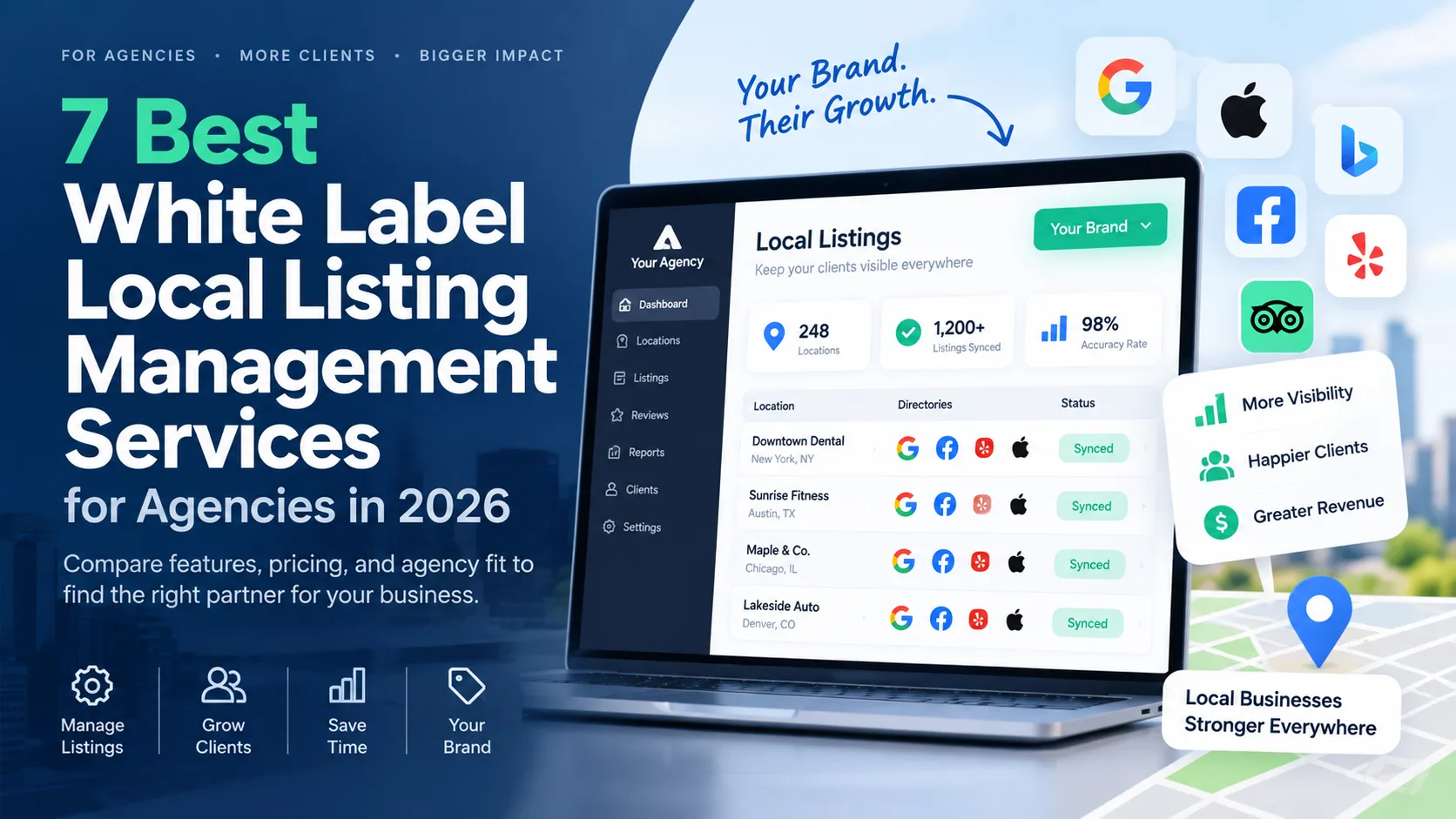
White label local listing management services let agencies manage and resell business listings under their own brand without building their own directory distribution infrastructure. In 2026, the strongest options include Synup, Yext, Uberall, Vendasta, BrightLocal, Merchynt, and managed-service providers such as Accurate Local.
Choosing between them takes more than comparing directory counts. Agencies need to look at branding, client separation, permissions, bulk updates, reporting, duplicate handling, verification workflows, publisher connections, APIs, fulfillment requirements, and pricing.
That operational fit becomes increasingly important as you move from a handful of SMB clients to hundreds or thousands of locations.
Key Takeaways
- Synup is particularly relevant to agencies that want listings management combined with a branded client experience and multi-client operations.
- Yext supports 200+ direct integrations and has a reseller program with white-label options, making it relevant to agencies handling larger and more complex location portfolios.
- Uberall supports 150+ platforms and explicitly offers white-label solutions through its reseller and agency partner programs.
- BrightLocal takes a different approach, combining local SEO software with manual citation-building services and white-label reporting.
- Agencies should distinguish between white-label software and white-label fulfillment. The first gives your team tools; the second moves some or most of the listings work to another provider.
- Google recommends location groups for organizations managing many Business Profiles and specifically supports third-party agency access rather than shared login credentials.
Quick Comparison Table
| Platform | Best fit | White-label capability | Listings model | Agency model | Pricing approach |
|---|---|---|---|---|---|
| Synup | Agencies wanting branded multi-client software | Client-facing white labeling | Publisher synchronization | Software | Published tiers plus custom enterprise pricing |
| Yext | Enterprise and high-volume agencies | Reseller white-label options | 200+ direct integrations | Software | Partner/custom pricing |
| Uberall | Multi-location agencies and resellers | White-label agency/reseller program | 150+ platforms | Software | Quote-based |
| Vendasta | Agencies reselling several SMB services | White-label client experience | Listings within broader local SEO suite | Software + services | Varies by product |
| BrightLocal | Local SEO agencies and citation campaigns | White-label reporting | Citation building + synchronization | Software + fulfillment | Subscription and usage-based |
| Merchynt | SMB-focused local SEO agencies | Branded agency offering | Listings plus GBP/local SEO automation | Software | Subscription/add-ons |
| Accurate Local | Agencies wanting listings work outsourced | White-label reporting/service | Hands-on listings management | Managed service | Custom quote |
Product capabilities and pricing should always be confirmed with the provider before purchase because agency programs, publisher connections, and plan inclusions can change.
What Are White Label Local Listing Management Services?
White label local listing management services allow an agency to manage client business information across search engines, maps, directories, social networks, navigation services, and other local discovery platforms while presenting the service under the agency's own brand.
The underlying problem is straightforward. Businesses need accurate information wherever customers search for them.
Google, for example, instructs businesses to represent themselves consistently, use accurate addresses or service areas, choose appropriate categories, and generally maintain only one Business Profile per business location. Its guidelines also require consistent naming and categories for chains when the real-world business information is consistent.
Google's Guidelines for Representing Your Business
For an agency managing 300 client locations, maintaining that information manually can become difficult. Hours change. Locations move. Phone numbers get replaced. New stores open. Old profiles remain online. Clients add managers, and publishers may contain conflicting information.
Listing management platforms centralize much of that work.
White labeling adds another layer. Instead of exposing the underlying software provider to your client, you may be able to apply your own branding to reports, dashboards, domains, emails, or other client-facing surfaces.
The exact meaning of "white label" varies considerably between providers.
White-Label Software vs Managed Fulfillment
Before comparing platforms, decide which service you actually want to buy.
With white-label software, your team operates the platform. You import clients and locations, connect profiles, submit changes, monitor synchronization, investigate errors, and respond when clients need help.
With managed fulfillment, another company performs some or most of those tasks behind your agency's brand.
A third option combines the two.
This distinction affects staffing and margins. A low software fee may still result in significant operational costs if your employees spend hours every week chasing verification requests, cleaning duplicates, fixing disconnected accounts, and communicating with clients.
Agency access should also be structured correctly.
Google specifically allows third-party agencies to manage client locations. Its documentation says existing clients can add an agency account as a manager to individual locations or location groups. Google recommends location groups when organizations manage large sets of locations instead of sharing usernames and passwords.
Google's Guidance for Managing Locations at Scale
That makes permissions and account ownership worth evaluating alongside ordinary software features.
Best White Label Local Listing Management Platforms in 2026
1. Synup
Best for: Agencies and resellers that want multi-client listings management with a branded client experience.
Synup is built around local listings and related local marketing workflows. For agencies, the important distinction is that its white-label capabilities extend beyond putting an agency logo on a downloadable report.
Its agency offering supports centralized management of multiple client accounts and locations, while its listings product connects business information with major discovery platforms and publishers.
For agencies exposing software directly to clients, this can be useful. The platform can sit closer to the agency's own service rather than appearing as an unrelated third-party product.
The listings side includes centralized business information, publisher synchronization, monitoring, bulk operations, and support for major platforms such as Google Business Profile, Apple, Bing, Facebook, and other local discovery sources.
Strengths: Synup combines agency-oriented account management with listings, reporting, and client-facing branding. This makes it suitable for agencies selling an ongoing listings product rather than occasional citation cleanup.
Limitations: Agencies should confirm which publisher connections, API features, branding controls, and support options apply to their intended plan. Larger portfolios move toward custom commercial arrangements.
Pricing: Synup publishes plans for smaller and midsize portfolios, while enterprise requirements are handled separately.
Assessment: Synup is particularly relevant when your agency wants listings management to feel like part of its own service and needs to administer multiple client portfolios centrally.
2. Yext
Best for: Agencies and resellers supporting large, complex, or enterprise location portfolios.
Yext's approach centers heavily on direct publisher distribution. Its current Listings materials state that it has 200+ direct integrations and supports centralized management of location information, publisher synchronization, audit trails, role-based access, duplicate detection, and analytics.
The reseller program is particularly relevant for this comparison. Yext says reseller partners can manage multiple clients or locations from one login and provides APIs, automation, onboarding support, and white-label options.
That gives Yext a different agency profile from tools primarily designed for smaller citation campaigns.
An agency servicing a national retailer, financial-services organization, healthcare network, or large franchise system may need approval workflows, structured data controls, audit history, permissions, and large-scale publisher distribution.
Strengths: Direct publisher integrations, mature multi-location infrastructure, APIs, reseller support, and enterprise governance.
Limitations: Reseller pricing isn't presented as a simple public per-location package. Agencies need to speak with Yext to determine their actual cost structure and margin.
Pricing: Custom reseller or partner pricing.
Assessment: Yext is most relevant when publisher distribution, governance, integrations, and high location counts carry more weight than simple self-service pricing.
3. Uberall
Best for: Agencies and resellers serving larger multi-location brands.
Uberall currently states that its listings product supports 150+ platforms, including Google, Apple Maps, Bing, Facebook, navigation services, and other discovery platforms. It supports centralized updates and bulk management across multiple locations.
Its partner program is one of the clearest reasons to include Uberall in an agency-specific comparison.
Uberall explicitly identifies separate reseller and agency tracks. Resellers can white-label Uberall solutions, while agencies can add Uberall's white-labeled products to their own service portfolios. Technology partners can integrate through APIs.
The listings platform also supports bulk edits. Uberall says agencies and brands can update multiple locations using spreadsheets or APIs, which becomes important once a client portfolio reaches hundreds or thousands of locations.
Strengths: Clear white-label partner model, 150+ supported platforms, bulk workflows, and strong alignment with multi-location operations.
Limitations: Pricing isn't published as a straightforward agency rate card. Agencies also need to determine which functionality is included in their proposed package rather than assuming every Uberall capability comes with listings.
Pricing: Quote-based.
Assessment: Uberall is worth evaluating when your agency manages sophisticated multi-location clients and wants listings within a wider local marketing platform.
4. Vendasta
Best for: Agencies that want to resell listings alongside other digital marketing software and services.
Vendasta's model differs from specialist listings platforms. Its broader focus is giving agencies a white-label environment through which they can sell multiple products and services to SMB clients.
That can include local SEO and listings alongside reputation management, social tools, websites, CRM capabilities, and other services.
This approach makes sense for agencies that think of listings as one product in a broader catalog.
For example, an agency might package business listings, review management, social publishing, and website services into one monthly subscription rather than selling listing synchronization independently.
Strengths: The broader reseller infrastructure makes it easier to package listings with additional agency products. Vendasta also offers service options for agencies that don't want to fulfill every marketing task internally.
Limitations: Agencies buying only listings may find the broader platform more extensive than they need. Publisher coverage and fulfillment can also vary according to the specific listing product or package selected.
Pricing: Depends on the platform package and individual products being resold.
Assessment: Vendasta makes the most sense when your objective is building a broader white-label marketing catalog rather than selecting a specialist listings platform alone.
5. BrightLocal
Best for: Local SEO agencies that want citation building, reporting, and local SEO tools with flexible fulfillment.
BrightLocal approaches listings differently from large direct-distribution networks.
Its Citation Builder service focuses on creating and updating business citations, while its broader platform provides local SEO auditing, rank tracking, Google Business Profile tools, reporting, and related agency functionality.
This can work well for agencies that don't want every client locked into the same recurring listings product.
A small local SEO agency might, for example, order citation cleanup for a new client during onboarding, run local rank tracking continuously, and use additional listing synchronization only where it makes operational sense.
White-label reporting also lets agencies present local SEO reports under their own identity.
Strengths: Flexible citation fulfillment, agency reporting, local SEO tooling, and a model that works well for project-based citation campaigns.
Limitations: Citation building and always-on publisher synchronization are different services. Agencies expecting a single large real-time publisher network should compare the delivery model carefully with Synup, Yext, or Uberall.
Pricing: BrightLocal combines subscription pricing with separate charges for some citation and listings services.
Assessment: BrightLocal is especially relevant when citations are part of a wider local SEO engagement rather than the agency's entire product.
6. Merchynt
Best for: Smaller agencies selling automated local SEO services to SMB clients.
Merchynt combines Google Business Profile-oriented local SEO automation with agency branding and citation management.
Its white-label positioning makes it particularly relevant to agencies that want clients interacting with a branded product rather than simply receiving a report every month.
The model is aimed more heavily at SMB local SEO than enterprise location-data administration. That distinction is important.
An agency serving independent dentists, plumbers, restaurants, or professional-services businesses may value automated GBP work and client-facing branding more than sophisticated enterprise approval structures.
Strengths: Agency branding, local SEO automation, and citation management can be packaged together for SMB clients.
Limitations: Agencies managing large enterprise portfolios should compare its publisher network, permissions, data governance, and bulk operations against platforms built specifically for high-volume multi-location deployments.
Pricing: Subscription-based, with listings or citation functionality available as additional services depending on the agency arrangement.
Assessment: Merchynt is worth considering when your agency primarily serves SMBs and wants to combine listings with automated local SEO delivery.
7. Accurate Local
Best for: Agencies that want people handling listings work behind the scenes rather than another platform for their staff to operate.
Accurate Local is different from most of the software providers in this comparison because the primary value is managed fulfillment.
That model can cover work such as finding existing listings, correcting business information, dealing with duplicates, supporting verification, updating profiles, and producing branded reports.
For agencies, this addresses a staffing problem.
Listing management isn't always difficult because the software lacks a button. The difficult cases are often exceptions: an old owner controls the profile, a location has duplicates, Google requests verification, the business moves, or information keeps reverting.
A managed service can take responsibility for more of those cases.
Strengths: Hands-on execution can reduce internal agency workload and remove the need to build a dedicated listings operations team.
Limitations: Agencies looking for extensive APIs, custom software integrations, or self-service enterprise workflows may prefer a platform-first provider.
Pricing: Custom quote.
Assessment: Accurate Local fits agencies that want to sell listing management without making their own employees responsible for every operational task.
Why Agency Access and Ownership Matter
White labeling shouldn't come at the expense of correct account ownership.
Google's policies for authorized representatives say agencies should keep business owners informed about actions taken on their profiles and should encourage owners to own their Business Profiles while adding representatives as managers. Google also states that authorized representatives should transfer ownership to the business owner upon request.
Google Business Profile Eligibility and Ownership Guidelines
That is a useful principle when designing your agency process.
Your agency may operate the listing management service, but clients should understand who owns their underlying profiles and what happens if the commercial relationship ends.
Before signing with a white-label provider, ask:
- Who owns the individual publisher profiles?
- What happens to listings after cancellation?
- Can the client retain Google Business Profile ownership?
- Can another agency take over later?
- Are directory credentials available where publishers support them?
- Does cancelling synchronization cause information to revert?
- How are users and permissions removed during offboarding?
These questions can be more important than cosmetic white labeling.
Synup vs Yext
Synup and Yext both address multi-location listing management, but they fit different agency buying situations.
Synup places substantial emphasis on agency workflows, multi-client administration, and white-label delivery. That makes it relevant to agencies that want clients interacting with a branded service.
Yext places greater emphasis on its direct publisher infrastructure. Its current materials state 200+ direct integrations, plus centralized controls, analytics, duplicate management, and enterprise workflows. Its reseller program includes white-label options.
An agency serving dozens of SMB clients may place more weight on straightforward packaging and branding.
An agency managing a national enterprise account may place more weight on integrations, governance, publisher connections, and operational controls.
The right comparison therefore isn't simply "which has more directories?" It is whether the platform fits the way your agency sells and fulfills listings management.
Synup vs Uberall
Synup and Uberall are closer competitors for agencies that want a client-facing listings platform.
Both support multi-location operations and agency or reseller use cases.
Uberall currently states coverage across 150+ platforms and explicitly offers white-label products through its agency and reseller partner program.
Synup's appeal lies in combining listings with multi-client agency operations and extensive branding options.
For an agency comparing them, focus on:
- the exact publishers required by your clients;
- client and location limits;
- user permissions;
- branding controls;
- API requirements;
- bulk updates;
- duplicate management;
- reporting;
- onboarding assistance;
- contract structure;
- cost per active client location.
A live pilot with several real locations will tell you more than comparing marketing feature lists.
How We Evaluated These Platforms
We evaluated these providers primarily for agency use rather than general local SEO functionality.
That means white-label capabilities, multi-client administration, bulk management, reseller workflows, reporting, permissions, APIs, fulfillment, and scalability carried significant weight.
Publisher coverage also matters, but raw directory totals need context.
A platform can count hundreds of publishers while an agency's clients receive most of their meaningful discovery traffic through a smaller group of major services. Conversely, niche directories can be valuable in industries where specialist citations matter.
We also considered whether the provider gives agencies a workable operating model.
A platform that works well for one brand managing 500 stores isn't automatically ideal for an agency managing 50 unrelated clients with ten locations each.
How to Choose the Right White Label Local Listing Management Service
Decide Whether You Need Software or Fulfillment
Start by identifying who will actually perform the work.
If your employees will manage profiles, investigate errors, communicate with clients, and maintain location information, software-first providers such as Synup, Yext, and Uberall make sense to evaluate.
If you want another company handling much of the operational work, managed or hybrid providers deserve more attention.
Calculate labor as part of the price.
Saving $200 per month on software isn't useful if your team spends ten additional hours resolving listing issues.
Check the Depth of White Labeling
"White label" can mean anything from changing a logo on a PDF to presenting an entire platform through your own domain.
Ask the vendor to demonstrate:
- login screens;
- dashboard branding;
- custom domains;
- reports;
- automated emails;
- sender addresses;
- audit tools;
- client notifications;
- help documentation;
- support interactions.
This matters if clients will use the platform themselves.
Check Major Publishers Before Counting Directories
Directory totals are useful, but verify the individual platforms your clients need.
For US agencies, this commonly includes Google, Apple, Bing, Facebook, Yelp, and relevant vertical or navigation platforms.
Google alone requires careful management because profiles can contain hours, categories, attributes, service areas, media, reviews, and other location information. Google's Business Profile APIs support programmatic management of location data and related functionality for approved users.
Google Business Profile API Documentation
If your agency expects to build custom workflows around listings, verify API availability before purchasing rather than assuming every platform exposes the same functions.
Model Cost Per Location
For recurring listings services, calculate your real unit economics.
A simple starting point is:
Monthly software cost ÷ active billable locations = base software cost per location
Then add:
- staff time;
- onboarding;
- support;
- citation fees;
- verification work;
- reporting;
- account management;
- payment processing;
- other required software.
If a $600 monthly platform supports 60 billable locations, the base software cost is $10 per location before labor and other expenses.
That gives you a much clearer basis for setting your retail price.
Test Bulk Operations
Agency scale changes the way listings work.
Updating one client's holiday hours manually may take minutes. Updating 500 locations individually is an operations problem.
Google's own documentation recommends location groups for managing large sets of locations and provides account structures for controlling access at scale. Its Business Profile APIs can also manage business location information programmatically for approved users.
Your listings vendor should make equivalent high-volume work manageable.
Test importing locations, editing several locations together, scheduling special hours, assigning permissions, exporting reports, and identifying failed updates.
Test the Exception Workflow
Don't evaluate a listings platform only when everything works correctly.
Test situations such as:
- an existing duplicate;
- an incorrect map pin;
- a disconnected account;
- a closed location;
- a location move;
- changed holiday hours;
- ownership disputes;
- verification requests;
- rejected edits.
Google notes that locations can require verification and that edits to verified locations can undergo review. Businesses with more than ten locations may use individual or bulk verification depending on the circumstances.
How your vendor handles these exceptions can have a larger effect on agency workload than the number of publishers on its network.
Best White Label Listing Platforms by Use Case
| Use case | Platforms to evaluate |
|---|---|
| Branded multi-client listings platform | Synup |
| Large enterprise and reseller programs | Yext |
| Multi-location agency/reseller deployments | Uberall |
| Broader white-label SMB software catalog | Vendasta |
| Citation campaigns and local SEO reporting | BrightLocal |
| SMB-focused local SEO automation | Merchynt |
| Outsourced listings fulfillment | Accurate Local |
These categories aren't universal rankings.
A 12-person local SEO agency managing independent businesses has different requirements from a national agency handling thousands of franchise locations. The operating model should determine which products reach your shortlist.
Frequently Asked Questions
What are white label local listing management services?
White label local listing management services are software or managed services that agencies can resell under their own brand to manage client business information across search engines, maps, directories, and other discovery platforms.
Depending on the provider, they may include listing creation, synchronization, monitoring, duplicate management, reporting, verification support, APIs, and client dashboards.
Can agencies manage Google Business Profiles for clients?
Yes. Google explicitly supports third-party agency management.
Clients can add agencies as managers to individual profiles or location groups. Google recommends structured access rather than sharing account passwords, particularly when many locations are involved.
Google's Agency and Location Management Documentation
Should the agency own the client's Google Business Profile?
Google's guidance favors the business owner retaining ownership and adding authorized representatives as managers. Google says authorized representatives should encourage business owners to own their profiles and transfer ownership back to the business owner when requested.
That makes client ownership and agency manager access a sensible default for many agency relationships.
Is white label listing management the same as white label local SEO?
No.
Listings management primarily focuses on maintaining accurate business information across publishers.
Local SEO can include listings but may also cover Google Business Profile optimization, local keyword research, location pages, content, local rank tracking, reviews, technical SEO, and other work.
A listings platform shouldn't automatically be treated as a complete local SEO service.
Should agencies use manual citations or automated synchronization?
Both models can work.
Manual citation building is useful when you need specific niche directories or a project-based cleanup campaign.
Automated synchronization is better suited to clients whose business information changes regularly or agencies managing large numbers of locations.
Many agencies use both.
Do agencies need API access?
Not always.
A smaller agency may operate effectively through a dashboard.
API access becomes more important when you want to connect listing management with your CRM, client portal, internal database, reporting system, or other software.
Google itself provides Business Profile APIs for approved use cases, including account, location, review, media, verification, and other profile-management functionality.
What should an agency test before choosing a listing management provider?
Test the service with real locations rather than relying entirely on a sales demonstration.
Create or import locations, make bulk changes, test branding, investigate a duplicate, connect Google Business Profile, examine user permissions, export a client report, and submit a support request.
Also test offboarding. You need to know what happens to client listings when your subscription ends.
Final Recommendation
The best white label local listing management service for your agency depends on how you intend to sell and fulfill the service.
Synup is a strong candidate when you want listings management, multi-client operations, and a branded client experience in the same platform.
Yext deserves consideration for enterprise-oriented agencies that need extensive direct publisher infrastructure, governance, APIs, and reseller capabilities. Its current Listings materials state 200+ direct integrations.
Uberall is similarly relevant for multi-location agencies and resellers. It currently states support for 150+ platforms and explicitly allows agencies and resellers to white-label its products.
Vendasta becomes more interesting when listings are part of a larger catalog of resold marketing products. BrightLocal fits agencies that combine citation work with broader local SEO. Merchynt targets a more SMB-focused local SEO workflow, while Accurate Local is worth considering when you want fulfillment handled for you.
Whichever providers make your shortlist, don't choose based on directory count alone. Test how each one handles client ownership, permissions, bulk changes, duplicates, verification, reporting, branding, APIs, and offboarding.
Google's own documentation makes clear that accurate representation, structured permissions, ownership, and scalable location management are fundamental parts of managing business profiles. Those same principles should guide the platform you put between your agency and its clients.