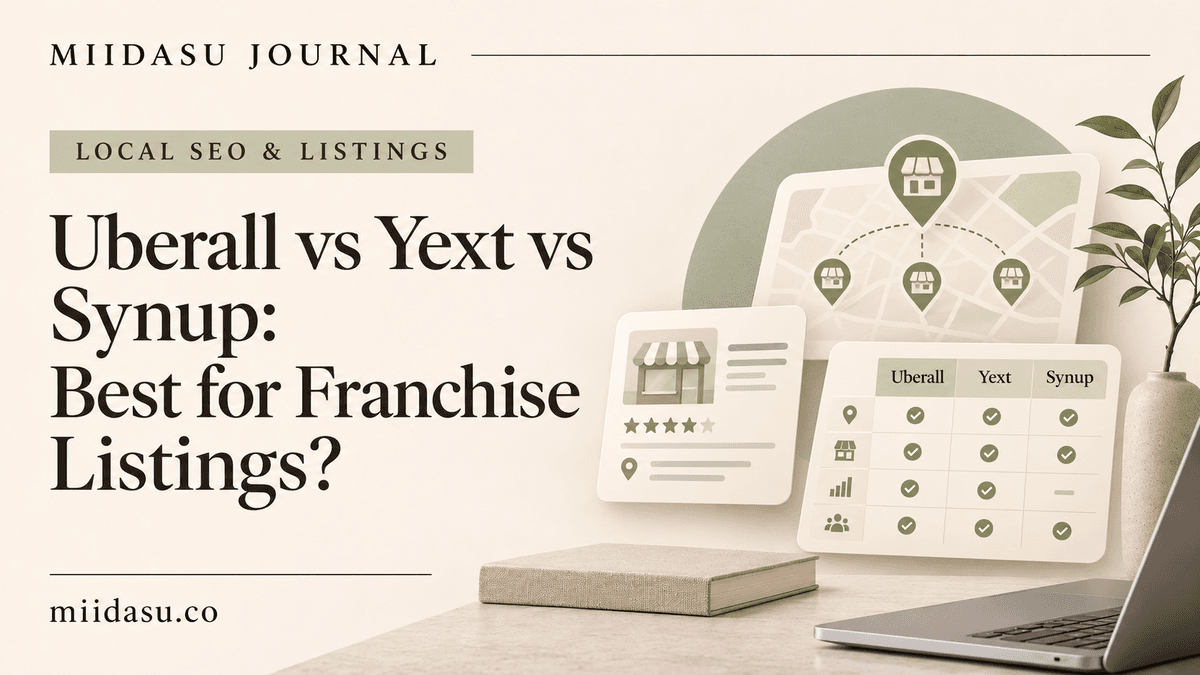
All three support multi-location businesses, including franchise networks. The differences become more important when headquarters must maintain brand standards while individual franchisees manage local operating information.
For a franchise with dozens, hundreds, or thousands of locations, the right platform is not necessarily the one with the most features or publisher connections. It is the one that keeps location information accurate, supports the required approval processes, and reduces operational work without compromising control.
This comparison examines Uberall vs Yext vs Synup across features, franchise governance, integrations, pricing, implementation, and long-term location data management.
Quick Comparison: Uberall vs Yext vs Synup
| Evaluation criteria | Uberall | Synup | Yext |
|---|---|---|---|
| Best suited for | Franchise location marketing and engagement | Centralized local marketing operations | Enterprise location data governance |
| Core focus | Listings, reviews, social, location visibility | Listings, reputation, local SEO, marketing automation | Knowledge Graph, listings, connected digital experiences |
| Multi-location management | Yes | Yes | Yes |
| Bulk listing updates | Supported | Supported | Supported |
| Review management | Available | Available | Available |
| Local social management | Available | Available | Available through relevant products |
| Franchise permissions | Role-based and collaborative operating models | Account roles and configurable access | Granular roles, entity access, and permission controls |
| AI capabilities | UB-I for location marketing workflows | Sydekick agent and AI-supported marketing tasks | AI and automation across supported platform workflows |
| Pricing | Packages and custom quotes | Published plans; enterprise pricing for larger portfolios | Product packages and enterprise quotations |
| Main consideration | Confirm package scope and local approval workflows | Evaluate location tiers, agent credits, and integrations | Evaluate licensing, data architecture, and implementation effort |
Feature availability, publisher integrations, account permissions, AI usage, and pricing can vary by product configuration, market, and contractual terms.
Which Platform Should Your Franchise Shortlist?
Choose Uberall as a starting point when headquarters and franchisees need to coordinate listings, reviews, local social media, and customer engagement through one location marketing platform.
Choose Synup as a starting point when centralized listings, review management, local marketing automation, and published location-based pricing are important purchasing considerations.
Choose Yext as a starting point when location information must support a broader enterprise data architecture, configurable entities, permission controls, and multiple connected digital experiences.
These are editorial fit recommendations, not independently tested performance rankings.
How We Evaluated These Franchise Listing Management Platforms
This comparison uses publicly available vendor documentation, product information, support resources, and pricing pages reviewed in November 2026.
Six criteria guide the evaluation:
- Location data management: How each platform manages business names, addresses, phone numbers, operating hours, categories, and other location information.
- Publisher distribution: How approved data reaches supported search engines, maps, and directories, including monitoring of synchronization and errors.
- Franchise governance: How headquarters, regional managers, and franchisees can share responsibility without losing control of brand-sensitive information.
- Operational scalability: Support for bulk changes, location openings, relocations, closures, and recurring audits.
- Integrations and reporting: Connections with existing business systems and the availability of location-level reporting.
- Commercial fit: Pricing transparency, licensing requirements, implementation effort, and ongoing operating costs.
The evaluation distinguishes documented product capabilities from recommendations about likely buyer fit.
No hands-on product testing, customer interviews, implementation benchmarking, or independent performance measurement is claimed. Buyers should validate the required features through demonstrations and contractual documentation.
Why Franchise Location Data Management Matters
Franchise location data management is the process of maintaining accurate business information across every physical location and the digital services customers use to discover those businesses.
A location record commonly includes:
- Business name, address, and phone number (NAP).
- Store-specific website and booking URLs.
- Regular, holiday, and temporary operating hours.
- Business categories, services, and attributes.
- Map coordinates and location identifiers.
- Opening, relocation, and closure status.
- Ownership and operational responsibilities.
Inconsistent information can create immediate customer problems.
A restaurant may appear open when it is closed. A relocated service center may still direct customers to its previous address. A franchisee may change a phone number locally without informing headquarters.
These problems become harder to manage as the number of locations grows.
How Accurate Listings Support Local SEO
According to Google's guidance on improving local rankings, businesses with complete and accurate information are more likely to appear in relevant local searches.
Google describes three main local ranking considerations: relevance, distance, and prominence.
Maintaining accurate business information can support relevance and help customers interact with the correct location. However, no listing management platform can guarantee improved local rankings.
Google also explains that information displayed in Business Profiles can come from business owners, third-party sources, users, and other available information.
As a result, successfully submitting an update through software does not always mean that customers will immediately see the intended information.
Franchise teams need to verify what appears on public platforms, not simply whether the software reports that an update was sent.
Why Franchise Governance Adds Complexity
A single-location business often has one team responsible for maintaining its information.
A franchise network may involve several parties:
- Headquarters establishes brand standards and core business information.
- Franchisees provide accurate local operating details.
- Regional managers oversee compliance and operational changes.
- Marketing agencies manage listings and reporting.
- Software providers distribute approved information.
Problems emerge when responsibility is unclear.
For example, headquarters might control brand naming while a franchisee changes the business name to include promotional keywords. A listings platform could distribute that change even though it conflicts with the brand's standards or publisher rules.
A reliable process requires both software controls and clear ownership policies.
For a detailed governance framework, see Miidasu's guide to franchise listings management and field ownership.
Uberall vs Yext vs Synup: Detailed Platform Reviews
1. Uberall — For Franchise Location Visibility and Customer Engagement
Best for: Franchise networks seeking to coordinate business listings, customer reviews, local social media, and location-level marketing activity.
Uberall is a multi-location marketing platform that helps brands manage their digital presence across search engines, maps, directories, and customer engagement channels.
Its franchise offering connects centralized oversight with tools intended for local operators.
Rather than focusing exclusively on business data distribution, Uberall combines listing management with reputation, social media, local content, and reporting capabilities.
Key Capabilities
Uberall supports centralized location information, bulk listing updates, duplicate management, and synchronization with supported publisher platforms.
Its broader capabilities include:
- Location listings and business information management.
- Review monitoring and response workflows.
- Local social media publishing.
- Location pages and related digital experiences.
- Location-level reporting and analytics.
- Role-based controls for headquarters and local operators.
- AI-assisted tasks and recommendations through UB-I.
Uberall introduced its UB-I AI agent to support location marketing activities across listings, reviews, social media, and local pages.
These AI features should be assessed as workflow capabilities rather than evidence of guaranteed improvements in rankings, customer acquisition, or AI-search visibility.
Franchise Governance and Permissions
An important part of Uberall's franchise offering is its support for different management structures.
Its documentation describes three approaches:
Centralized management: Headquarters controls major location marketing activities and maintains consistent brand information.
Decentralized management: Franchisees or local managers receive greater responsibility for local activities.
Collaborative management: Headquarters establishes standards and oversight while local operators manage designated tasks.
This flexibility can be relevant when different regions or franchise groups operate under different administrative arrangements.
However, buyers should verify which permission controls, approval requirements, and collaboration features are included in the selected package.
Where Uberall Works Well
Consider a hypothetical restaurant franchise operating 250 locations.
Headquarters needs to update holiday hours across the network, while regional managers monitor customer reviews and individual stores publish approved local promotions.
Uberall's combination of listings, reputation, and local marketing tools makes it a relevant candidate for coordinating those activities.
The platform is also worth evaluating for retail, hospitality, automotive, and service franchises that want marketing teams to work across several local channels.
Limitations
Uberall's broader product portfolio means that purchasing teams need to examine what is included in each package.
A franchise that primarily needs accurate NAP distribution may not require additional social publishing or local marketing functionality.
Similarly, complex organizations should request demonstrations of their exact requirements, including franchisee permissions, content approvals, location segmentation, and reporting exports.
Publisher support and available functionality may differ by market.
Pricing
Uberall publishes product packages and offers quote-based purchasing options.
Its pricing information separates core visibility features from broader review and social engagement capabilities, with certain enhancements offered as add-ons.
Buyers should request a written proposal specifying:
- Number of licensed locations.
- Included products and modules.
- Publisher connections and regional coverage.
- Franchisee access and collaboration capabilities.
- Implementation and onboarding services.
- Reporting, support, and optional enhancements.
Consider Uberall when: Your franchise wants coordinated location marketing, customer engagement, and listings management, with defined responsibilities for headquarters and local operators.
2. Synup — For Centralized Listings and Local Marketing Operations
Best for: Franchise networks, multi-location businesses, and agencies seeking centralized listing management alongside reviews, reporting, and local marketing automation.
Synup provides software for managing business listings, customer reputation, local search visibility, and related marketing workflows.
Its platform supports businesses operating across multiple locations and agencies managing multiple client accounts.
Synup's current offering also incorporates Sydekick, an AI agent intended to support local marketing operations.
This expands the platform's positioning beyond traditional listings synchronization.
Key Capabilities
Synup provides centralized business information management and distribution to supported publishers.
Its documented capabilities include:
- Location profile management and listing synchronization.
- Bulk management of business information.
- Review monitoring and response workflows.
- Duplicate listing identification and resolution requests.
- Social content publishing.
- Local search visibility and reporting.
- AI-assisted operational tasks through Sydekick.
The Synup Listings Help Center documents workflows for profile updates, publisher connection monitoring, duplicate management, and location information synchronization.
It also distinguishes between saving location information, sending updates to publishers, and the eventual completion of those updates.
That distinction is important for franchise teams measuring data accuracy.
Franchise Governance and Permissions
Synup provides administrative roles and access controls for users within its platform.
Its role documentation describes administrators and managers, along with permissions related to account management and marketing activities.
For a franchise network, these controls may help separate corporate responsibilities from regional or local work.
However, buyers should verify the precise permission model available in their proposed configuration.
For example, having different account roles does not necessarily establish that every location field can have a separate approval requirement.
A franchise should ask Synup to demonstrate whether a local operator can submit a business-hours change without being able to modify a corporate-controlled business name.
Where Synup Works Well
Consider a hypothetical home services franchise with 120 branches.
The company needs consistent business categories, contact information, service descriptions, and customer review processes.
Its central marketing team also wants to coordinate local content and identify locations with incomplete or conflicting information.
Synup provides a relevant environment for managing these connected activities.
The platform may also suit marketing agencies that handle multiple franchise clients, provided its account structure, client access controls, and pricing meet their needs.
Limitations
Synup's suitability depends on the operating complexity of the franchise and the integrations required.
Businesses with sophisticated internal location databases should validate API capabilities, synchronization methods, and any custom integration requirements.
Organizations should also examine the platform's AI usage-credit model.
Although Synup's published pricing describes access to its marketing features across plans, usage allowances, concurrent agent capacity, and infrastructure arrangements differ.
This means two plans may offer access to similar features while supporting different workloads.
Pricing
Synup publishes location-based subscription plans.
As of November 2026, its US pricing page lists the following monthly rates:
| Plan | Published monthly price | Included location capacity |
|---|---|---|
| Solo | $49 | 1 location |
| Premium | $299 | Up to 10 locations |
| Pro | $499 | Up to 25 locations |
| Scale | $899 | Up to 50 locations |
| Enterprise | Custom quote | Larger portfolios |
These are the published monthly plan rates, not independently negotiated franchise quotations.
Annual billing discounts may be available. Usage credits, agent capacity, infrastructure, and white-label availability differ across plans.
For a franchise operating more than 50 locations, enterprise pricing should be discussed directly with Synup rather than extrapolated from the smaller packages.
The official Synup pricing page provides the current rate card and plan conditions.
Consider Synup when: Your franchise prioritizes centralized listings, review management, local marketing operations, and a pricing model that can be evaluated against the number of managed locations.
3. Yext — For Enterprise Location Data Governance
Best for: Franchise organizations that need structured location records, configurable business information, detailed permissions, and connections to multiple enterprise systems.
Yext provides a digital presence platform built around structured business information.
Its Knowledge Graph organizes information about locations, products, services, and other business entities.
The Listings product uses this information to manage and synchronize supported public business listings.
This approach is particularly relevant when location data must be used beyond directory management.
Key Capabilities
Yext supports structured information management and distribution across its publisher network.
Its capabilities include:
- Knowledge Graph entities and business information management.
- Custom fields and entity relationships.
- Bulk editing and scheduled updates.
- Listing synchronization and accuracy monitoring.
- Duplicate listing identification.
- User roles, permissions, and approval workflows.
- APIs, data connectors, and related enterprise integrations.
Yext also offers products for reviews, pages, social media, and other digital experiences.
The Yext Listings documentation explains how location information stored in the Knowledge Graph connects to publisher-facing listings.
Yext's listing accuracy documentation also describes how the system compares stored business information with data retrieved from connected publishers.
Franchise Governance and Permissions
Yext documents a detailed user-permission model.
Its platform supports built-in and custom roles, with controls that can determine what users are allowed to access or modify.
For example, its documentation describes roles for entity managers, viewers, and users who submit content suggestions for approval.
Custom permissions can also be used to control access to particular fields.
This is relevant to franchises where headquarters needs to protect brand-sensitive information while local operators contribute operational updates.
A franchise could evaluate a process in which local teams request changes to hours or services while corporate teams retain control of naming and other restricted fields.
The exact implementation and licensing requirements should be confirmed during vendor evaluation.
Where Yext Works Well
Consider a hypothetical healthcare franchise operating 500 clinics.
Each location has its own hours, services, contact information, and website details.
Some locations may also have information about eligible individual practitioners.
A structured data model can help the organization maintain relationships among locations, services, and other relevant records.
Yext is therefore worth considering when the same authoritative information needs to support directory listings, location pages, internal systems, and other customer-facing experiences.
Limitations
Yext's architecture can involve more planning when organizations need custom entities, integrations, detailed permissions, or several product licenses.
A franchise seeking only basic listing synchronization should assess whether it needs that broader configuration.
Buyers should also establish which features require separate products, add-ons, or enterprise services.
Publisher synchronization remains subject to each publisher's processes and acceptance rules.
Pricing
Yext provides enterprise product packages and custom commercial arrangements.
Its official package comparison describes the different products and available capabilities.
Franchise buyers should request pricing based on the required products, number of locations or entities, user access, integration needs, and implementation scope.
Smaller-business or reseller packages should not automatically be treated as representative enterprise franchise pricing.
Consider Yext when: Your organization needs location information to operate as structured enterprise data across listings, websites, and connected business systems.
Uberall vs Yext vs Synup: What Are the Main Differences?
The three platforms overlap significantly in location management, publisher distribution, and reputation-related functionality.
Their differences become clearer when comparing the work each platform is expected to support.
Yext vs Uberall: Structured Data and Location Marketing
Yext places particular emphasis on structured business information through its Knowledge Graph.
Uberall places greater emphasis on managing location visibility, customer engagement, and local marketing activity.
Both provide centralized listing management and additional enterprise capabilities.
| Requirement | Uberall | Yext |
|---|---|---|
| Location data | Centralized location records | Structured Knowledge Graph entities |
| Listings | Multi-publisher distribution | Publisher Network synchronization |
| Reviews | Reputation management workflows | Dedicated reviews capabilities |
| Local marketing | Integrated local engagement and social tools | Related products for social and digital experiences |
| Franchise governance | Corporate, local, and collaborative management | Granular user roles and permissions |
| Data integrations | Available connectors and integration options | Knowledge Graph, connectors, and APIs |
| Key evaluation question | Does it support our local marketing operating model? | Does it support our data and integration architecture? |
A franchise whose main challenge is coordinating local marketing activity may start with Uberall.
An organization that needs to model complex business data and connect that data with internal applications may start with Yext.
Neither approach guarantees faster listing updates or stronger search visibility.
Those outcomes depend on the relevant publishers, data quality, implementation, and operating processes.
Synup vs Yext: Consolidated Operations and Enterprise Data Architecture
Synup and Yext both support centralized location management.
Synup is worth evaluating when the organization wants listings, review workflows, local marketing activity, and AI-assisted operations in one environment.
Yext is relevant when the organization needs configurable data entities, granular governance, and extensive integration planning.
Consider two different franchise operating models.
A network with 80 locations and a small marketing team may prioritize straightforward location updates, review management, reporting, and workload reduction.
A network with 800 locations, multiple business systems, and complex data relationships may place greater emphasis on structured information management and integrations.
These examples illustrate different purchasing requirements, not proven platform performance differences.
Both companies should be asked to demonstrate the same location-data workflow before a purchasing decision.
Uberall vs Synup: Location Marketing and Automation
Uberall and Synup both combine location listings with broader marketing features.
Uberall's franchise offering emphasizes coordination between headquarters and local operators, including reputation and local social activity.
Synup's current offering includes an agent-oriented marketing approach with usage-based automation capacity.
Franchise buyers should therefore examine who performs routine work, which actions can be automated, what requires approval, and how exceptions are handled.
The useful distinction is not simply whether a platform advertises AI.
It is whether the software can complete approved tasks reliably, provide understandable records, and escalate problems to the correct people.
Which Platform Handles Franchise Location Data Most Effectively?
All three platforms provide location management capabilities.
However, effective franchise operations require more than transferring business information to directories.
The following requirements are especially important when comparing vendors.
1. Bulk Updates Across Locations
Bulk editing becomes essential when a franchise manages frequent changes to hours, contact information, services, and location status.
Uberall, Synup, and Yext support multi-location updates, but the available controls and workflows should be demonstrated.
For example, a franchise with 400 locations may need to adjust holiday hours for only 75 stores in one state.
The system must identify the correct locations, distribute approved changes, and show which publishers have accepted or rejected them.
A useful demonstration should include exceptions, such as locations with different schedules or markets with different publisher requirements.
2. Data Ownership and Franchisee Permissions
One of the most important purchasing considerations is deciding who controls each field.
A practical framework divides information into three categories.
| Field | Suggested owner | Typical change process |
|---|---|---|
| Brand name | Headquarters | Corporate approval |
| Primary business category | Headquarters | Controlled review |
| Store ID | Franchise operations | Central record management |
| Regular hours | Franchisee or local operations | Local submission with defined controls |
| Holiday hours | Local operations | Approved or delegated update |
| Phone number | Local operations and headquarters | Validation before publication |
| Store-specific website URL | Headquarters or web team | Centralized approval |
| Location status | Franchise operations | Formal opening, relocation, or closure workflow |
This is a suggested operational model, not a requirement imposed by any of the three vendors.
Some businesses may delegate more responsibility to franchisees, while others require corporate approval for most changes.
The purchasing requirement is to establish whether the platform can support the intended division of responsibility.
3. Duplicate Listings and Relocations
Duplicate business listings can confuse customers and complicate location management.
Duplicates may appear after relocations, ownership changes, or the creation of additional profiles for the same business.
All three vendors provide listing management capabilities, but buyers should verify how suspected duplicates are identified, reported, and resolved.
Google's duplicate Business Profile guidance explains that businesses generally should not maintain multiple profiles representing the same business.
However, distinct eligible businesses at the same address may each qualify for their own profile.
Google also advises businesses that relocate to update their existing Business Profile rather than automatically creating a new one.
A vendor cannot guarantee that every duplicate will be removed immediately because publisher rules and review processes still apply.
4. Publisher Coverage and Data Accuracy
The number of supported publishers is useful, but it should not be the only selection criterion.
A franchise should first identify the services its customers actually use.
Depending on the country and industry, these may include Google Maps, Apple Maps, Bing, Facebook, Yelp, and specialist directories.
Businesses can also manage important profiles directly through official services:
A third-party platform may simplify distribution and monitoring, but it does not replace every account ownership, verification, or publisher approval requirement.
Ask each vendor to provide a current publisher list for the countries and industries relevant to your franchise.
5. Reporting and AI-Search Visibility
Uberall, Synup, and Yext provide reporting and AI-related capabilities, but buyers should distinguish traditional location management from AI-search measurement.
Traditional listings reporting may include publisher connection status, profile completeness, listing accuracy, and location engagement data.
AI-search tools may offer monitoring, optimization suggestions, or analysis of how locations appear in selected AI-powered experiences.
These measurements are not necessarily comparable across vendors.
Organizations should ask how each metric is calculated, which systems it covers, how often information is refreshed, and whether it measures an actual customer outcome.
No vendor can guarantee that a location will be recommended by ChatGPT, Google AI Overviews, Gemini, Perplexity, or another AI system.
How Much Do Uberall, Yext, and Synup Cost?
The total cost of franchise listing management software depends on location count, selected products, usage, integrations, support, and implementation requirements.
Pricing Comparison
| Cost consideration | Uberall | Synup | Yext |
|---|---|---|---|
| Pricing transparency | Packages and quotes | Published monthly plans | Product packages and enterprise quotes |
| Public starting rate in this comparison | No standardized franchise rate verified | $49/month for one location | No standardized enterprise rate verified |
| Larger franchise networks | Request proposal | Enterprise quote above published tiers | Request enterprise proposal |
| Optional capabilities | Package-dependent | Usage and capacity conditions | Product and add-on dependent |
| Implementation | Confirm scope | Confirm scope | Confirm scope |
| Integrations | Confirm requirements | Confirm requirements | Confirm requirements |
| Support | Confirm service level | Confirm service level | Confirm service level |
Synup's published rate card provides a more concrete starting point for estimating smaller portfolios.
However, the enterprise price for a network of 100 or 500 locations cannot be determined reliably from the published small-location packages alone.
Uberall and Yext buyers should request proposals that cover the same services and number of locations.
Compare Total Cost of Ownership
A practical cost comparison should include:
Annual total cost = subscription fees + onboarding + integrations + support upgrades + internal operating costs.
For example, a platform with a lower subscription fee may require more manual reconciliation or additional software.
Conversely, a broader enterprise platform may be unnecessarily expensive if a franchise uses only a small portion of its capabilities.
Ask all three vendors to price the same requirements, including:
- Number of locations and geographic markets.
- Required publishers and supported fields.
- Headquarters and franchisee users.
- Approval and permission requirements.
- Review management and reporting.
- API connections or imports.
- Implementation and data migration.
- Usage-based charges and renewal terms.
This provides a more meaningful comparison than evaluating subscription prices in isolation.
How to Choose the Right Platform for Your Franchise
Selecting between Yext, Uberall, and Synup requires matching the product to the franchise's data ownership model and daily operations.
Step 1: Define Your Location Data Source of Truth
Establish where approved location information originates.
For some organizations, this may be a franchise management system, an internal database, or a centrally maintained location registry.
Each location should have a stable internal identifier and clearly defined information fields.
The listings platform should receive or manage approved changes without creating conflicting versions of the same data.
Miidasu's guide to multi-location business listings management explains how to coordinate master records, ownership, updates, and verification.
Step 2: Identify Required Permissions and Approvals
Document what headquarters, regional managers, agencies, and franchisees can do.
For example, a franchisee may need permission to update holiday hours without changing the business name or primary category.
Ask each vendor to demonstrate those exact restrictions.
Also determine whether the platform records who changed information, when the change occurred, and whether approval was required.
Step 3: Use a Real-World Proof of Concept
Before signing a contract, request a controlled evaluation using 10–20 representative locations.
Include different types of franchise operations, such as corporate-owned stores, franchisee-operated locations, recently relocated businesses, and stores with unusual operating hours.
Ask each vendor to complete the same tasks.
| Test scenario | What to evaluate |
|---|---|
| Bulk holiday-hours update | Location selection, publishing, and verification |
| Franchisee-submitted change | Access restrictions and approval workflow |
| Location relocation | Record continuity, publisher handling, and duplicate prevention |
| Duplicate listing | Detection, reporting, and resolution process |
| New location launch | Data creation, verification requirements, and publishing |
| Reporting export | Location-level visibility, errors, and usable data |
| Integration update | Data transfer, field mapping, and exception handling |
Record the results using consistent criteria.
A useful scorecard should measure:
- Whether the task was completed correctly.
- Whether the appropriate approvals were enforced.
- Whether the target publisher accepted the change.
- How errors and exceptions were reported.
- How much manual work was required.
- Whether the workflow could be repeated across the full franchise network.
Do not confuse a successful demonstration inside the software with a verified change on a public publisher.
Step 4: Evaluate Migration and Vendor Exit Requirements
Franchise businesses switching from an existing listings provider should plan the transition carefully.
Before implementation, document:
- Current publisher connections and account ownership.
- Master location records and store identifiers.
- Active duplicate-resolution cases.
- Existing review-management workflows.
- Data exports and historical reporting needs.
- Integration dependencies.
- Contract termination and data-access requirements.
Ask the replacement provider how it will handle account connections, publisher verification, and the transition from the current vendor.
Also clarify what happens when the new contract eventually ends.
A franchise should not discover during termination that it lacks access to important location records, publisher accounts, or required operational information.
Step 5: Establish Ongoing Governance
Software implementation is only the beginning.
The franchise needs a repeatable process for submitting changes, validating information, distributing updates, and checking public listings.
Assign responsibility for unresolved errors and establish escalation procedures.
This makes location data management a continuing operational process rather than a one-time cleanup project.
Common Mistakes When Comparing Franchise Listing Platforms
Selecting Software Based Only on Directory Count
A broad publisher network does not automatically provide the best coverage for every franchise.
Compare the specific destinations relevant to your customers, the data fields supported, and the platform's ability to report failed updates.
Ignoring the Source of Truth
A listing platform cannot reliably correct information if the approved internal source is itself inaccurate.
Maintain one authoritative record per location and establish a process for resolving conflicting information.
Overlooking Franchisee Adoption
A system may provide strong central administration but still be difficult for franchisees to use.
Include local operators in demonstrations and verify that routine tasks can be completed without unnecessary complexity.
Treating Publishing as Verification
Sending an update does not always mean that the publisher has accepted or displayed it.
Check live listings, especially after relocations, closures, major hours changes, and other high-impact updates.
Buying AI Features Without Testing the Workflow
AI-assisted marketing features should be evaluated on what they actually do.
Determine what information they use, which actions require approval, how mistakes are corrected, and how results are recorded.
Automation should make the operating process more reliable rather than simply increasing the volume of changes.
Ignoring Future Data Portability
Franchise networks should maintain control of approved location records and critical publisher accounts.
Confirm export formats, termination arrangements, and integration dependencies before signing a contract.
Recommended Franchise Location Data Management Workflow
Regardless of whether a franchise chooses Uberall, Synup, or Yext, the operational process should follow a consistent sequence.
| Step | Action | Suggested responsible team |
|---|---|---|
| 1 | Maintain approved master location records | Franchise operations |
| 2 | Receive and validate proposed changes | Corporate or regional owners |
| 3 | Approve brand-sensitive information | Headquarters |
| 4 | Distribute approved information | Listings management team |
| 5 | Verify changes on public platforms | Local SEO or listings team |
| 6 | Investigate duplicates and mismatches | Listings support |
| 7 | Report unresolved issues and correction times | Marketing leadership |
How Often Should Location Data Be Audited?
The appropriate review schedule depends on how frequently location information changes and how critical it is to customers.
A reasonable starting approach is to:
- Review high-priority publisher profiles regularly.
- Spot-check important location data monthly.
- Conduct broader quality audits quarterly.
- Review affected profiles promptly after openings, closures, relocations, or major hours changes.
These are suggested operating practices rather than mandatory schedules established by Google or other publishers.
A franchise with frequent operational changes may require more intensive monitoring.
What Should Be Measured?
Listing management performance should focus on accuracy and operational effectiveness.
Useful measures include the percentage of verified accurate location records, unresolved high-priority errors, time required to correct incorrect information, duplicate-resolution status, and the proportion of locations with complete core details.
Dashboard connection status can be useful, but it should not replace checks of the information customers actually see.
Frequently Asked Questions
What Are the Best Yext Alternatives for Franchise Businesses?
Uberall and Synup are relevant alternatives to Yext for franchise location data management.
Uberall is particularly relevant for location marketing and customer engagement. Synup is worth evaluating for centralized listings, reputation management, and local marketing workflows.
The better choice depends on operational requirements, integrations, permissions, and total cost.
Is Uberall Better Than Yext for Franchise Listing Management?
Uberall may be more suitable when a franchise wants coordinated listings, reputation, and local marketing execution.
Yext may be more suitable when structured business data and enterprise integrations are central requirements.
Neither is universally better. Both should be evaluated through realistic franchise workflows.
Can Synup Manage Listings for Multiple Franchise Locations?
Yes. Synup supports multiple business locations, centralized listing management, and related marketing functionality.
Its published plans include location-based tiers, with enterprise arrangements for larger portfolios.
Franchise buyers should confirm the required integrations, permissions, user access, and contract conditions.
Does Franchise Listing Management Software Improve Local SEO?
Listing management software can support local SEO by helping maintain accurate business information across important public platforms.
However, it cannot guarantee higher rankings.
Google considers relevance, distance, and prominence when determining local results. Accurate information helps establish a reliable business presence, but it is only one part of local search performance.
What Should Franchises Prioritize When Switching From Yext?
Franchises should prioritize data ownership, publisher account access, migration planning, integration compatibility, duplicate handling, and ongoing verification.
Before changing providers, export important location information and establish how active publisher connections will transition.
A pilot involving a limited group of locations can help identify operational issues before the entire network is migrated.
Is a Dedicated Listing Management Platform Necessary for Every Franchise?
Not always.
A small franchise with relatively few locations and limited changes may be able to manage its most important publisher profiles directly.
Dedicated software becomes more useful as the number of locations, publishers, users, approval requirements, and recurring updates increases.
The decision should account for the cost of manual management as well as software licensing.
Final Verdict: Uberall vs Yext vs Synup
Uberall, Synup, and Yext are all credible candidates for franchise location data management, but each deserves consideration for different reasons.
Uberall is worth shortlisting when location listings, reviews, and local customer engagement need to be coordinated across headquarters and franchisees.
Synup is relevant when the priority is centralized listings, reputation workflows, local marketing automation, and a location-based commercial model.
Yext is particularly relevant when location information must support structured enterprise data, configurable permissions, and several connected digital experiences.
The strongest purchasing decision comes from testing each platform against the same franchise requirements rather than relying on advertised feature counts or general product positioning.
Focus on verified publisher coverage, data ownership, permission controls, location accuracy, integrations, implementation requirements, and total operating cost.
Ultimately, effective franchise listing management depends on three things: reliable source data, clearly assigned responsibilities, and ongoing verification that customers see accurate information.
The software should make those processes easier to manage at scale.