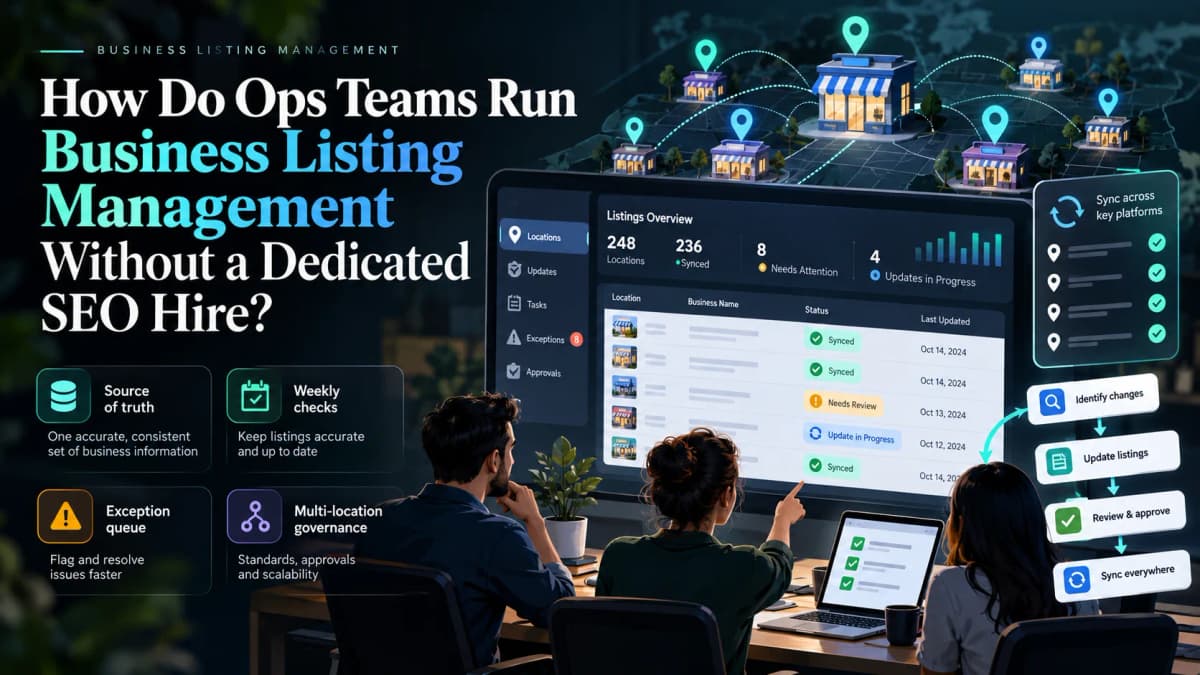
Ops teams can run business listing management without a dedicated SEO hire when they treat listings as an operational data system, not a marketing side task. The minimum model is one approved source of truth, company-controlled profile access, a repeatable change workflow, a weekly exception queue, a monthly audit, and clear escalation rules for suspensions, duplicates, ownership conflicts, and search-policy questions.
The goal is not to make an operations manager become an SEO specialist. Routine listing work is mostly about data quality, access, approvals, timing, and exception handling. Ops should own the process it can standardize. A local SEO specialist or agency should enter only when the problem requires search strategy, policy interpretation, difficult recovery work, or deeper local visibility analysis.
Editorial approach: this guide is written for US multi-location and service businesses that need a durable operating model. It separates routine operational work from specialist SEO work, uses current Google Business Profile access guidance, and compares software by how much manual work it can remove. It does not claim that a tool eliminates governance or that every listing issue can be automated.
What can Ops own without an SEO specialist?
Ops can own the parts of business listing management that depend on accurate company data and repeatable execution: location setup, access, hours, phone numbers, URLs, opening and closure status, approved categories, holiday schedules, location-page links, user permissions, and the internal handoff that triggers each change. These tasks are operational because the correct answer comes from the business itself.
A practical ownership split looks like this:
| Work | Primary owner | Why |
|---|---|---|
| Canonical location data | Operations / data owner | The business knows its real address, phone, hours, status, and lifecycle dates. |
| Profile ownership and user access | Operations / IT | Access is an account-control issue, not an SEO tactic. |
| Routine listings updates | Operations | Standard changes can follow an SOP and approval path. |
| Holiday and special hours | Operations / field teams | The source of truth is the operating schedule. |
| Openings, moves, closures | Operations + marketing | Timing must match real-world readiness and customer communication. |
| Duplicate or ownership cases | Ops first, specialist escalation | Ops can identify and document the case; difficult resolution may require expertise. |
| Category strategy and local visibility analysis | Local SEO specialist | These require search-intent judgment and competitive interpretation. |
| Suspension recovery or complex policy disputes | Specialist / experienced agency | High-risk cases can worsen if handled as routine edits. |
How should Ops build the source of truth?
Start with a clear source-of-truth strategy, but avoid reinventing location-data architecture from scratch. For deep dives on establishing a canonical location master and evaluating spreadsheet workflows versus dedicated software, refer to our guides on location master data in RevOps and choosing between spreadsheets and location management software.
For an Ops-led team operating without a dedicated SEO hire, the primary focus should remain strictly on the operational SOP, approval workflows, exception queues, and knowing when to escalate complex issues to an expert.
How should access and ownership be set up?
Keep profile ownership under company-controlled accounts and give employees, agencies, or vendors only the access they need. Shared passwords create operational risk because the business loses an audit trail and can be locked out when a person leaves.
Google explicitly supports this model. Its Business Profile owner and manager guidance says owners have full control, managers can handle most day-to-day work, and each user should use a separate Google Account rather than a shared password. For Ops, that means the brand should retain primary ownership and use manager access for routine operators or partners.
For multi-location portfolios, group access should follow real operational boundaries. A regional operator may need 40 locations, while a corporate admin may need all locations. Avoid adding the same user manually to hundreds of profiles when a supported group structure can provide the same access more safely.
Google's business group documentation describes business groups as a more secure way to manage and share access to sets of Business Profiles. This is especially useful when Ops, marketing, agencies, and regional teams all need different levels of access.
What should the standard business listing management SOP look like?
The SOP should turn every routine change into the same sequence: request, validate, approve, publish, verify, and close. The fewer one-off instructions the team creates, the easier it becomes to run listings without specialist oversight.
1. Receive the change. Use one intake channel, such as an operations form, ticket queue, or location-data system. Do not accept important listing changes only through chat messages or personal email.
2. Validate against the source of truth. Confirm the change with the operational owner. A store manager request should not override an approved corporate record without an approval rule.
3. Classify the change. Mark it as routine, lifecycle, or exception. Routine includes hours and phone updates. Lifecycle includes openings, moves, closures, and rebrands. Exceptions include duplicates, suspensions, or ownership conflicts.
4. Publish through the controlled path. Use the listings platform or the native publisher account. Avoid parallel edits in several systems unless the workflow is intentionally designed that way.
5. Verify the customer-facing result. A dashboard status is useful, but the team should spot-check the live profile for important or high-risk changes.
6. Record the outcome. Close the ticket only when the change is live, intentionally pending, or escalated with a named owner.
What weekly and monthly cadence keeps listings under control?
Ops does not need to inspect every field on every profile every day. A good operating cadence is event-driven for urgent changes, weekly for exceptions, monthly for governance, and quarterly for a portfolio-level reconciliation against the master location record.
| Cadence | Ops work | Evidence | Escalate when |
|---|---|---|---|
| As needed | Urgent hours, phone, closure, safety, access, or opening changes | Approved ticket and live check | Publisher rejects the edit or the profile is inaccessible |
| Weekly | Review duplicate alerts, failed syncs, unverified profiles, ownership issues, suggested edits, and unresolved cases | Exception queue with owner and age | Case requires policy interpretation, appeal, or repeated publisher support |
| Monthly | Audit user access, top-priority profiles, stale hours, upcoming openings/closures, and location-page links | Monthly checklist and exception trend | Systemic data drift or repeated unauthorized changes appear |
| Quarterly | Reconcile platform data against the master location file and review vendor performance | Portfolio export and reconciliation report | Large mismatch, duplicate growth, or process failure appears |
How should Ops handle duplicates, suspensions, and other exceptions?
Use a separate exception queue. Routine updates should not compete with high-risk cases, and exceptions should not be solved by repeatedly editing the same field. Each exception needs evidence, a case owner, a next action, and an escalation threshold.
Duplicate profile: Capture both URLs, ownership state, addresses, reviews, status, and why they appear to represent the same business. Escalation: Escalate when the correct surviving profile is unclear or ownership is split.
Suspension or disabled profile: Stop routine edits, document the real-world business, gather requested evidence, and review policy compliance. Escalation: Escalate before repeated appeals or creating a replacement profile.
Ownership conflict: Identify current owners, company-controlled accounts, former agencies, and proof of business authority. Escalation: Escalate when access recovery or transfer is disputed.
Wrong public edit: Compare the live value with the source of truth and determine whether the change came from the publisher, a user, or another data source. Escalation: Escalate when the value keeps reverting.
Moved or closed location: Confirm lifecycle date, replacement address, customer instructions, and whether the old profile should be marked moved or closed. Escalation: Escalate when historical profiles, reviews, or ownership make the correct action ambiguous.
How should corporate Ops and local managers split edit rights?
Use local managers as data contributors, not uncontrolled publishers. Field teams usually know when a location closes early, changes a phone line, or needs a holiday-hours exception, but corporate Ops should decide which fields can publish immediately and which changes require approval. This preserves local knowledge without allowing one store to accidentally change the brand name, primary category, website, or ownership structure.
A simple approval matrix is enough for most teams:
- Local managers can request or propose temporary hours, local phone corrections, photos, and operational notes through the approved intake path.
- Corporate Ops approves permanent hours, addresses, location status, core phone numbers, primary URLs, ownership, and new or closed locations.
- Marketing or a local SEO specialist reviews business-name changes, primary-category changes, service-area strategy, and other fields that can materially change local search relevance.
- IT or security owns company accounts, authentication, service accounts, and offboarding access for former staff or vendors.
The approval matrix should also state what happens when the local team and the master record disagree. Do not resolve the conflict by letting whichever person edited last become the source of truth. Route it back to the operational owner, record the approved answer, then publish once. That single control prevents many recurring listing errors from becoming permanent workflow noise.
When does Ops need business listing management software?
Software becomes useful when the cost of repeated manual work exceeds the value of direct control. The usual triggers are multiple locations, frequent hours or lifecycle changes, several people editing the same data, multiple publishers, recurring duplicate or drift problems, and a need for one dashboard or audit trail.
A small business with three stable locations may be able to manage Google, Apple, Bing, and Yelp directly. An Ops team with 80 locations, seasonal hours, acquisitions, franchisees, and weekly changes benefits from a platform because the work becomes a coordination problem rather than a simple editing task.
Which tools fit an Ops-led business listing management model?
The right tool is the one that reduces repetitive operations without hiding ownership or creating a new black box. Yext, Synup, Uberall, SOCi, and BrightLocal can all support Ops-led teams, but they differ in governance depth, automation, publisher scope, and how much specialist knowledge the operator still needs.
| Platform | Best Ops fit | What it removes | Main limitation | When to shortlist |
|---|---|---|---|---|
| Yext | Large enterprises with strong governance needs | Centralizes structured location data, permissions, bulk workflows, and broad publisher distribution | Enterprise setup can take longer to configure, but standard publishing and core data management remain active. | When listings are part of enterprise data governance and multiple systems depend on the same location record |
| Synup | Growing multi-location teams and agencies that want listings alongside broader local marketing | Supports single, CSV, and API location onboarding plus centralized listings workflows | Credits can pause agent work when they run out, while listings, reviews, and rank keep running. | When Ops wants a practical multi-location system without building an enterprise master-data program |
| Uberall | International and enterprise multi-location brands | Centralizes listings across a broad network and connects local presence with reviews, BI, CRM, and other workflows | Broader platform modules require initial onboarding, while core listing distribution continues without interruption. | When Ops needs listings connected to a larger customer-experience stack |
| SOCi | Franchises and decentralized multi-location organizations | Automates large-scale listing monitoring and correction with approval-oriented workflows | Advanced franchise governance rules can add initial complexity, though basic location sync stays straightforward. | When corporate Ops must govern many local operators or franchisees |
| BrightLocal | Agencies, SMB portfolios, and hands-on Ops teams | Active Sync covers core platforms and alerts teams to external changes; Citation Builder handles broader citation work | Core direct API sync is focused on key publishers, while additional citation builds can be run as needed. | When Ops wants transparent, hands-on control of priority listings rather than a heavy enterprise system |
When should Ops escalate to an SEO specialist instead of solving the issue internally?
Escalate when the correct answer depends on search strategy, platform policy, or competitive context rather than operational truth. Ops should not spend hours trying to reverse-engineer local ranking behavior or repeatedly test risky profile edits just because the business does not have a full-time SEO employee.
- A profile is suspended, disabled, or repeatedly rejected and the reason is unclear.
- A duplicate or ownership case involves valuable reviews, historical profiles, acquisitions, or complex entity relationships.
- The business needs a category or service-area strategy rather than a simple factual update.
- Locations are accurate but local visibility is weak and the company needs competitive diagnosis.
- A rebrand, merger, or mass relocation creates a large SEO migration risk.
- The team needs to interpret whether a tactic complies with Google or another publisher's guidelines.
- Search performance, local pages, reviews, links, and listings need to be analyzed together.
This can be handled through a retained consultant, an agency, or a fractional local SEO specialist. The point is to buy expertise for difficult cases, not to create a full-time role solely because someone needs to update holiday hours.
Which KPIs should Ops track if there is no dedicated SEO hire?
Track operational health first. Rankings can matter, but Ops should be accountable for whether business information is controlled, current, accessible, and recoverable. That creates a reliable foundation for marketing or an SEO specialist to optimize later.
- Percentage of locations with company-controlled ownership or verified admin access.
- Percentage of active locations whose core data matches the master location record.
- Number of unresolved listing exceptions and median age of the queue.
- Time from approved business change to verified live update on priority publishers.
- Number of locations with duplicate, suspension, ownership, or verification issues.
- Percentage of upcoming holiday-hour changes submitted and verified before the holiday.
- Number of stale users or former vendors with unnecessary profile access.
- Reconciliation difference between the location master and the listings platform.
If the company also wants local-search performance metrics, keep them separate from operational SLAs. Local pack visibility, calls, website clicks, directions, and review trends can be reported alongside Ops health, but they should not replace the basic question of whether the data itself is correct.
What does a 90-day Ops rollout look like?
A 90-day rollout should establish control before automation. The first month is about ownership and source data, the second month standardizes workflows, and the third month tests the system under real operating conditions.
| Phase | What Ops does | Success condition |
|---|---|---|
| Days 1-30: control | Inventory locations, owners, access, publisher URLs, source data, duplicates, suspended profiles, and upcoming lifecycle events. Choose the master location record. | Every active location has an ID, a known source of truth, and a named owner. |
| Days 31-60: standardize | Create the intake form, approval rules, routine-change SOP, exception queue, holiday process, access policy, and escalation rules. Configure software if needed. | The team can process a normal change without relying on one person's memory. |
| Days 61-90: prove | Run holiday or hours updates, process a real opening/closure if available, test access handoffs, review the exception backlog, and reconcile the platform against the master file. | The process survives real work and exceptions are visible rather than hidden. |
What mistakes make an Ops-led model fail?
The model fails when operations own the workload but not the controls. The most common problems are shared logins, spreadsheets without stable IDs, undocumented local overrides, vendor dashboards treated as the only source of truth, and no boundary between routine changes and expert cases.
Letting every local manager edit everything: Local knowledge is useful, but unrestricted editing creates conflicting hours, categories, names, and ownership.
Using one shared Google account: It weakens security, access auditing, and offboarding.
Treating the listings platform as the master database: A vendor account can change or end; the business should retain its own canonical record.
Measuring only rankings: Ops may miss ownership gaps, stale data, or unresolved exceptions until they become customer-facing problems.
Escalating nothing: High-risk cases get worse when routine operators improvise.
Escalating everything: The company recreates a full-time SEO dependency for tasks that should be standardized.
Conclusion: can Ops run business listing management without a dedicated SEO hire?
Yes, if the company treats business listing management as disciplined operations. Ops should own the source of truth, access, routine publishing, lifecycle changes, exception tracking, and governance. Software can reduce repetitive work, but it does not replace ownership or an escalation process.
The leanest model is not “no SEO expertise.” It is “SEO expertise only where it is actually needed.” Routine data changes stay with Ops; difficult policy, recovery, category, and visibility questions go to a specialist. That structure is usually more scalable than making every listing task depend on a dedicated SEO hire.
Frequently asked questions
These questions focus on the operating model rather than advanced local SEO strategy.
Can operations manage business listings without SEO experience?
Yes. Ops can manage factual business data, access, routine updates, holiday hours, openings, closures, and exception tracking with a clear SOP. Complex policy, recovery, category, and local-search strategy issues should still be escalated.
Who should own Google Business Profile access?
The business should keep primary ownership under a company-controlled account. Employees, agencies, and vendors should receive separate owner or manager access based on what they need to do.
How often should business listings be checked?
Use event-driven updates for urgent changes, a weekly exception review, a monthly governance check, and a quarterly reconciliation against the master location database. Stable portfolios may need less manual inspection than fast-changing ones.
When does Ops need listing management software?
Software becomes useful when location count, publisher count, change volume, access complexity, or exception volume makes manual updates and spreadsheets inefficient or difficult to audit.
Which listing platform is best for an Ops team?
There is no universal winner. Yext fits enterprise governance, Synup fits growing multi-location teams and agencies, Uberall fits broad enterprise local-experience stacks, SOCi fits franchise governance, and BrightLocal fits hands-on teams focused on core listings and local SEO workflows.
When should Ops bring in a local SEO specialist?
Bring in a specialist for suspensions, difficult duplicate or ownership cases, category strategy, local ranking diagnosis, complex rebrands or migrations, and any issue where the correct action depends on search policy rather than business facts.