Car dealerships can lose local search visibility because of incomplete Google Business Profiles, inaccurate business information, duplicate listings, weak location pages, neglected reviews, and technical website problems. Fixing these dealership local SEO mistakes starts with identifying inaccurate information, prioritizing issues that affect customers, and maintaining dependable business details across every dealership location.
For U.S. dealerships, effective local SEO goes beyond appearing for searches such as "car dealership near me." It helps nearby shoppers find relevant inventory, contact the right department, schedule maintenance, and navigate to the correct showroom.
This guide covers 12 common mistakes, how to diagnose them, practical fixes, useful dealership SEO tools, and a 30-day improvement plan.
What Are Dealership Local SEO Mistakes?
Dealership local SEO mistakes are errors or missed opportunities that make an automotive business harder to discover, evaluate, or contact through location-based searches.
These problems typically involve inaccurate business details, incorrectly configured Google Business Profiles, weak location pages, inaccessible inventory, unmanaged customer reviews, or inadequate performance tracking.
For example, someone searching for "used SUVs near me" may never discover a dealership's relevant inventory if its vehicle pages cannot be accessed by search crawlers. Likewise, a customer searching for Saturday vehicle maintenance might choose another dealership because the original location publishes incorrect service hours.
According to Google's official local ranking guidance, local results are primarily determined by three factors:
- Relevance: How well a business matches the search.
- Distance: How far the business is from the searcher's location or the location implied by the search.
- Prominence: How well-known or established the business is, based on signals that may include links, reviews, and other information.
These factors explain why accurate business information, relevant website content, and customer reputation all matter.
However, no individual optimization guarantees better rankings, and dealerships cannot pay Google for better organic local rankings.
Quick Comparison: 12 Common Dealership Local SEO Mistakes
| Mistake | How to identify it | Recommended fix | Priority |
|---|---|---|---|
| Incomplete Google Business Profile | Missing categories, hours, or important details | Complete and verify the profile | Critical |
| Incorrect NAP information | Conflicting names, addresses, or numbers | Maintain an approved business record | Critical |
| Incorrect department profiles | Sales, service, and parts details are mixed | Configure eligible profiles correctly | High |
| Duplicate listings | Multiple profiles represent the same business | Resolve genuine duplicates | High |
| Poor review management | Unanswered reviews or inconsistent collection | Introduce a compliant review workflow | High |
| Weak location pages | Generic pages without useful local information | Create unique dealership pages | High |
| Poor inventory optimization | Missing specifications, broken pages, outdated stock | Improve vehicle content and indexing | High |
| Technical and mobile issues | Broken forms, indexing errors, slow interactions | Audit and fix technical problems | High |
| Inconsistent citations | Old information on maps and directories | Correct important listings | Medium |
| Weak local authority | Missing legitimate regional mentions | Earn relevant links and references | Medium |
| Inadequate conversion tracking | Leads and appointments cannot be evaluated | Improve analytics and CRM reporting | High |
| AI search information gaps | Inaccurate or inaccessible dealership information | Maintain clear, consistent, crawlable content | Medium |
These priorities are an editorial framework rather than Google's ranking formula. A problem affecting customer access, such as a disconnected phone number or incorrect map pin, should generally be addressed before optional content improvements.
1. Incomplete or Incorrect Google Business Profile Information
A Google Business Profile helps customers discover a dealership through Google Search and Maps. Yet some dealerships verify their profiles and never regularly review the information.
Missing categories, outdated showroom hours, incorrect website links, and incomplete location details can all create problems.
How to identify the problem
Search for the dealership's exact name in Google Search and Maps. Inspect the profile as a customer would.
Check the name, map pin, address, primary category, phone number, website link, photographs, operating hours, and relevant attributes.
Also confirm that authorized dealership employees have access to manage the profile.
How to fix it
Start by claiming and verifying the profile, if necessary. Then select the most accurate primary category and complete the fields relevant to the dealership.
Google's dealership Business Profile guide recommends categories such as "Car dealer" for dealership sales, "Car service" for maintenance, and "Auto parts business" for parts sales.
Upload genuine photographs that help customers recognize the business, including showroom entrances, service reception areas, and relevant customer facilities.
Update special hours before holidays and regularly inspect Google-suggested edits or unexpected changes.
Avoid inserting promotional keywords into the business name. For instance, a dealership officially named "Riverside Toyota" should not rename its profile "Riverside Toyota Best Cheap Used Cars Chicago" merely to target searches.
Google requires Business Profile names to reflect how businesses are genuinely represented in the real world.
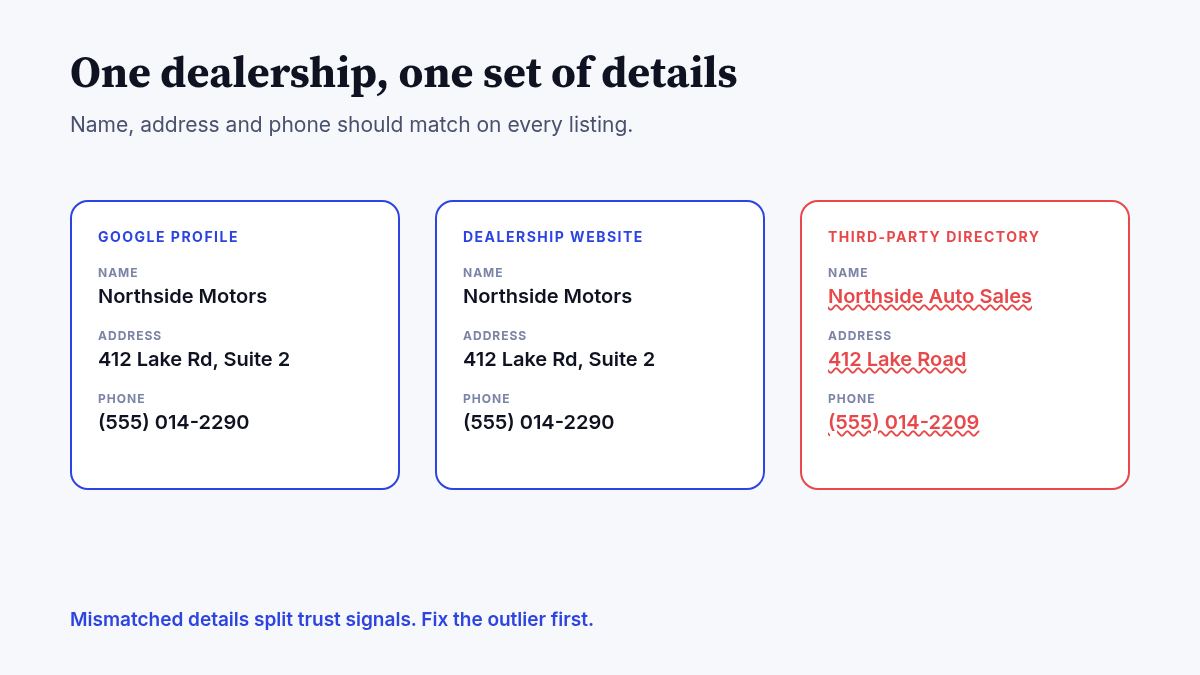
2. Inconsistent Dealership Name, Address, and Phone Information
NAP stands for Name, Address, and Phone Number. Accurate NAP information helps customers identify and contact the correct dealership.
Problems commonly appear after acquisitions, relocations, franchise rebranding, or changes to dealership telephone systems.
How to identify the problem
Compare approved dealership information against Google Maps, Apple Maps, Bing Places, Facebook, and relevant local or automotive directories.
Look for previous business names, disconnected telephone numbers, incorrect street addresses, and outdated department contact details.
Also compare directory information with the dealership's own website.
Minor punctuation or abbreviation differences are usually less important than materially incorrect information.
How to fix it
Create a master location record that acts as the approved reference for each dealership.
A useful record should contain:
| Field | Information to maintain |
|---|---|
| Location ID | Unique internal dealership identifier |
| Business name | Approved public-facing name |
| Address | Current customer-facing physical address |
| Map location | Verified pin and entrance information |
| Phone | Approved dealership or department number |
| Primary category | Correct business classification |
| Hours | Regular and special operating hours |
| Website | Relevant location or department URL |
| Profile owner | Authorized employee or account |
| Last verified | Date of the most recent review |
Update important consumer-facing platforms first. Then correct relevant secondary directories.
For dealership groups, assign someone responsibility for reporting changes and another person or team responsibility for approving publication.
Practical example: If a dealership relocates within Dallas, update its eligible existing Google Business Profile instead of creating another profile for the new address. Google explicitly advises businesses to update their existing profile after a move.
3. Incorrect Sales, Service, and Parts Department Profiles
Dealerships often operate several customer-facing departments at the same physical address.
Sales, service, and parts may have different business categories, working hours, contact numbers, and landing pages.
Using identical information for every department can confuse customers. Creating unnecessary profiles can also violate Google's policies.
How to identify the problem
Review how the dealership appears when people search for its sales department, service center, or parts counter.
Determine whether each profile represents a genuine dealership or department rather than an individual service offered by the business.
Check whether customers can find accurate department hours and relevant contact details.
How to fix it
Under Google's car dealership profile guidance:
- Dealerships may have a profile for the dealership and additional profiles for qualifying departments, including sales, service, and parts.
- New-car dealerships may also create profiles for individual new-car brands they sell.
- Used-car dealerships cannot create separate profiles for each used-car brand they sell.
Use the dealership name together with the department name where appropriate. Select the relevant business category and provide genuine customer-facing operating information.
For example, a service department should direct customers toward maintenance and repair information, not an unrelated new-car inventory page.
The dealership's main profile should accurately represent its dealership operations, while eligible department profiles should reflect their corresponding activities.
Important distinction: Multiple eligible departments may share one address. They are not automatically duplicate businesses merely because their addresses match.
4. Duplicate Dealership Listings on Google Maps
Duplicate Google Business Profiles can arise following acquisitions, dealership rebrands, ownership changes, or repeated attempts to create a listing.
Accidental duplicates can confuse customers, complicate management, and create uncertainty about which profile is authoritative.
How to identify the problem
Search using the dealership's current and previous names, address, and telephone number.
Compare the resulting profiles to determine whether they represent the same customer-facing business.
Check for differences in ownership, verification status, categories, reviews, and location details.
Do not classify a legitimate service department as an accidental duplicate without investigating.
How to fix it
Google's duplicate profile and ownership guidance describes different procedures for different situations.
If an existing profile belongs to another account, request ownership through Google's process.
If two profiles genuinely represent the same business, follow Google's process for reporting and requesting a merge.
If separate eligible businesses or departments have incorrectly been treated as duplicates, use the appropriate support or appeal process.
Avoid creating additional profiles while trying to recover access to an existing listing.
Also avoid deleting profiles without understanding the consequences. Removing a profile from an account and requesting its removal from Google Maps are not necessarily the same action.
Practical example: A dealership acquired by a new automotive group may discover two showroom profiles associated with the same location. The marketing team should investigate the older profile's status and ownership before submitting a merge request or making account changes.
5. Ignoring Dealership Reviews and Customer Feedback
Online reviews help shoppers evaluate a dealership's customer service, purchasing experience, maintenance quality, and communication.
They also matter to local search. Google states that review quantity and positive ratings can contribute to local prominence.
However, a dealership should not treat review generation as an exercise in manipulating its average rating.
How to identify the problem
Examine recent reviews across the main dealership and relevant department profiles.
Identify recurring complaints, unanswered feedback, unusual gaps in review activity, and inconsistent procedures for asking customers to share experiences.
Look at the operational patterns behind negative reviews rather than focusing exclusively on star ratings.
How to fix it
Establish a consistent process for inviting customers to leave genuine reviews after relevant interactions.
For example, a dealership can send a neutral review request after a vehicle purchase or completed maintenance appointment.
Google supports using business review links or QR codes to make this process easier.
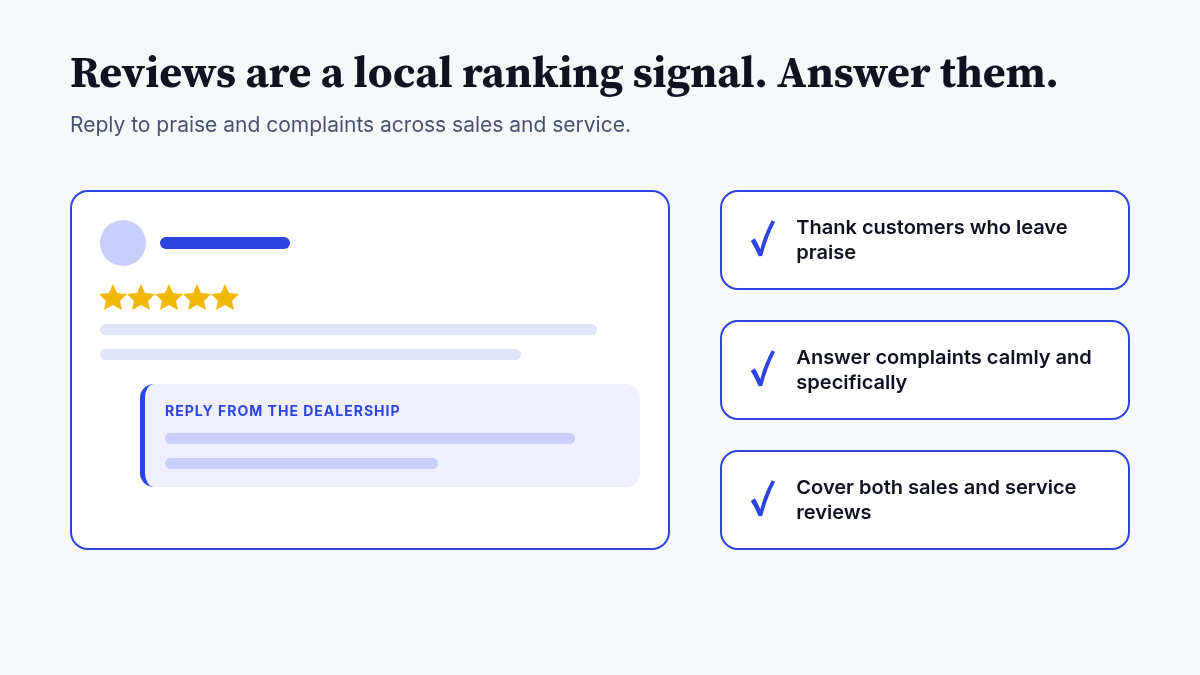
Respond to feedback professionally, particularly when customers raise concerns about service delays, billing discrepancies, or communication.
Do not disclose private customer or transaction information in public responses.
Crucially, Google's review policies prohibit incentives for posting, changing, or removing reviews, as well as discouraging negative reviews or selectively requesting positive ones.
Practical example: A service manager notices several reviews mentioning unclear repair timelines. Instead of posting identical apologies, the dealership can improve its customer communication process and respond individually when appropriate.
The objective is to improve the customer experience while making it easy for all customers to share authentic feedback.
6. Weak or Duplicate Dealership Location Pages
A multi-location automotive group may operate several showrooms but use nearly identical website pages for each location.
Some groups also direct every Google Business Profile to the same corporate homepage, even when customers need dealership-specific information.
A central homepage is useful, but it should not be the only place where shoppers can find relevant local details.
How to identify the problem
Examine the website page associated with each dealership.
Determine whether it provides the correct location name, contact information, operating hours, services, directions, and appointment options.
Look for pages created by replacing city names in otherwise identical text.
Also check whether important pages are accessible through normal website navigation and eligible for indexing.
How to fix it
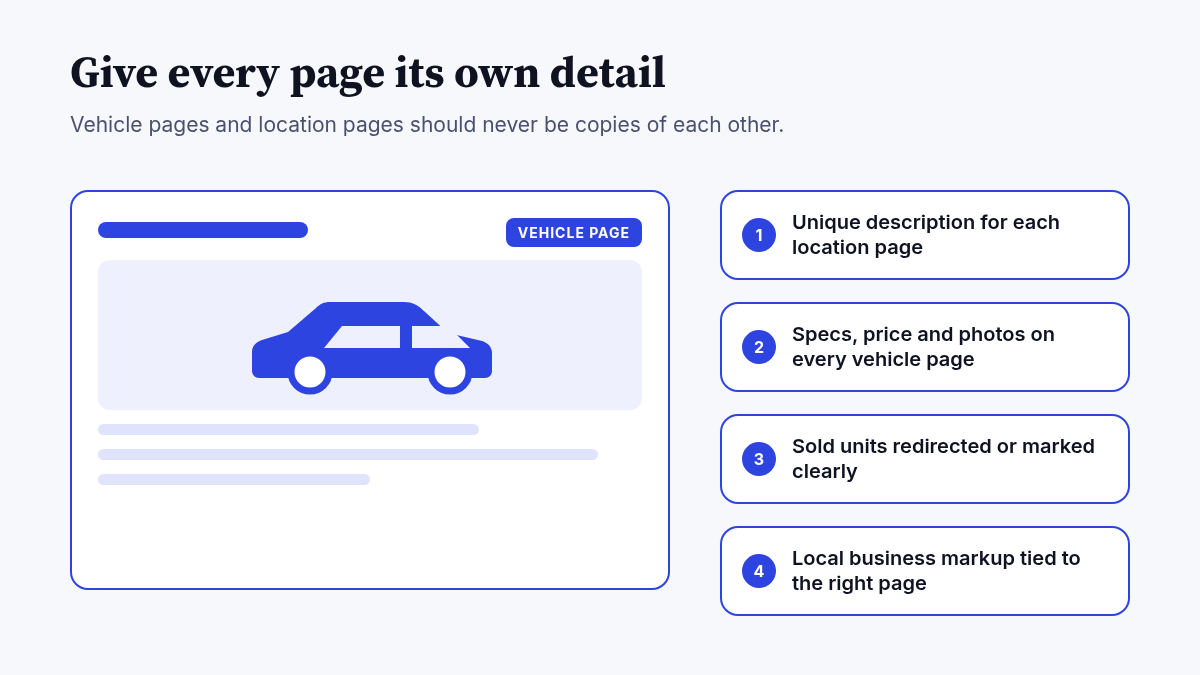
Create a useful, dedicated page for each physical dealership location.
For example:
exampledealer.com/locations/austin/
exampledealer.com/locations/san-antonio/
Each page should provide information that genuinely distinguishes that dealership.
Include the address, directions, relevant departments, sales and service hours, available customer facilities, and links to local inventory or appointment scheduling.
If a dealership has a separate service landing page, link to it from the relevant location page.
Use natural page titles and descriptive headings rather than repeating variations of "best car dealership" throughout the content.
Google's spam policies warn against doorway pages created primarily to rank for similar geographic searches while sending visitors to essentially the same destination. A dealership should therefore avoid producing dozens of generic city pages for places where it has no physical operation or meaningful localized offering.
Practical example: An Austin dealership location page could explain where the showroom entrance is located, whether service customers use a different entrance, and how customers can schedule a test drive.
These details are more useful than repeating a generic description of the parent dealership group.
7. Poorly Optimized Vehicle Inventory and Detail Pages
Vehicle inventory is central to dealership website performance.
A dealership might maintain accurate business listings but still lose potential opportunities because vehicle detail pages are inaccessible, outdated, or difficult to navigate.
Common problems include missing specifications, weak internal linking, incorrect availability, and inventory filtering systems that create excessive URLs.
How to identify the problem
Use Google Search Console to investigate important inventory categories and vehicle detail pages (VDPs).
Check whether important pages are crawlable, indexable, and correctly linked from relevant inventory categories.
Inspect representative pages for missing specifications, outdated stock information, broken images, and unclear customer actions.
Also determine whether inventory filters produce numerous near-identical URLs without meaningful additional value.
How to fix it
Publish accurate vehicle information, including the make, model, model year, trim, condition, mileage where applicable, and current availability.
Provide original vehicle photographs where available, along with clear information about important features and the next steps for interested shoppers.
Inventory category pages should help customers browse relevant stock. Individual vehicle pages should provide enough information for someone to evaluate a specific vehicle.
When inventory changes, update the affected pages promptly.
For sold vehicles, the appropriate treatment depends on the page's ongoing purpose:
| Vehicle page situation | Recommended approach |
|---|---|
| Vehicle remains available | Keep specifications, availability, and calls to action current |
| Vehicle is sold but page remains useful | Clearly mark its status and link to relevant alternatives |
| Vehicle is permanently unavailable and has no useful replacement | Consider a proper 404 or 410 response |
| Page has a genuinely close replacement | Consider a relevant redirect rather than an unrelated homepage redirect |
| Filter creates unnecessary duplicate URLs | Review crawling, canonicalization, and indexing strategy |
Google's guidance on faceted navigation explains how extensive filter combinations can generate unnecessary URLs and complicate crawling.
Important structured-data change in 2025
Google announced the retirement of several Search rich-result features in June 2025, including the special Vehicle Listing display.
By September 2025, Google had also begun removing related reporting and testing support.
Dealerships should therefore not expect deprecated Vehicle Listing markup to generate that former Google Search rich-result appearance.
Other relevant structured data can still describe suitable page content, provided it follows the applicable requirements.
The priority should be accurate, accessible inventory information rather than adding markup solely in pursuit of a search feature that no longer exists.
8. Ignoring Mobile Performance and Technical SEO
Dealership websites commonly use inventory filters, large image galleries, financing tools, appointment forms, and third-party chat systems.
These features can improve usability, but poor implementation can introduce performance problems.
How to identify the problem
Test the website on a real mobile device and use Google Search Console and PageSpeed Insights for additional diagnostics.
Check for slow image loading, unresponsive buttons, layout movement, broken forms, unnecessary redirects, and important pages incorrectly blocked from search indexing.
Test actual dealership tasks rather than evaluating performance scores alone.
For instance, a shopper should be able to filter used vehicles, view a vehicle detail page, and submit a test-drive request without the interface becoming difficult to use.
How to fix it
Optimize large vehicle images, reduce unnecessary scripts, and investigate third-party widgets that negatively affect responsiveness.
Check server responses, redirects, canonical tags, internal links, and crawl directives.
Google's Core Web Vitals documentation recommends the following good user-experience thresholds:
| Metric | Good threshold | What it measures |
|---|---|---|
| Largest Contentful Paint (LCP) | 2.5 seconds or less | Loading performance |
| Interaction to Next Paint (INP) | 200 milliseconds or less | Responsiveness |
| Cumulative Layout Shift (CLS) | 0.1 or less | Visual stability |
These measures help assess page experience. Meeting them does not guarantee higher search rankings.
For dealership websites, prioritize functional inventory searches, click-to-call actions, service scheduling, finance inquiries, and test-drive forms.
A technically accessible page is valuable, but a page that allows users to complete their intended task is even more useful.
9. Neglecting Local Citations and Business Directories
A dealership's Google Business Profile may be accurate while its information on other consumer platforms remains outdated.
Customers researching vehicle sales or maintenance may encounter contradictory addresses, contact numbers, or opening hours.
These discrepancies can create unnecessary friction.
How to identify the problem
Inspect important mapping platforms, social profiles, relevant automotive directories, and established regional business listings.
Compare their information against the dealership's approved master record.
Prioritize material errors that could misdirect customers.
How to fix it
Claim and correct important listings where the platform allows it.
Update information following acquisitions, relocations, rebrands, telephone changes, and department restructures.
Avoid acquiring hundreds of low-quality directory mentions simply to increase the number of citations.
There is no Google-published citation count that guarantees a particular local ranking.
For multi-location organizations, maintain centralized approval while allowing local dealership teams to report operational changes.
An effective workflow should track the requested change, responsible person, publication status, and verification outcome.
10. Failing to Build Relevant Local Authority
Business profiles and directories are only part of a dealership's digital presence.
Legitimate local recognition can help customers discover the dealership and contribute to its wider online reputation.
A dealership may already participate in community activities without documenting those relationships on its website.
How to identify the problem
Review the dealership's community involvement, relevant referring websites, and existing local partnerships.
Identify legitimate organizations that already mention or work with the dealership.
Look for inaccurate or missing information in public-facing partner references.
How to fix it
Where relevant, maintain relationships with local business organizations, charitable initiatives, educational programs, automotive events, and community sponsorships.
Publish genuinely useful information about those activities.
For example, if a dealership helps organize a local road-safety event, an organizer might naturally publish a link to the dealership as a participating organization.
The primary purpose should be a legitimate community or business relationship, not acquiring links solely to manipulate rankings.
Avoid paid links intended to pass ranking credit, artificial link exchanges, and large-scale manipulative link-building schemes.
Google treats link spam as a violation of its Search spam policies.
11. Not Tracking Dealership SEO Conversions
Dealership marketing teams sometimes measure local SEO success using only keyword positions, website traffic, or profile views.
These numbers help describe visibility, but they do not necessarily show whether the business is receiving qualified inquiries.
A dealership needs to understand what happens after a potential customer discovers it.
How to identify the problem
Review whether analytics systems can distinguish organic discovery, profile interactions, website inquiries, appointments, and qualified leads.
Test contact forms and conversion events to ensure submissions are recorded correctly.
Check whether dealership CRM records can help evaluate lead quality.
How to fix it
Use Google Search Console to understand organic discovery and an appropriate analytics platform to measure relevant website interactions.
Where possible, connect reporting to the dealership CRM or lead management process.
Track the following metrics:
| Metric | Business purpose |
|---|---|
| Organic impressions and clicks | Understand search discovery |
| Local search visibility | Identify geographic visibility gaps |
| Business Profile interactions | Monitor engagement with local profiles |
| Phone inquiries | Assess potential customer demand |
| Test-drive requests | Measure buyer interest |
| Finance inquiries | Track financing-related intent |
| Service appointments | Monitor aftersales opportunities |
| Qualified leads | Evaluate inquiry quality |
| Lead-to-appointment rate | Identify conversion friction |
Use distinct reporting for dealership locations and major customer-facing departments where practical.
Be careful with attribution. A Google Business Profile call click is not necessarily a completed telephone conversation, and a form submission is not automatically a qualified buyer.
Practical example: Suppose a dealership's organic website visits decline while its verified service appointment inquiries increase. Traffic alone would suggest weaker performance, but appointment data could reveal a more commercially useful result.
Evaluate visibility and customer outcomes together rather than treating search rankings as the only measure of success.
12. Overlooking AI-Powered Local Search Experiences
Car shoppers can encounter dealership information through conventional search results, maps, and AI-assisted discovery tools.
Some searches are highly specific, such as asking which nearby dealership offers a particular service or which vehicle sellers have weekend hours.
Inaccurate business information can create problems regardless of the discovery system involved.
How to identify the problem
Check how dealership information is presented across relevant search experiences.
Test representative customer questions, such as:
- "Which Toyota dealerships in Austin offer Saturday service?"
- "Where can I find a used SUV dealership near Dallas?"
- "Which dealerships nearby offer online service scheduling?"
Evaluate the accuracy of any returned dealership names, service descriptions, website links, and operating information.
Treat these observations as diagnostic examples, not comprehensive visibility measurements.
AI-generated responses can vary, and a business appearing in one test does not establish consistent visibility.
How to fix it
Maintain complete and accurate Business Profile information.
Make important location, department, and service information available in crawlable text on the dealership website.
Use descriptive internal links so customers and search crawlers can discover the relevant pages.
Where appropriate, implement valid LocalBusiness structured data that matches the visible business information.
Google's LocalBusiness structured-data documentation explains how businesses can describe locations, addresses, telephone numbers, and opening hours.
However, Google's AI features guidance explicitly states that no additional special optimization or schema is required to appear in AI Overviews or AI Mode. Existing SEO fundamentals remain applicable.
Dealerships should therefore prioritize accurate, helpful, accessible information rather than creating special AI-only pages or relying on promises of guaranteed citations.
Tools for Fixing Dealership Local SEO Problems in 2026
Software can help dealerships identify inaccurate listings, manage customer feedback, coordinate updates, and monitor local search performance.
The following four platforms address different operational needs.
The comparisons are based on publicly documented product capabilities rather than hands-on testing or independently measured dealership performance.
1. Synup — Centralized Multi-Location Listings Management
Best for: Dealership groups and agencies that need coordinated business-listing management across multiple locations.
Key capabilities: Synup provides centralized tools for distributing location information across supported platforms. Its documented capabilities include location data management, duplicate-listing detection, bulk updates, performance monitoring, and reporting.
Differentiator: Synup is particularly relevant when dealership teams need to maintain a common set of approved business details across many profiles. Its listing-management features can reduce repeated manual work when information changes across locations.
Limitations: The platform still depends on accurate dealership data and appropriately configured publisher connections. Dealership teams should confirm how department profiles, approval permissions, integrations, and duplicate-resolution workflows would operate in their specific environment.
Pricing: Request or review the current commercial terms and included features directly with Synup.
Choose Synup if: Coordinating accurate business listings across several dealership rooftops is your primary requirement.
2. BrightLocal — Local SEO Auditing and Citation Monitoring
Best for: Dealership marketing teams and agencies that need visibility diagnostics, citation monitoring, and local search reporting.
Key capabilities: BrightLocal provides local rank tracking, Google Business Profile auditing, citation tracking, local search audits, and review-related features depending on the selected offering. Citation-building services are also available.
Differentiator: BrightLocal is useful for systematically identifying visibility problems, reviewing citation accuracy, and comparing performance across target locations. It can support teams that prioritize diagnosis and reporting alongside listing corrections.
Limitations: The available features depend on the product and plan. Dealership groups should assess location allowances, reporting requirements, citation services, and whether the chosen package supports the required level of ongoing listings management.
Pricing: BrightLocal publishes subscription pricing and separate citation-building options on its website.
Choose BrightLocal if: Your dealership needs structured local SEO audits, ranking diagnostics, and citation monitoring.
3. Yext — Enterprise Location Data Management
Best for: Large dealership groups that need centralized location information, permissions, publisher integrations, and coordinated publishing.
Key capabilities: Yext offers centralized business information management, listings distribution, publisher connections, performance reporting, and enterprise controls. Its platform supports managing updates across numerous business locations.
Differentiator: Yext emphasizes structured information management and enterprise governance. This may be useful when corporate marketing, regional teams, and individual dealerships need different responsibilities and permissions.
Limitations: Buyers should assess implementation requirements, pricing, account structure, publisher coverage, and the practical handling of dealership and department profiles. Its broader capabilities may exceed the needs of a smaller dealership with limited operational complexity.
Pricing: Confirm current packages, location-based costs, and contractual arrangements with Yext.
Choose Yext if: Your automotive organization prioritizes centralized governance and controlled distribution across many locations.
4. Birdeye — Dealership Reviews and Listings Management
Best for: Dealership groups that want to manage reputation, customer feedback, and business-listing accuracy within a broader customer-experience workflow.
Key capabilities: Birdeye provides tools for monitoring and responding to reviews, collecting customer feedback, managing business listings, and reviewing multi-location information. Its product range includes reputation and local-presence capabilities.
Differentiator: Birdeye is particularly relevant when customer feedback and business-listing operations are closely connected. Dealership teams can evaluate reputation management alongside broader customer engagement and reporting needs.
Limitations: Feature availability varies by package and configuration. Buyers should confirm which listings, reviews, automation, messaging, and integration capabilities are included, especially where dealership CRM connections are required.
Pricing: Request current pricing based on the number of locations and selected products.
Choose Birdeye if: Customer reputation management and accurate dealership listings are both major priorities.
Dealership Local SEO Software Comparison
| Platform | Best use case | Main capability focus | Main buying consideration |
|---|---|---|---|
| Synup | Multi-location dealerships | Centralized listing publishing and management | Department support and workflow requirements |
| BrightLocal | Local SEO auditing | Ranking, citation, and visibility diagnostics | Plan features and location allowances |
| Yext | Enterprise dealer groups | Business data governance and distribution | Implementation and contract requirements |
| Birdeye | Reputation-focused dealerships | Review and listing management | Module selection and integrations |
What Should Dealerships Ask Before Choosing Software?
The platform with the most features is not necessarily the most appropriate for every dealership.
A purchasing evaluation should investigate whether the software supports the organization's actual operating model.
Ask vendors how they handle multiple dealership rooftops, eligible sales and service profiles, publisher-specific changes, duplicate records, and employee access.
Request a demonstration using a representative dealership location rather than only viewing generic examples.
Also confirm which tasks are automated and which require human approval, how sync errors are escalated, and what happens to business listings when the subscription ends.
For dealership groups, evaluate total cost across the actual number of locations and departments rather than comparing a single-location subscription with an enterprise contract.
No software can replace reliable source data, useful website information, or a dealership's responsibility for customer service.
How to Conduct a Dealership Local SEO Audit
An effective dealership audit should identify search visibility problems and customer-experience issues within the same workflow.
The following seven-step process can be used by individual dealerships or automotive groups.
Step 1: Audit Google Business Profiles
Review profile ownership, verification status, categories, addresses, map pins, hours, department configuration, and customer contact information.
Pay particular attention to discrepancies that could send customers to the wrong address or department.
Record each issue rather than making untracked changes across multiple accounts.
Step 2: Compare Business Listings
Use the approved master dealership record to compare information across important maps, social platforms, and directories.
Prioritize errors involving phone numbers, opening hours, addresses, and business status.
Step 3: Investigate Duplicate Profiles
Search dealership names, historical brands, locations, and contact numbers.
Determine which profiles are genuine duplicates and which represent legitimate departments or eligible businesses.
Review ownership and verification before requesting changes.
Step 4: Review Location and Inventory Pages
Inspect dealership location pages, inventory categories, representative VDPs, and service landing pages.
Use Google Search Console to investigate indexing and canonicalization problems.
Identify broken links, outdated inventory, missing local details, and unnecessary duplicate URLs.
Step 5: Test Mobile Customer Tasks
Load the website on a mobile phone and complete representative customer journeys.
Attempt to search for a vehicle, open a detail page, call the dealership, request a test drive, and schedule a service appointment.
Document the point at which any task fails.
Step 6: Audit Reviews and Local Authority
Review customer feedback, response practices, and relevant local mentions.
Identify recurring operational concerns and opportunities to improve genuine community relationships.
Avoid manipulative review collection or artificial link building.
Step 7: Evaluate Conversions and Assign Owners
Review organic search visibility, Business Profile interactions, website leads, phone inquiries, and appointments.
Create an issue register that records the problem, affected location, severity, assigned owner, and next action.
For example:
| Issue | Location | Severity | Owner | Required action |
|---|---|---|---|---|
| Incorrect service hours | Dallas dealership | Critical | Location manager | Verify and update hours |
| Missing local inventory links | Austin dealership | High | Website team | Restore inventory navigation |
| Outdated directory phone | Houston dealership | Medium | Listings manager | Correct directory entry |
| Unanswered customer feedback | San Antonio dealership | Medium | Customer experience team | Review and respond |
This structure makes the audit actionable rather than producing a report that nobody owns.
Dealership SEO Audit Priority Framework
| Severity | Example | Recommended response |
|---|---|---|
| Critical | Wrong address, disconnected phone, incorrect map pin | Correct as soon as possible |
| High | Broken appointment form, missing eligible location page, important indexing error | Prioritize in the current work cycle |
| Medium | Outdated relevant directory entry, content gap, unresolved review issue | Schedule corrective work |
| Low | Minor formatting differences or optional enhancements | Include in routine maintenance |
The priority should reflect business consequences as well as SEO considerations.
A moderately important ranking issue may be less urgent than a broken service booking form that prevents customers from scheduling appointments.
30-Day Dealership Local SEO Improvement Plan
A focused 30-day plan helps dealerships correct existing problems before expanding their marketing efforts.
| Timeline | Main activities | Deliverable |
|---|---|---|
| Days 1–7 | Review profiles, NAP details, departments, duplicates, and site accessibility | Prioritized issue register |
| Days 8–14 | Correct inaccurate core listings and resolve profile management issues | More reliable business information |
| Days 15–21 | Improve location pages, important inventory content, mobile usability, and technical SEO | Corrected website issues |
| Days 22–30 | Improve review workflows, validate conversion tracking, and establish reporting | Ongoing maintenance process |
Days 1–7: Identify the Highest-Impact Problems
Begin with issues that could prevent customers from finding or contacting a dealership.
Review every physical location and eligible department. Create a master information record and document profile access.
Avoid spending the first week on optional keyword refinements while critical address or telephone errors remain unresolved.
Days 8–14: Correct Location Information
Fix inaccurate addresses, phone numbers, categories, operating hours, and important directory records.
Follow the correct Google procedures for duplicate profiles and ownership problems.
Some platform changes may require additional verification or review, so monitor their status rather than assuming that submitting an update means it is already live.
Days 15–21: Improve Website Content and Usability
Update dealership location pages and inspect major inventory categories.
Correct broken pages, inaccurate vehicle availability, and significant indexing issues.
Test customer journeys on mobile devices and investigate slow or unresponsive interactions.
Give priority to pages and functions that support genuine customer decisions.
Days 22–30: Establish Repeatable Processes
Introduce a compliant review-request workflow and clear review-response responsibilities.
Validate conversion tracking and CRM reporting where applicable.
Set a recurring maintenance schedule covering profile accuracy, website functionality, and unresolved issues.
A useful operating rhythm might involve weekly checks for urgent changes, monthly location-data reviews, and more comprehensive quarterly audits.
These frequencies are practical recommendations, not Google requirements.
For an additional perspective on organizing ongoing work, see Miidasu's guide to business listing management without a dedicated SEO hire.
How Can Dealerships Measure Local SEO Improvement?
Local SEO performance should be assessed through multiple types of evidence.
Visibility metrics help determine whether searchers can discover the dealership. These include relevant organic impressions, clicks, geographic search visibility, and available Business Profile performance metrics.
Engagement metrics describe customer interaction. Examples include calls, direction requests, local landing-page visits, and inventory engagement.
Conversion metrics connect discovery with dealership outcomes. These include test-drive submissions, service appointments, financing inquiries, and qualified leads.
Operational metrics measure whether dealership information remains dependable. Useful measures include the number of unresolved critical listing errors, correction times, and the accuracy of important location fields.
Compare meaningful time periods and account for seasonality, inventory availability, promotions, and other demand changes.
For example, a dealership may experience higher branded search activity during an advertising campaign. That increase should not automatically be attributed entirely to local SEO improvements.
Likewise, lower search visibility in one geographic area does not necessarily indicate an optimization failure. Distance is one of Google's main local ranking considerations.
The objective is to understand how accurately represented dealership locations, useful website content, and improved customer journeys contribute to real business outcomes.
Frequently Asked Questions
What are the most common dealership local SEO mistakes?
Common problems include incomplete Google Business Profiles, incorrect NAP information, duplicate listings, misconfigured department profiles, weak location pages, outdated inventory, unmanaged reviews, and technical website issues. Dealerships should prioritize problems that prevent customers from finding, contacting, or visiting the business.
Why is my dealership not ranking on Google Maps?
Google Maps visibility depends on relevance, distance, and prominence. An unsuitable primary category, inaccurate business information, weak local prominence, or the searcher's location may affect results.
Start by verifying profile eligibility, categories, address accuracy, and search visibility across relevant geographic areas.
Do dealerships need separate profiles for sales, service, and parts?
Google allows dealerships to maintain additional profiles for eligible departments, including sales, service, and parts. Each profile should accurately represent the relevant department. Creating separate profiles for every individual service or product is not appropriate.
Do Google reviews help dealership local rankings?
Google states that more reviews and positive ratings can contribute to local rankings. However, there is no guaranteed review-count threshold. Dealerships should focus on authentic reviews, compliant requests, helpful responses, and improving the customer experience.
Should multi-location dealerships use separate location pages?
Dedicated location pages are generally useful when each page represents a genuine physical dealership and provides relevant local information.
They should include accurate contact details, operating hours, available services, and links to location-specific customer actions.
Avoid creating near-identical pages solely to target different city names.
How often should car dealerships audit local SEO?
Monthly spot-checks and quarterly comprehensive reviews are reasonable starting points, although the ideal schedule depends on the number of locations and how frequently information changes.
Immediate additional checks are appropriate after relocations, acquisitions, rebrands, department changes, or significant website updates.
Can dealerships improve their presence in AI-powered search?
Dealerships can make their information easier to discover and interpret by maintaining accurate business profiles, publishing clear website content, allowing appropriate crawling, and using valid structured data.
These practices follow established SEO fundamentals, but they do not guarantee inclusion in AI-generated answers.
Final Thoughts
Fixing common dealership local SEO mistakes starts with dependable business information, correctly configured Google Business Profiles, and dealership website pages that help customers accomplish real tasks.
The most urgent problems are often straightforward: incorrect addresses, wrong department hours, duplicate profiles, broken inventory links, and nonfunctional appointment forms.
Reviews, technical website quality, legitimate local relationships, and reliable conversion reporting also deserve attention.
For multi-location automotive groups, a consistent operating process is especially important. Centralized tools such as Synup, BrightLocal, Yext, and Birdeye can support different requirements, but each organization still needs clear accountability for data accuracy and customer experience.
Effective dealership local SEO is not simply about improving search positions. It is about helping nearby customers find the right dealership, understand its services, access current inventory, and contact or visit the business with confidence.