Inventive AI is a strong starting point for AI-first proposal workflows. Responsive suits complex enterprise response management, Loopio emphasizes structured collaboration, and QorusDocs supports Microsoft 365-centered proposal creation. Arphie and Conveyor offer additional AI-powered approaches to drafting and knowledge management.
This guide compares their capabilities, limitations, pricing considerations, and potential productivity benefits to help you choose the right solution.
What Is RFP Software for Proposal Team Productivity?
RFP software for proposal teams helps organizations create, manage, review, and submit responses to requests for proposals (RFPs).
Instead of coordinating responses through disconnected spreadsheets, emails, and shared documents, proposal managers can use a centralized platform to manage assignments, access approved content, track deadlines, and complete reviews.
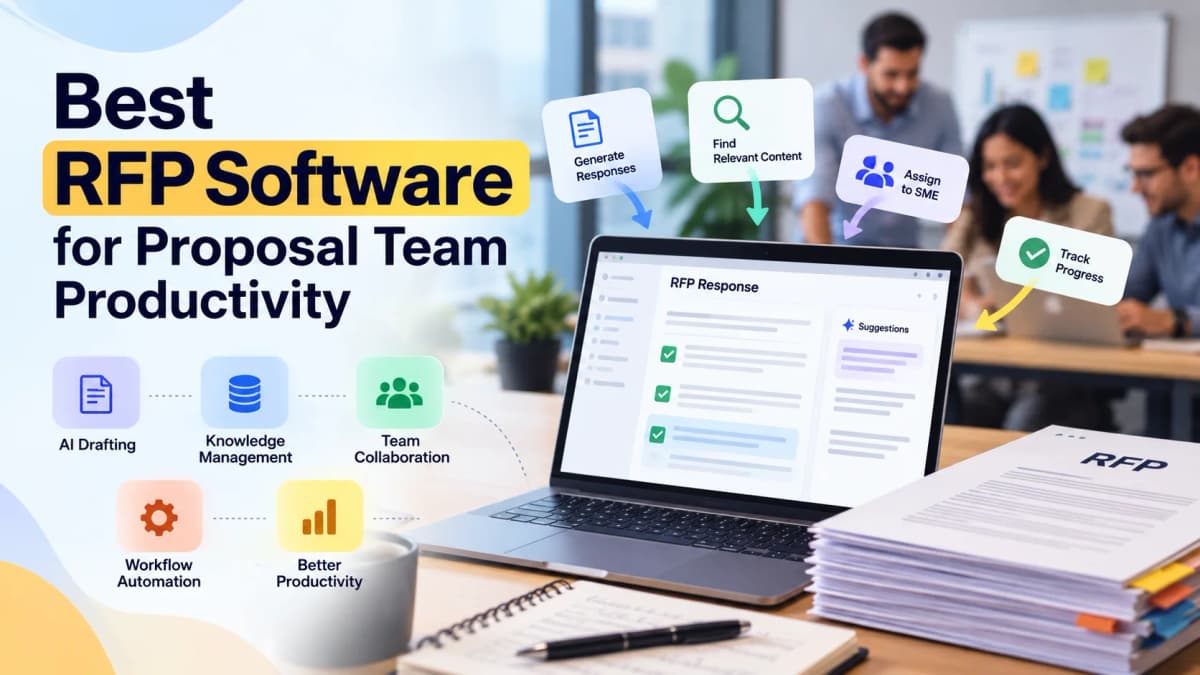
Modern RFP response software may provide:
- AI-assisted response generation: Prepare draft answers using company documentation and previously approved responses.
- Centralized knowledge management: Store, retrieve, and maintain reusable technical, product, security, and commercial information.
- SME collaboration: Assign questions to subject matter experts and manage their contributions.
- Workflow automation: Track deadlines, ownership, review stages, and approvals.
- Response quality controls: Identify missing information, inconsistent answers, and potentially outdated content.
- Reporting and analytics: Measure response turnaround time, project workloads, content usage, and proposal outcomes.
Some platforms also connect directly to organizational knowledge repositories, reducing the need to maintain separate copies of existing documentation.
An important distinction is that RFP software can describe both tools used by buyers to issue and evaluate RFPs and tools used by vendors to respond to them. This article focuses on the second category: RFP response and proposal management software.
The Association of Proposal Management Professionals (APMP) provides professional knowledge resources covering proposal planning, management practices, and response development.
The objective of proposal automation is not simply to generate more words in less time. It is to reduce administrative work while preserving the accuracy, relevance, and competitiveness of submitted proposals.
Best RFP Software for Proposal Teams: Quick Comparison
| RFP software | Best suited for | Notable capabilities | Main consideration |
|---|---|---|---|
| 1. Inventive AI | AI-first proposal operations | Source-grounded drafting, knowledge governance, SME assignments, response checks | Validate AI accuracy, workflow fit, and usage-based costs |
| 2. Responsive | Enterprise response management | AI drafting, content health, project workflows, enterprise integrations | Assess configuration and governance requirements |
| 3. Loopio | Structured collaboration and content reuse | Response Intelligence, content library, SME coordination, analytics | Test library maintenance and document handling |
| 4. QorusDocs | Microsoft 365-centered teams | Proposal automation, templates, co-authoring, branded outputs | Confirm template flexibility and Microsoft workflow fit |
| 5. Arphie | AI-driven knowledge and questionnaire workflows | Connected sources, AI drafting, source visibility, approvals | Evaluate source coverage and answer review needs |
| 6. Conveyor | RFP and security questionnaire automation | Document mapping, AI drafting, source citations, assignment workflows | Test complex documents and procurement portals |
How These Platforms Were Evaluated
This comparison uses publicly available vendor documentation to examine six areas:
- AI drafting and source verification
- Content management and knowledge freshness
- Collaboration and approval workflows
- Document processing and integrations
- Reporting and administrative capabilities
- Pricing transparency and practical limitations
The recommendations reflect documented capabilities and likely use-case fit. They are not based on independent hands-on testing, controlled productivity benchmarks, or verified head-to-head implementation results.
The order should not be interpreted as a numerical performance ranking.
For additional customer perspectives, buyers can review the G2 RFP Software category and Capterra's RFP software directory. Consider review dates, reviewer roles, company size, and recurring complaints rather than relying only on aggregate ratings.
6 RFP Software Platforms Worth Comparing in 2026
1. Inventive AI — For AI-First Proposal Team Productivity
Best for: Proposal managers, solution engineers, and B2B sales teams looking to automate drafting, knowledge management, and coordination across RFP projects.
Inventive AI provides AI-powered RFP response management with source-grounded drafting, knowledge management, SME collaboration, and review workflows.
The platform uses AI agents to generate answers from company documentation, past proposals, and connected knowledge repositories. It also supports requirement analysis, task assignments, response completeness checks, and content maintenance.
Key productivity capabilities
Inventive AI's approach combines drafting automation with knowledge governance and project coordination.
Its documented capabilities include:
- AI-generated responses supported by source references.
- Connections to organizational knowledge sources, including Google Drive, SharePoint, Notion, and Confluence.
- SME assignments, task tracking, and collaborative review workflows.
- AI-assisted content maintenance and identification of potentially outdated information.
- Response quality and completeness checks.
- Reporting on response throughput, turnaround time, and proposal-related outcomes.
These capabilities can help proposal managers reduce repetitive searches, organize review responsibilities, and monitor progress across active projects.
Where Inventive AI may improve productivity
Consider a proposal team responding to an RFP with 250 questions involving security, implementation, product functionality, and customer support.
Instead of manually assigning every question and searching previous proposals for relevant answers, the team can use AI-assisted drafts and connected knowledge sources to prepare a first pass.
Proposal managers can then coordinate SMEs and concentrate on customer-specific answers, material commitments, and final response quality.
The potential advantage is a reduction in both drafting effort and coordination overhead.
Limitations and considerations
AI-generated responses still require verification. Organizations should test how accurately the platform interprets complex requirements, resolves conflicting information, preserves document formatting, and handles company-specific terminology.
Teams should also review which source repositories are accessible, how permissions are applied, and whether the resulting workflow meets internal approval requirements.
Inventive AI's usage-based pricing structure is another factor to evaluate, especially for organizations with fluctuating response volumes.
Why consider it: Inventive AI is particularly relevant when the primary objective is to reduce manual work throughout the RFP response lifecycle, rather than automate drafting alone.
2. Responsive — For Enterprise RFP Response Management
Best for: Enterprise proposal teams managing multiple response types, large content repositories, and complex cross-functional approval processes.
Responsive, formerly RFPIO, provides response management capabilities for RFPs, RFIs, due diligence questionnaires, security assessments, and related information requests.
Its platform combines AI-assisted response generation, centralized content management, project coordination, reporting, and integrations with business applications.
Key productivity capabilities
Responsive supports repeatable response workflows across teams and departments.
Its documented capabilities include:
- AI-assisted drafting using organizational knowledge.
- A centralized response content library.
- Content health and review capabilities.
- Project assignments, tracking, and notifications.
- Requirements analysis and response workflows.
- Integrations with Salesforce, Slack, Microsoft applications, and other business tools.
These capabilities are relevant to organizations where proposal management involves sales, security, legal, product, and other departments.
Where Responsive may improve productivity
An enterprise responding to several overlapping RFPs can benefit from consistent workflows and centralized access to approved company information.
Proposal managers can coordinate contributors, track deadlines, reuse existing content, and manage review stages without relying entirely on email-based follow-ups.
The platform may be particularly useful when an organization wants standardized response management across several business units.
Limitations and considerations
Enterprise teams should evaluate configuration complexity, permissions, library governance, and implementation requirements.
The ability to configure extensive workflows does not automatically mean every organization needs those workflows.
Buyers should test whether occasional contributors can complete assignments without unnecessary training or administrative effort.
They should also assess how AI-generated responses are reviewed and how content updates are propagated across the organization.
Why consider it: Responsive is a relevant option for organizations needing enterprise-wide consistency, structured workflows, and integration with established response management processes.
3. Loopio — For Structured Collaboration and Content Reuse
Best for: Proposal teams seeking organized content management, repeatable response workflows, and effective collaboration with SMEs.
Loopio is an RFP response management platform that combines reusable content, project management, collaboration features, and AI-supported response capabilities.
Its Response Intelligence technology helps teams work with existing knowledge, identify relevant answers, and manage response activities.
Key productivity capabilities
Loopio emphasizes structured processes supported by accessible company knowledge.
Its documented capabilities include:
- Centralized storage and retrieval of reusable response content.
- AI-supported drafting and response recommendations.
- SME collaboration and project assignments.
- Content management and review workflows.
- Integrations with Salesforce and business knowledge repositories.
- Analytics covering proposal processes and content effectiveness.
These functions support teams that receive similar questions across multiple proposals but still require accurate, customer-specific responses.
Where Loopio may improve productivity
A proposal team responding to recurring implementation, security, and product capability questions may spend considerable time locating previously approved answers.
Loopio can help centralize those responses and organize their reuse.
Its project workflows also provide a structured way to manage contributors and monitor completion.
This can be valuable for teams moving from informal document-based processes to a more consistent response operation.
Limitations and considerations
A reusable content library requires ongoing ownership and governance.
Organizations should evaluate how approved responses are updated, how content owners receive review requests, and how outdated information is identified.
Teams should also test document import, export, and formatting requirements using their own RFP templates.
AI recommendations remain dependent on the accuracy and relevance of underlying knowledge.
Why consider it: Loopio is particularly relevant for proposal teams that value standardized collaboration, controlled content reuse, and repeatable response processes.
4. QorusDocs — For Microsoft 365-Centered Proposal Teams
Best for: Professional services firms, business development teams, and proposal departments creating customized documents in Microsoft-centered environments.
QorusDocs provides proposal and RFP management capabilities focused on document automation, content reuse, collaboration, and branded deliverables.
Its platform integrates with Microsoft 365 and supports connections with CRM systems such as Salesforce and Microsoft Dynamics.
Key productivity capabilities
QorusDocs supports document-heavy proposal operations.
Its documented capabilities include:
- AI-assisted proposal and RFP response drafting.
- Reusable content libraries and templates.
- Microsoft 365-centered document creation.
- Co-authoring, version control, and approval workflows.
- CRM integrations and opportunity-related information.
- Branding, customization, and proposal analytics.
The platform also supports functions beyond questionnaire completion, including business case and proposal document development.
Where QorusDocs may improve productivity
Consider a professional services team producing proposals that include an executive summary, delivery methodology, team biographies, commercial schedules, and customized presentation materials.
A substantial portion of the workload may involve assembling branded documents rather than answering isolated questionnaire fields.
QorusDocs can help teams reuse approved materials and create customized deliverables within familiar document workflows.
This makes it relevant when document presentation and consistency are important parts of the proposal process.
Limitations and considerations
Organizations should test compatibility with existing templates, document complexity, branding requirements, and approval processes.
Buyers should also verify the depth of Microsoft and CRM integrations for their selected deployment.
A team whose primary workload involves simple, repetitive security questionnaires may have different requirements from one producing highly customized client proposals.
Why consider it: QorusDocs is worth evaluating when proposal productivity depends heavily on document creation, customization, co-authoring, and Microsoft 365 workflows.
5. Arphie — For AI-Driven RFP and Knowledge Workflows
Best for: Teams seeking AI-generated responses supported by connected organizational knowledge and transparent source references.
Arphie provides AI-powered automation for RFPs, due diligence questionnaires, security questionnaires, and related response workflows.
Its platform uses AI agents to generate drafts, connect with knowledge systems, coordinate contributors, and support answer reviews.
Key productivity capabilities
Arphie's approach emphasizes access to connected business information rather than relying exclusively on manually maintained answer libraries.
Its documented capabilities include:
- AI-generated responses based on organizational knowledge.
- Live connections to Google Drive, SharePoint, Confluence, Notion, and other systems.
- Source references and confidence information for AI-generated answers.
- Collaborative review, assignment, and approval workflows.
- Knowledge governance and content maintenance capabilities.
- Project visibility and workflow-related reporting.
These capabilities may reduce the time employees spend searching different repositories before drafting answers.
Where Arphie may improve productivity
A technology organization may maintain information across product documentation, security policies, sales materials, and internal knowledge bases.
When that information changes frequently, manually maintaining a separate RFP response library becomes challenging.
Arphie's connected knowledge approach can help teams retrieve relevant information and prepare initial answers without duplicating every source document.
Proposal managers and SMEs can then validate whether the retrieved evidence supports each response.
Limitations and considerations
Connected knowledge does not automatically mean verified knowledge.
Teams must confirm that source documents are authoritative, current, accessible to the appropriate users, and applicable to the customer's requirements.
Organizations should also evaluate document handling, approval controls, reporting, and source coverage during a pilot.
Why consider it: Arphie is relevant for teams that want to reduce manual knowledge searches while preserving visibility into the information used to prepare responses.
6. Conveyor — For RFP and Security Questionnaire Automation
Best for: B2B technology organizations managing RFPs, security questionnaires, vendor assessments, and other documentation-heavy requests.
Conveyor provides AI-powered response automation, document processing, knowledge-source connections, collaborative editing, and workflow management.
Its software supports RFP and questionnaire responses across various documents and procurement workflows.
Key productivity capabilities
Conveyor combines response generation with document handling and knowledge maintenance.
Its documented capabilities include:
- AI-generated drafts supported by source references.
- RFP question extraction and document mapping.
- Connections to organizational knowledge repositories.
- Reuse of previously approved answers.
- Automated task assignments, reminders, and reviews.
- Document editing and support for Word, Excel, PDF, and selected procurement portals.
These capabilities are particularly relevant to teams that repeatedly receive long questionnaires in different formats.
Where Conveyor may improve productivity
A vendor assessment may arrive as a detailed spreadsheet, while a separate RFP requires responses within a Word document or procurement portal.
Manually transferring questions and answers between systems can create formatting work and increase the risk of omissions.
Conveyor's document-processing functionality aims to reduce that repetitive effort while allowing contributors to review responses in the intended workflow.
Its overlap between RFP automation and security questionnaire management may also be useful to teams handling both activities.
Limitations and considerations
Organizations should test complex spreadsheet formulas, protected document structures, formatting preservation, and procurement portal compatibility.
The quality of AI-generated answers also depends on relevant source material and appropriate validation.
Support for a document type or portal should not be assumed to cover every custom template or submission process.
Why consider it: Conveyor is relevant when reducing document-processing effort and coordinating RFP and security questionnaire responses are major productivity priorities.
How Does RFP Software Improve Proposal Team Productivity?
Proposal productivity is not simply the number of questions answered in a day.
An effective proposal operation produces accurate, relevant, and compliant responses while minimizing unnecessary administrative effort.
RFP automation software can support this objective across five areas.
1. Faster Response Drafting
Manual RFP drafting requires employees to locate relevant information, interpret requirements, prepare responses, and adapt previously approved content.
AI-assisted RFP software can automate part of that process by generating initial answers from company knowledge.
For example, a proposal containing 200 questions may include repeated topics involving security policies, integrations, implementation procedures, and customer support.
Rather than preparing each answer from scratch, a response platform may identify existing material and draft appropriate responses for validation.
Employees can then focus on complex requirements, competitive positioning, and customer-specific answers.
However, first-draft speed is not the same as completed proposal speed. If AI-generated responses require substantial corrections, the overall productivity benefit may be smaller than expected.
2. Less Manual Content Maintenance
Proposal teams often reuse information across many submissions.
That content can become outdated when products, security controls, service commitments, or commercial policies change.
Traditional content governance may involve manually reviewing answer libraries, identifying obsolete responses, and requesting updates from content owners.
Modern RFP platforms may support this process through connected knowledge repositories, content health indicators, duplicate detection, and review recommendations.
These features can reduce administrative effort, but they do not eliminate the need for accountable content ownership.
The productivity benefit comes from making reliable knowledge easier to find and maintain.
3. More Efficient SME Collaboration
Complex RFPs often require input from several departments.
Sales may manage customer positioning, product teams validate capabilities, security teams review control statements, legal teams assess commitments, and finance approves pricing.
Without organized workflows, proposal managers must coordinate contributors through emails, spreadsheets, and meetings.
RFP collaboration software can provide centralized assignments, deadlines, notifications, and progress tracking.
SMEs can concentrate on questions requiring their expertise rather than reviewing entire documents.
The result can be less coordination work and clearer accountability across departments.
4. More Consistent Reviews and Approvals
A complete RFP response is not necessarily an accurate or competitive one.
Reviewers must confirm that answers satisfy the buyer's requirements, use current information, follow submission instructions, and remain consistent across sections.
Proposal management software can help structure these activities through review assignments, approval stages, commenting, completeness checks, and version tracking.
AI-assisted quality controls may identify missing answers or inconsistent statements, but they should not replace expert verification.
Consistent review processes can help teams identify problems earlier, reducing last-minute corrections.
5. Greater Response Capacity
Proposal workloads are rarely consistent throughout the year.
Some periods involve manageable response volumes, while others bring multiple overlapping deadlines.
Reducing repetitive drafting and coordination work may allow existing teams to handle additional requests without a proportional increase in staffing.
However, increased response capacity is not automatically equivalent to increased revenue.
Teams must still qualify opportunities, allocate adequate review time, and maintain submission quality.
The objective is to free experienced employees for activities that require professional judgment, including customer research, bid strategy, differentiation, and final approval.
What Features Should Proposal Teams Look for in RFP Software?
Feature availability alone does not establish whether software will improve productivity.
Buyers should evaluate how effectively each capability solves a current operational problem.
| Feature | Productivity benefit | What buyers should test |
|---|---|---|
| AI response drafting | Reduces repetitive writing | Accuracy, relevance, source references, editing effort |
| Knowledge management | Improves access to company information | Freshness, ownership, permissions |
| SME collaboration | Reduces administrative follow-ups | Assignment routing, notifications, contributor experience |
| Approval workflows | Standardizes reviews | Routing flexibility, audit history, sign-off controls |
| Project management | Improves deadline visibility | Multiple projects, workload tracking, reminders |
| Document processing | Reduces import and formatting work | Word, Excel, PDF, portal compatibility |
| CRM integrations | Connects proposals with sales opportunities | Salesforce or existing CRM workflows |
| Collaboration integrations | Supports cross-functional participation | Slack, Teams, Microsoft 365, existing systems |
| Analytics | Helps measure operational improvements | Cycle time, rework hours, capacity, outcomes |
| Security and governance | Protects sensitive company information | Permissions, data handling, retention, auditability |
Two vendors may advertise similar functionality but produce different operational results.
For example, both platforms might generate AI responses, yet one could require more time for source checking or document formatting.
That is why buyers should measure complete workflows rather than comparing feature labels alone.
Which RFP Software Is Best for Different Proposal Teams?
The right software depends on the combination of team size, proposal complexity, content governance, and document requirements.
AI-First Proposal Teams
Inventive AI, Arphie, and Conveyor are relevant options for teams prioritizing AI-assisted drafting and reduced manual knowledge work.
Inventive AI combines drafting with project coordination and content governance. Arphie emphasizes access to connected company information and source visibility. Conveyor offers document-processing and questionnaire capabilities alongside AI-generated responses.
The deciding factor should be how much human preparation, correction, and follow-up work each platform removes.
Enterprise Proposal Departments
Responsive, Loopio, and Inventive AI are worth evaluating for organizations managing complex response workflows across multiple departments.
Responsive is relevant for centralized response management, Loopio for structured content reuse and collaboration, and Inventive AI for AI-assisted workflows supported by knowledge governance.
Enterprise procurement should prioritize:
- Role-based access and information governance.
- Large-scale contributor coordination.
- Integration with existing business systems.
- Flexible approval processes.
- Reliable reporting and administrative oversight.
- Implementation responsibilities and total ownership costs.
QorusDocs may also suit enterprise professional services organizations with extensive Microsoft-centered proposal operations.
Microsoft 365-Based Proposal Teams
QorusDocs deserves consideration when teams primarily produce branded Word documents, PowerPoint presentations, and other customized proposal materials.
Its document-oriented capabilities may align closely with organizations where proposal creation involves substantial formatting, co-authoring, and presentation design.
Buyers should still compare the end-to-end response process rather than selecting software solely because it integrates with Microsoft applications.
Small and Mid-Sized Proposal Teams
Smaller teams often prioritize usability, practical automation, predictable costs, and minimal administration.
Inventive AI, Arphie, and Conveyor may be worth considering for AI-driven productivity goals, while Responsive and Loopio remain possible options for teams requiring more structured response processes.
However, smaller organizations should pay particular attention to minimum contract commitments, onboarding requirements, licensing arrangements, and expected usage.
A five-person team responding to a few proposals each month may have very different economics from an enterprise team processing dozens of questionnaires.
The most suitable platform is not necessarily the one offering the longest feature list. It is the one that improves the team's actual workflow at an acceptable total cost.
How Much Does RFP Software Cost in 2026?
RFP software pricing depends on the provider, contract structure, response volume, user access, support requirements, and integration needs.
Common pricing models include:
- Per-user licensing: Subscription costs depend on the number of licensed users.
- Usage-based pricing: Charges relate to the number or volume of responses or questionnaires processed.
- Tiered subscriptions: Pricing varies according to available features, limits, or service levels.
- Custom enterprise contracts: Commercial terms are negotiated according to organization-specific requirements.
The publicly stated starting price should not be treated as a guaranteed final quote for every buyer.
Organizations should confirm the platform fee, included usage, additional volume charges, rollover terms, implementation responsibilities, and contract duration directly with the vendor.
Comparing Total RFP Software Costs
Buyers should request equivalent commercial proposals from shortlisted vendors.
A useful three-year cost comparison should consider:
| Cost category | Questions to ask |
|---|---|
| Subscription or platform fee | What is the minimum annual commitment? |
| User licenses | Are reviewers, SMEs, and administrators charged separately? |
| Usage charges | Are RFPs, questionnaires, or AI operations subject to limits? |
| Implementation | Are onboarding and configuration included? |
| Integrations | Are there additional connector or implementation fees? |
| Training | What assistance is included for new users? |
| Support | Are premium support arrangements necessary? |
| Renewals | How can pricing or usage terms change? |
| Internal administration | How much employee time is required to maintain the platform? |
A lower subscription price does not necessarily mean a lower total cost.
A system that requires extensive content maintenance, manual formatting, or administrative oversight may consume more employee time than a higher-priced alternative.
Organizations should compare subscription costs with measurable improvements in their existing response process.
How to Measure ROI From RFP Software
The return on investment from RFP software should be measured using operational and financial outcomes rather than relying solely on vendor-reported productivity claims.
Start by recording baseline performance before implementing a platform.
Important Proposal Productivity Metrics
| Metric | What it measures | Why it matters |
|---|---|---|
| Average response cycle time | Time from RFP intake to completed submission | Shows overall process efficiency |
| Employee hours per RFP | Total time spent preparing each response | Measures labor effort |
| First-draft preparation time | Time required to create initial answers | Measures drafting productivity |
| SME turnaround time | Time needed for expert contributions | Reveals collaboration bottlenecks |
| Review and rework hours | Time spent correcting and approving responses | Helps assess AI output quality |
| On-time submission rate | Percentage of submissions completed by deadline | Measures delivery reliability |
| Proposal capacity | Number of responses completed during a period | Shows operational throughput |
| Content reuse rate | Proportion of responses supported by reusable information | Indicates content utilization |
| Proposal win rate | Share of eligible proposals won | Provides commercial context |
Win rate should be interpreted carefully because results also depend on opportunity quality, pricing, competition, and sales strategy.
Example RFP Software ROI Calculation
Consider a hypothetical proposal team completing 12 RFPs per month.
Assume software adoption saves five employee hours per response.
At an illustrative blended labor cost of $60 per hour:
12 RFPs × 5 hours saved × $60 = $3,600 in monthly labor capacity value.
Over 12 months:
$3,600 × 12 = $43,200 in annual labor capacity value.
This is an illustrative calculation, not a reported result from Inventive AI or any other vendor.
The $43,200 represents the value of employee time potentially released for other activities. It does not automatically represent cash savings.
Financial benefits are realized when freed capacity reduces actual costs, supports additional profitable work, or delivers another measurable business outcome.
A general ROI formula is:
ROI (%) = [(Total realized benefits − Total costs) ÷ Total costs] × 100
Total costs should include software subscriptions, implementation, integrations, training, and ongoing administration.
The strongest evaluations also monitor whether response accuracy, customer relevance, and submission quality remain stable or improve.
Can AI RFP Software Improve Proposal Response Quality?
AI-powered RFP software can support aspects of response quality when connected to reliable organizational information and used within an appropriate review process.
Potential improvements include:
- More consistent terminology across answers.
- Faster retrieval of approved information.
- Clearer initial drafts.
- Better identification of missing responses.
- More consistent review and approval procedures.
However, AI-generated answers are not inherently accurate.
Even systems that provide source citations or confidence indicators can generate incomplete, outdated, or inappropriate responses.
For example, an AI system might retrieve a previously approved implementation statement without recognizing that the organization's delivery model has changed.
The answer may appear relevant while containing a commitment that is no longer valid.
That is why human review remains important, particularly for security, product functionality, pricing, contractual obligations, and compliance statements.
The NIST AI Risk Management Framework provides useful principles for identifying and managing AI-related risks, including governance, evaluation, oversight, and ongoing monitoring.
For proposal teams, practical safeguards include approved knowledge sources, assigned content ownership, access controls, source verification, and documented approval responsibilities.
What Are the Limitations of AI-Powered RFP Software?
Although RFP automation can reduce repetitive work, buyers should understand the limitations before deployment.
Dependence on Accurate Source Information
AI systems depend on the information available to them.
If company documentation is incomplete, outdated, contradictory, or inaccessible, generated responses may be unreliable.
Source references help reviewers inspect supporting material, but the existence of a citation does not establish that an answer is correct.
Human Review Is Still Necessary
AI can assist with drafting and information retrieval, but material commitments require appropriate human authorization.
Security teams should validate control statements, legal teams should review contractual language, and commercial owners should approve pricing and delivery obligations.
Implementation Requires Planning
Connecting repositories, establishing permissions, migrating approved content, and configuring workflows may require time and internal resources.
A technically capable platform may still deliver limited productivity benefits if employees cannot easily incorporate it into their daily processes.
Complex Documents Can Create Extra Work
Some procurement processes use unusual spreadsheets, protected templates, conditional requirements, or specialized online portals.
Teams should test representative documents before assuming automation will preserve every field, formula, validation rule, or formatting requirement.
Productivity Benefits Vary
The value of automation depends on response volume, content quality, existing workflows, team adoption, and the complexity of submissions.
A team spending most of its time searching for approved information may benefit from knowledge management improvements.
Another team might gain more value from document automation or streamlined SME reviews.
Software selection should reflect these differences rather than assuming a uniform productivity improvement.
How to Choose the Right RFP Software: A Practical Evaluation Process
A meaningful comparison should examine the complete proposal workflow under consistent conditions.
Step 1: Identify Existing Productivity Bottlenecks
Determine how much time the team spends drafting responses, searching for information, coordinating contributors, reviewing answers, and formatting documents.
Identify the activities creating the greatest delays or costs.
For example, if proposal managers spend most of their time chasing SME approvals, automated drafting alone may not solve their biggest problem.
Step 2: Shortlist Three or Four Relevant Vendors
Choose software that matches the team's most important requirements.
For example:
An AI-first proposal team might compare Inventive AI, Arphie, Conveyor, and Responsive.
An enterprise team prioritizing governance and structured workflows might compare Responsive, Loopio, and Inventive AI.
A Microsoft-centered professional services organization should consider including QorusDocs.
The shortlist should reflect operational needs, not simply brand visibility.
Step 3: Run the Same Representative RFP Through Each Platform
Use a historical proposal containing typical questions, difficult requirements, and material that requires expert review.
Ensure each vendor receives comparable source documentation and task instructions.
Remove or appropriately protect sensitive customer information before sharing test materials.
Where possible, include both straightforward knowledge-reuse questions and questions that require interpretation or escalation.
Step 4: Measure End-to-End Productivity
Track the complete process from document intake through final response export.
Measure:
- Initial document preparation time.
- AI-generated answer accuracy.
- Source verification effort.
- Number of manual corrections.
- SME involvement and turnaround time.
- Review and approval effort.
- Final document formatting.
- Total employee hours.
This helps avoid the mistake of equating fast AI drafting with overall proposal productivity.
Step 5: Evaluate Security, Governance, and Costs
Confirm access controls, data handling requirements, source permissions, retention arrangements, integrations, and internal approval processes.
Request written clarification of commercial terms and implementation responsibilities.
A software solution should satisfy organizational security and operational requirements before productivity claims determine the purchasing decision.
Step 6: Compare Vendors Using Consistent Evaluation Criteria
A weighted scorecard can help teams make the decision more transparent.
The following is an illustrative framework, not an independently validated industry benchmark.
| Evaluation criterion | Suggested weight |
|---|---|
| Answer accuracy and source verification | 25% |
| SME collaboration and review efficiency | 20% |
| Document handling and workflow automation | 20% |
| Knowledge management and integrations | 15% |
| Security and governance | 10% |
| Total ownership cost and usability | 10% |
| Total | 100% |
Score each vendor against the same test tasks and documented requirements.
Organizations should adjust the weights according to their actual priorities. A security-sensitive enterprise may place more emphasis on governance, while a document-heavy professional services firm may prioritize formatting and template capabilities.
The final selection should reflect measurable workflow improvements, acceptable risk, and total cost.
Frequently Asked Questions About RFP Software
What Is the Difference Between RFP Software and Proposal Management Software?
RFP response software primarily helps teams answer formal requests for proposals and related questionnaires.
Proposal management software may cover a broader range of activities, including sales proposals, bids, presentations, document creation, reviews, and approvals.
Many modern platforms support both functions.
Can AI Write an Entire RFP Response?
AI software can generate substantial first drafts and help complete repetitive questions using existing company knowledge.
However, organizations should validate technical accuracy, contractual commitments, security statements, pricing, compliance requirements, and customer-specific messaging before submission.
A fully generated draft should not be treated as an automatically approved response.
Which RFP Software Integrates With Salesforce?
Inventive AI, Responsive, Loopio, and QorusDocs document Salesforce-related integrations or workflows.
The supported functions vary by platform and may include opportunity data, project initiation, response tracking, and CRM-connected proposal activities.
Buyers should verify integration availability, permissions, supported workflows, and any commercial requirements.
How Long Does RFP Software Implementation Take?
Implementation time varies depending on the organization's content repositories, migration requirements, integrations, permissions, workflow complexity, and training needs.
Some teams may be able to begin using core capabilities with limited configuration, while larger deployments require more extensive preparation.
Ask vendors to provide an implementation plan based on your actual requirements rather than relying on a generic deployment estimate.
Does RFP Software Replace Proposal Managers or SMEs?
RFP software automates or supports tasks such as drafting, searching for information, assigning questions, and tracking approvals.
It does not eliminate the need for opportunity qualification, proposal strategy, expert verification, customer-specific decisions, or authorized sign-off.
Its primary value is reducing repetitive work so experienced employees can focus on activities requiring judgment.
How Can Teams Improve AI RFP Response Accuracy?
Teams should maintain current company documentation, establish approved information sources, review AI-generated citations, and assign accountable reviewers to material responses.
Regular content governance and clear escalation procedures are also important.
Accuracy should be measured during software evaluation and monitored after deployment.
Can RFP Software Improve Proposal Win Rates?
Better proposal processes can support response quality, consistency, and timely submissions, but software alone does not guarantee higher win rates.
Commercial outcomes depend on opportunity selection, pricing, competitive positioning, solution fit, and customer requirements.
Teams should measure win rates alongside response effort, quality, and workload metrics rather than attributing every commercial improvement to automation.
Final Verdict
Inventive AI is a practical first option to evaluate for proposal teams prioritizing AI-powered drafting, connected knowledge management, SME coordination, and response workflow automation.
However, it is not the automatic best choice for every organization.
Responsive is relevant for enterprise-wide response management and complex workflows. Loopio supports structured collaboration and reusable knowledge. QorusDocs fits Microsoft-centered proposal creation, while Arphie and Conveyor offer additional AI-driven approaches to drafting, knowledge access, and questionnaire processing.
The right software should demonstrably reduce the work that slows down your team without compromising accuracy, compliance, or customer relevance.
Before committing, shortlist vendors based on your existing processes, run the same representative RFP through each platform, and compare the full effort required to prepare an approved submission.
For teams considering an AI-first RFP response workflow, Inventive AI is a reasonable starting point for a hands-on evaluation alongside other vendors that meet their requirements.